

Navigating the global market for glass liquor bottles wholesale is one of the most critical operational milestones for growing craft distilleries, independent bottlers, and multinational beverage brands. The glass bottle is not merely a liquid container—it is your brand’s physical handshake with the consumer. From selecting between standard inventory moulds and bespoke tooling, to auditing flint glass optical clarity and container palletization logistics, understanding how to source glass liquor bottles wholesale directly from certified manufacturers eliminates costly supply chain friction and maximizes per-bottle profit margins.
Wholesale Glass Liquor Bottles: Procurement Snapshot
• Stock Mould MOQs: 1,200 ~ 6,000 units (1 to 3 pallets for standard catalogue bottles)
• Custom Mould Tooling MOQs: 10,000 ~ 20,000 units (1x20GP or 1x40HQ container load)
• Core Volume Standards: 50ml, 200ml, 375ml, 700ml (EU standard), 750ml (US standard), 1000ml (1L)
• Glass Grades: Super Crystal Flint (Extra Flint), High Flint, Amber Glass, and Antique Green
• Common Neck Finishes: 18.5mm / 19.5mm Bar-top T-cork, GPI 28-400 / 33-400 Continuous Thread, Ropp Cap
1. Stock Moulds vs. Custom Moulds: Sourcing Strategy for Distillers
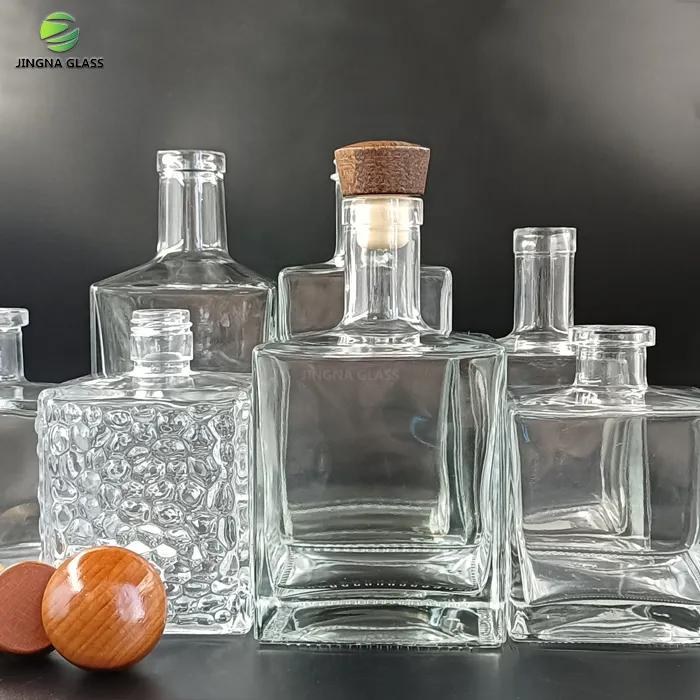
When purchasing glass liquor bottles wholesale, the primary fork in your procurement strategy is deciding between catalogue stock moulds and custom bespoke tooling.
Stock Mould Packaging: Established glass bottle manufacturers maintain libraries of hundreds of ready-to-run moulds. Choosing stock moulds eliminates upfront CNC tooling fees, shortens production lead times to 15–20 days, and permits flexible minimum order quantities as low as a single pallet (1,200 to 2,400 bottles). Brands personalize stock bottles through secondary decoration such as 360-degree ceramic silk screen printing, custom closures, and bespoke embossed paper labeling.
Custom Mould Development: For flagship bourbon, botanical gin, or luxury aged rum (see our dedicated guide on custom glass rum bottle packaging), custom tooling creates proprietary intellectual property. A custom mould allows you to specify distinctive geometric silhouettes, deep debossed shoulder logos, tactile grip patterns, and ultra-heavy solid bases (measuring 20mm to 30mm thick). Full production mould sets typically cost between $2,500 and $4,500 USD, with sample pilot moulds available within 7 to 10 days for rapid 3D physical verification.
2. Key Specifications for Glass Liquor Bottles Wholesale
Before issuing a Request for Quotation (RFQ) to a factory, ensure your packaging engineering team defines these four critical technical parameters:
| Technical Parameter | Standard Specification | Premium / Luxury Standard | Engineering Importance |
|---|---|---|---|
| Glass Clarity | High Flint Glass | Super Crystal Flint (Extra Flint) | Eliminates green/yellow undertones; optimizes spirit luminosity |
| 750ml Base Weight | 450g – 550g | 650g – 850g Heavy Solid Base | Lowers bottle center of gravity; conveys top-shelf tactile heft |
| Brimful Headspace | +3.5% above nominal | +5.0% expansion buffer | Prevents cork pop-out from ethanol thermal expansion in transit |
| Neck Bore Tolerance | ±0.5 mm | ±0.3 mm CNC Precision Bore | Guarantees 100% leak-proof hermetic seal with bar-top T-corks |
| Internal Pressure | ≥ 0.8 MPa | ≥ 1.2 MPa Thermal Shock Tested | Passes ASTM C148 polarized light stress and capping machine torque |
To accurately calculate volumetric fill lines, cork displacement, and pour cost yields across standard capacities, explore our detailed analysis answering how many ounces in 750 ml, as well as our global sizing guides on 750 ml to oz and 700 ml to oz standards.
3. Optical Clarity: Why Super Crystal Flint Dominates Premium Spirits
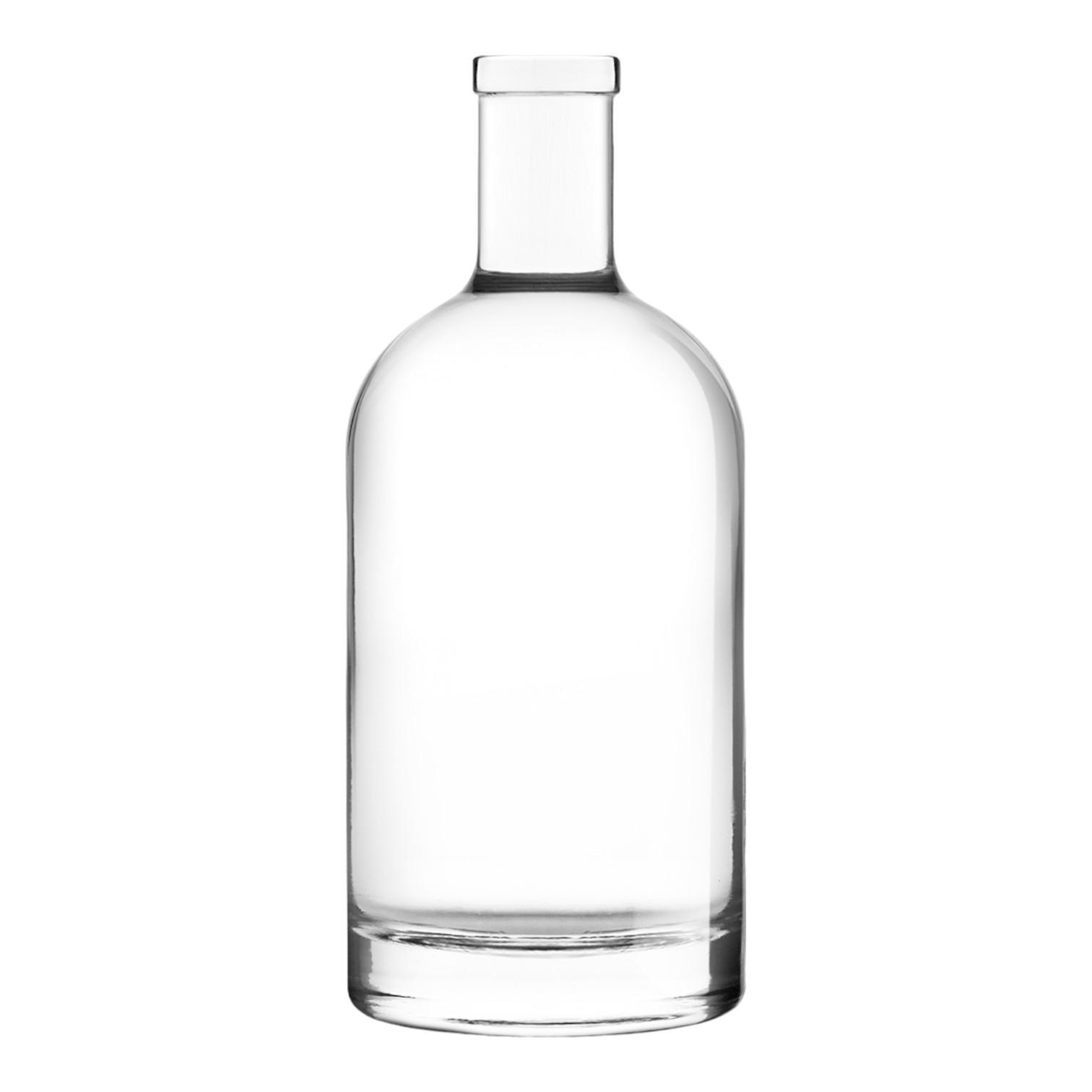
In wholesale glass manufacturing, not all clear glass is created equal. Commercial glass is divided into standard high flint and super crystal flint glass.
Standard flint glass utilizes natural silica sands containing iron oxide impurities (Fe₂O₃ > 0.04%). While acceptable for clear soda or vinegar, standard flint exhibits an unmistakable pale greenish tint when viewed through the thick glass heel or bottle shoulder. In contrast, super crystal flint employs high-purity refined quartz sand (iron content < 0.012%) combined with chemical decolorizers. The resulting glass delivers optical light transmission exceeding 92%, rivaling lead-free crystal tableware.
As documented in our analysis of American whiskey brand packaging standards, super flint glass is essential for aged bourbon, single malt scotch, and golden rum because it allows the spirit’s natural amber and copper hues to radiate without color distortion on retail shelves.
4. Secondary Decoration & Finishing for Wholesale Bottles
Ordering wholesale bottles directly from the manufacturing facility allows you to integrate secondary decoration on the production line, dramatically reducing handling costs compared to third-party post-processing:
• High-Temperature Ceramic Screen Printing: Inorganic ceramic enamels are screen-printed directly onto the glass and cured in an annealing lehr at 580°C to 600°C. The ink physically fuses into the glass matrix, delivering permanent scratch-proof, dishwasher-safe resistance that never peels.
• Matte Acid Frosting & Spray Coating: Chemical acid etching produces a velvety satin-smooth frosted finish that resists fingerprint oils. Selective window masking allows clear transparent viewing windows through frosted glass.
• Hot-Foil Stamping (24K Gold / Silver): Premium foil stamping applies metallic gleam to crests, medals, and vintage dates, creating brilliant contrast against dark spirits.
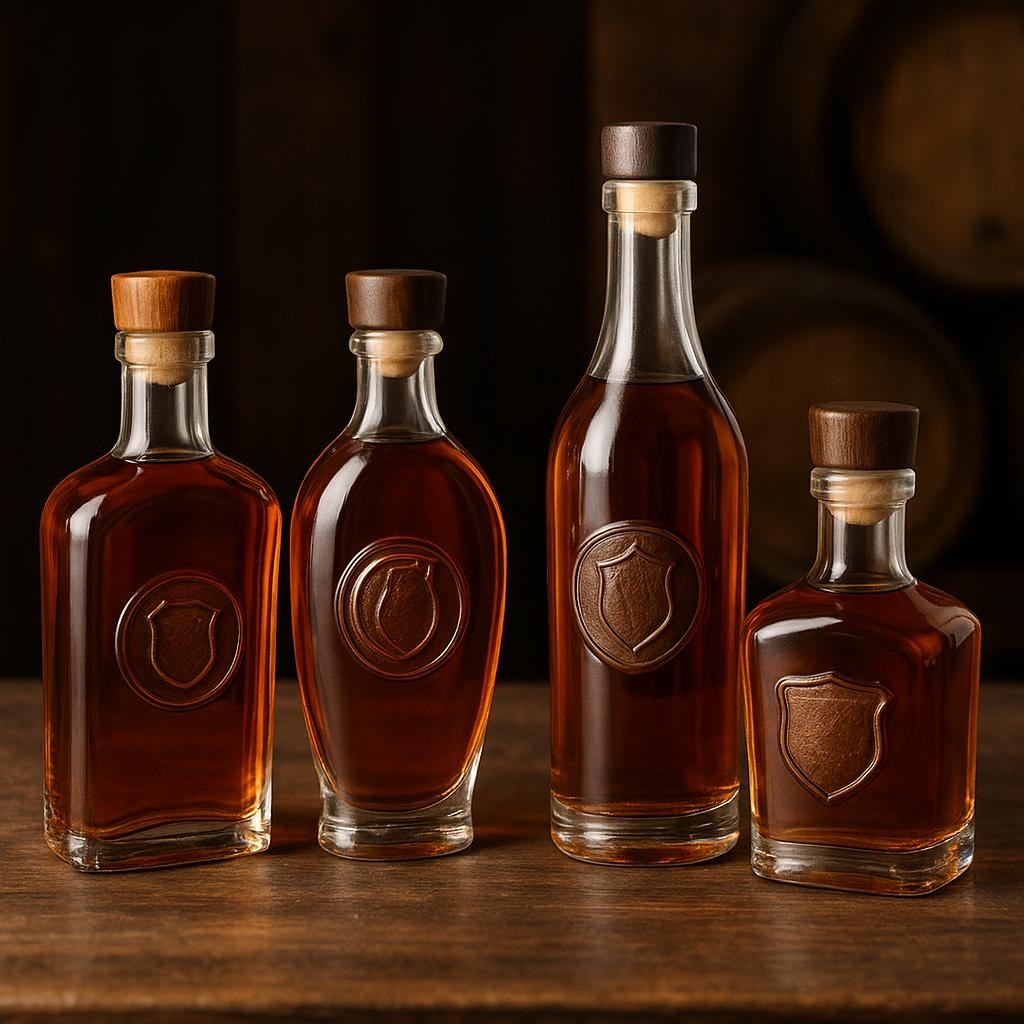
• 3D Glass Embossing: Incorporating brand emblems, custom graduation marks, or founding dates directly into the mould cavity delivers permanent tactile brand recognition at zero incremental unit cost.
5. Export Packaging & Breakage-Free Pallet Logistics
When purchasing glass liquor bottles wholesale from overseas manufacturers, rigorous export packaging engineering is the difference between seamless bottling runs and warehouse shipping disasters.
Professional glass manufacturers utilize two primary export packaging formats:
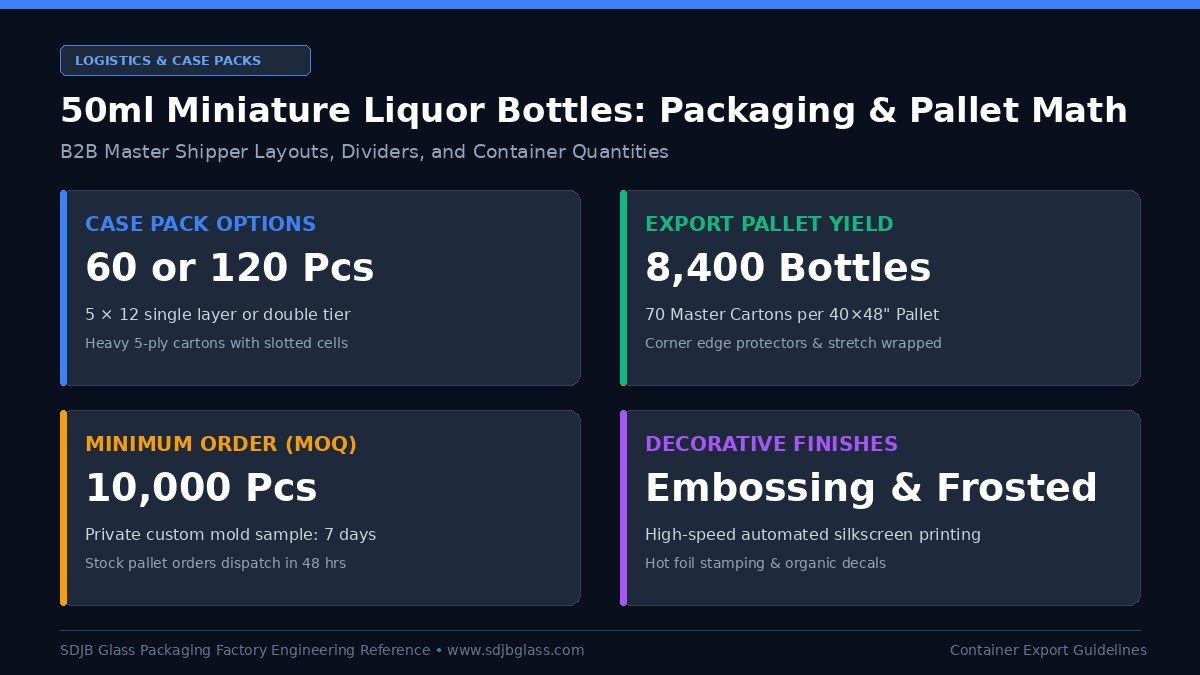
1. Divider Cartons (Box Packaging): Bottles are packed into heavy-duty 5-ply kraft corrugated cartons equipped with interlocking cardboard cell dividers. Each bottle is physically separated to prevent glass-to-glass friction and surface abrasion during intermodal rail and ocean transit. Cartons can be pre-printed with your retail branding or supplied in plain kraft for automated uncasing lines.
2. Bulk Pallet Packing: For distilleries operating automated depalletizing machinery, bottles are packed upright on ISPM-15 certified heat-treated wooden pallets. Each layer is separated by heavy corrugated tier sheets, protected by top caps, and bound with high-tension horizontal strapping and heavy-gauge shrink wrap. A standard 40ft High Cube container accommodates between 21,000 and 26,000 units of 750ml bottles, optimizing freight cost per unit.
Furthermore, all containers must pass stringent thermal stress verification through the lehr cooling phase. Read our technical breakdown on glass bottle annealing temperature and thermal shock resistance to understand how proper lehr gradient control prevents transit breakage.
Source Factory-Direct Glass Liquor Bottles Wholesale
Shandong Jingbo Glass Co., Ltd. operates state-of-the-art automated I.S. production lines with over 1,900+ ready moulds, dedicated export palletization, and zero-defect quality guarantees serving craft distilleries worldwide.
Request Wholesale Catalogue & Price ListExplore Spirit-Specific Glass Packaging Engineering Guides
Different spirits categories impose distinct mechanical, optical, and sealing demands on container glass. Explore our technical factory guides detailing mould tooling parameters, neck bore tolerances, and palletization specs:
Whiskey Bottles Wholesale →
Heavy punt 750ml bottles, 20mm+ base glass distribution, and ASTM cork finishes for bourbon and single malts.
Tequila Glass Bottles →
Artisanal agave relief engraving, rustic high-flint clarity, and hermetic bar-top cork bores for blanco and añejo.
Brandy & XO Decanters →
Luxury 26mm solid bases, Fe2O3 <0.015% super flint glass, and zamac closures for prestige cognac and armagnac.
Gin Glass Bottles Wholesale →
Apothecary and fluted decanters engineered for volatile botanical terpene retention and bar-top seal security.
Wholesale Vodka Bottles →
Tall slender Nordic profiles, satin acid frosting (Ra 1.8μm), and automated high-speed rinser-filler runnability.
Mini Liquor Bottles (50ml/100ml) →
High-speed double-gob forming, 18/400 GPI screw and 20mm ROPP pilfer-proof closures for airline and sampler retail.
Bottle Sizes & Dimensions Chart →
Complete dimensional engineering reference from 50ml miniatures to 1.75L handles and case packaging quantities.
Rum Bottle Packaging →
Maritime nautical shoulder embossing, squat pirate jugs, and UV protection for dark spiced and tropical rums.
[…] Selective Window Masking: Masking a clear geometric shape on the bottle prior to acid dipping, leaving a crystal-clear “peek-through” window displaying the rich amber color of bourbon or rye whiskey inside. Review custom design options on our wholesale glass liquor bottles manufacturing page. […]
[…] Standard Case Pack: 375ml bottles are typically packed in 24-bottle master cartons (totaling 9.0 liters per case) compared to standard 12-bottle cartons for 750ml fifths. Explore wholesale pallet configurations on our glass liquor bottles wholesale catalog. […]