

Factory Director’s Quick Answer: Tequila Glass Bottle Wholesale
Wholesale Procurement Benchmarks: Sourcing wholesale tequila glass bottles for commercial distilleries requires selecting between ready mould stock (MOQ: 3,000–5,000 units, 7–10 days dispatch) and custom private tooling (MOQ: 10,000 units, CNC pilot mold cost: 50–,400, mass mold set: ,800–,200).
Crucial Technical Parameters: For 100% Blue Agave tequila (Blanco, Reposado, Añejo, and Extra Añejo), standard specifications dictate Super Flint glass clarity (Fe2O3 < 0.020%, light transmission > 92%), precision 21.5mm ±0.25mm bar-top cork bores with chamfered sealing beads (Ra ≤ 1.6 μm), and reinforced 18mm–24mm heavy base punts annealed in 8-zone lehrs (520°C–550°C) to withstand 1.2 MPa internal pressure and 45°C thermal shock.
The Agave Spirit Packaging Landscape: Why Tequila Demands Heavy Flint & Precision Necks
In craft distilling and premium spirits packaging, tequila has evolved into one of the fastest-growing super-premium categories globally. As Mexican distilleries and international private-label brand owners scale their operations across North America and Europe, the bottle itself serves as the brand’s primary tactile ambassador. A high-end Tequila Reposado or Añejo cannot reside in a lightweight, utilitarian wine bottle; it demands architectural weight, optical purity, and an unmistakable heft that commands attention on back bars and retail shelves.
From an eighteen-year glass plant perspective, manufacturing premium tequila containers presents distinct thermodynamic challenges compared to standard spirits bottles. Agave spirits possess volatile aromatic congeners, subtle golden amber hues, and a relatively high thermal expansion coefficient. When bottles travel from Mexican coastal ports through humid ocean containers or freeze during winter rail transport across the American Midwest, improper glass wall distribution or loose neck bore tolerances will cause catastrophic cork leaks and micro-cracking.
Whether you are scaling from a boutique craft distillery producing 20,000 bottles annually or managing a turnkey contract bottling operation, understanding how mold engineering, bore tolerances, and lehr annealing interact is essential to protecting your product and your profit margin. If your product line also spans whiskey and bourbon, you can review our sister guide on custom glass whiskey bottles and mold tooling costs.
Bar-Top Neck Finish Engineering: Eliminating Leaks in 21.5mm Agave Spirit Bottles
The neck finish is the single most critical engineering interface on any wholesale tequila bottle. Unlike standard screw caps or Crown caps, super-premium tequila relies predominantly on T-bar top synthetic corks or natural agglomerated corks featuring bespoke wood, zamac alloy, or ceramic heads. A loose fit causes spirits evaporation (the “angel’s share” occurring prematurely in transit), while an excessively tight bore risks neck splitting on automated cording carousels.
1. Internal Bore Diameter & Ovality Limits
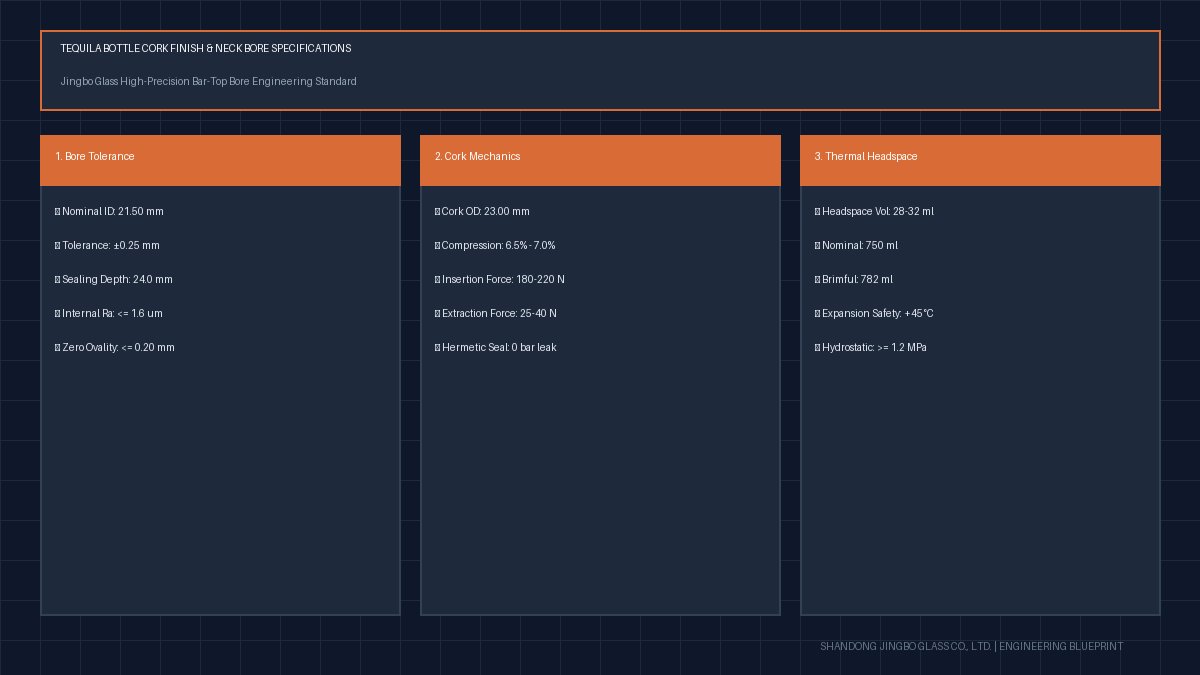
At Shandong Jingbo Glass, our CNC-cut neck ring tooling maintains an internal entrance diameter calibrated to 21.50 mm with a tight tolerance of ±0.25 mm down to a sealing depth of 24.0 mm. Standard bar-top corks have a nominal shank outer diameter of 23.0 mm. This creates an engineered interference compression ratio of 6.5% to 7.0%—the exact metallurgical and physical sweet spot required to guarantee an airtight seal under barometric pressure fluctuations without requiring more than 220 N of capping insertion force.
2. Sealing Surface Finish (Ra Value) and Chamfered Rim
Many contract packagers complain of microscopic spirit weeping along the cork wall. In our shop floor failure analyses, 90% of weeping issues trace back to rough, fire-polished glass seams inside the throat. Our automated blow-blow machines utilize polished stainless steel plungers that achieve an internal glass surface roughness of Ra ≤ 1.6 μm. Furthermore, a 1.2 mm radius chamfered lead-in bead is moulded into the upper lip, preventing cork slicing during high-speed bottling at lines running 60 to 120 bpm.
Heavy Punt Base & Optical Purity: Engineering Super Flint Glass for Reposado & Añejo
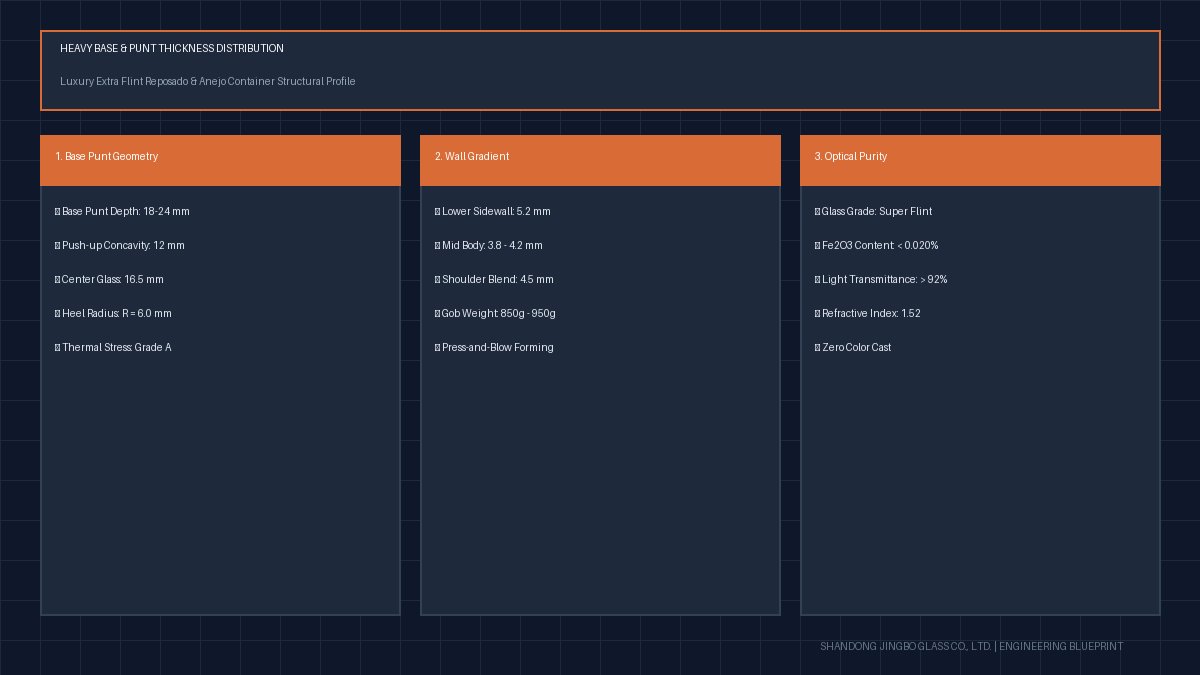
Pick up any artisanal tequila bottle, and the first thing you feel is the mass anchored at the bottom. A signature 18 mm to 24 mm solid glass base communicates heritage, craftsmanship, and shelf stability. However, achieving a flawless thick bottom requires strict raw material control and precise thermal profiling.
1. Super Flint vs. High White Glass Chemistry
Tequila distillers spend years ageing spirits in toasted American oak and French Limousin casks to develop deep topaz and golden amber shades. If bottled in commercial high-white glass containing iron oxide impurities, the bottle introduces an unwanted greenish-blue undertone that diminishes the spirit’s perceived age. At Jingbo Glass, our tequila containers are blown exclusively using Super Flint (Crystal Flint) batch formulas with iron oxide content strictly constrained to Fe2O3 < 0.020% and silica content > 72.5%. This delivers a light transmittance index exceeding 92% and a refractive index of 1.52, allowing the true brilliance of the agave liquor to shine through without chromatic distortion.
2. Press-and-Blow Forming & 8-Zone Lehr Annealing
Cooling an ultra-thick glass base is a high-stakes thermodynamic process. Molten glass enters the blank mould at approximately 1,120°C. While the thin sidewalls cool rapidly, the massive 22 mm base retains heat much longer. If ejected onto cooling conveyors without strict temperature modulation, severe tensile stress forms between the inner and outer skin, causing spontaneous bottom breakage (thermal shock cracking).
To eliminate residual stress, all our wholesale tequila production passes through an 8-zone continuous gas-fired annealing lehr spanning 48 meters. The bottles are soaked at 540°C ± 5°C to relieve molecular strain, followed by controlled cooling at 1.8°C per minute down to 120°C. Every production batch undergoes polarimeter cross-polarization inspection to guarantee Grade A residual stress (under 5 nm/cm optical path difference).
Technical Specification Comparison: Standard vs. Decanter vs. Architectural Square
To assist packaging procurement teams and master distillers in budgeting and technical evaluation, the table below compares key engineering parameters across our three most requested wholesale tequila bottle silhouettes:
| Engineering Spec | Standard Agave Cylinder | Heavy Base Reposado Decanter | Architectural Square Decanter |
|---|---|---|---|
| Nominal Capacity | 750 ml (25.36 fl oz) | 750 ml (25.36 fl oz) | 750 ml (25.36 fl oz) |
| Brimful Capacity | 782 ml ± 5 ml | 785 ml ± 5 ml | 788 ml ± 6 ml |
| Finished Weight | 650 g ± 20 g | 880 g ± 25 g | 950 g ± 30 g |
| Base Glass Thickness | 14.0 mm | 22.0 mm | 24.0 mm |
| Neck Finish Type | 21.5mm Bar Top Cork | 21.5mm Bar Top Cork / Carafe | 21.5mm Cork or GPI 28/400 |
| Neck Bore Tolerance | ±0.25 mm | ±0.25 mm | ±0.25 mm |
| Thermal Shock Resistance (ΔT) | ≥ 45°C | ≥ 42°C | ≥ 40°C |
| Hydrostatic Pressure | ≥ 1.4 MPa | ≥ 1.2 MPa | ≥ 1.2 MPa |
| Wholesale Pallet Pack | 1,296 btls / pallet | 1,152 btls / pallet | 1,008 btls / pallet |
For cross-category sizing comparisons between 375ml half-bottles, 750ml fifths, and 1.75L handles, explore our detailed engineering liquor bottle sizes chart and dimension breakdown.
Thermal Expansion Dynamics: Calculating Headspace for Export Containers
Distilleries shipping bottled tequila in standard dry containers from tropical production zones in Jalisco (average summer temperatures 32°C–35°C) across ocean transit routes where internal metal container temperatures frequently spike to 55°C–60°C must engineer sufficient liquid headspace. Failing to account for volumetric liquid expansion leads to cork hydraulic ejection or seam leaks.
ΔV = V_nominal × β × ΔT
Where:
• V_nominal = 750 ml
• β (Ethanol-Water 40% ABV Volumetric Expansion Coeff) ≈ 0.00082 / °C
• ΔT = 40°C (Temperature rise from 15°C bottling to 55°C shipping)
Calculated Liquid Volume Expansion:
ΔV = 750 × 0.00082 × 40 = 24.6 ml
Because the liquid expands by nearly 25 ml under peak heat, a 750 ml bottle with only 15 ml of headspace will experience severe hydraulic pressure buildup against the cork bottom. That is why all Jingbo Glass 750 ml tequila bottles are engineered with a brimful capacity of 782 ml to 788 ml, leaving an air buffer of 32 ml to 38 ml above the filling level. This safeguards hermetic integrity even during severe trans-Pacific or Caribbean cargo journeys.
Turnkey Private Mould Tooling: From 2D Concept to IS Machine Mass Production
While ready-made molds offer rapid entry, establishing an iconic agave brand often demands proprietary shoulder curves, embossed agave piña patterns, or personalized brand crests on the heel. Many buyers assume private mold tooling is cost-prohibitive, but our streamlined plant tooling process provides accessible commercial entry points for expanding distillers.
1. Pilot Sample Mould vs. Full Production Set Costs
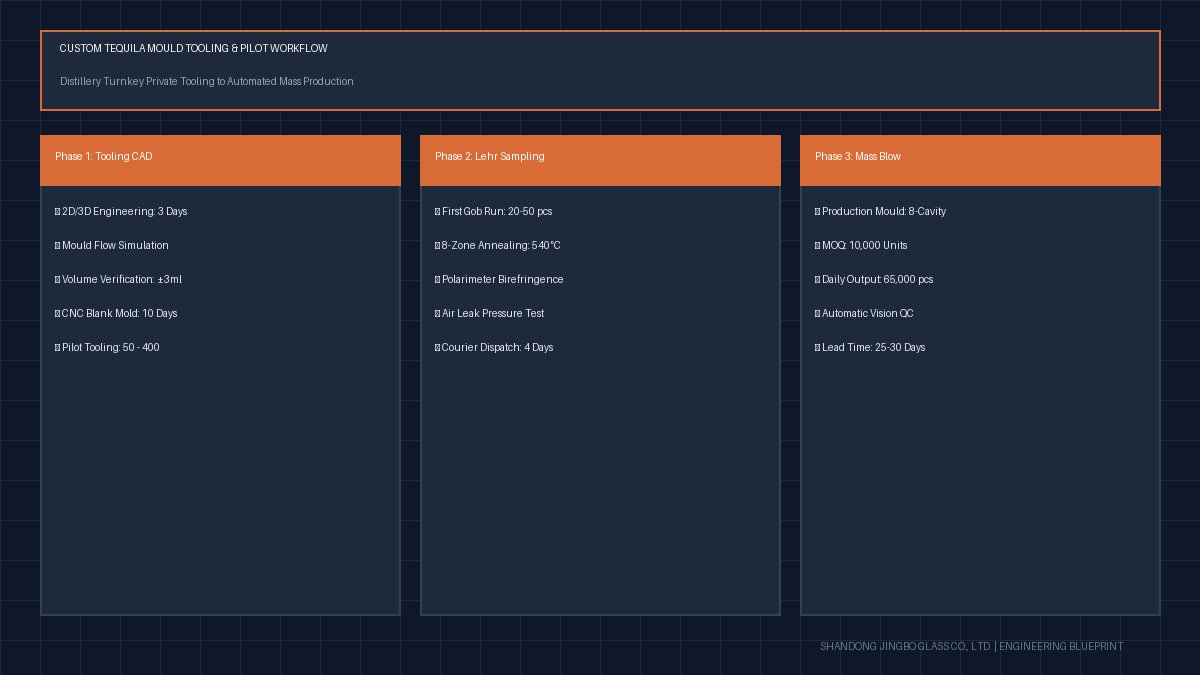
- Phase 1: 3D Engineering & Finite Element Analysis (FEA): Within 3 working days of receiving your sketch or reference sample, our CAD team models the 3D bottle geometry, calculates glass wall thickness distributions, and simulates mold cavity airflow.
- Phase 2: Single-Cavity CNC Pilot Tooling (50–,400): We machine a dedicated pilot blank and blow mold from wear-resistant cast alloy to produce 20 to 50 physical glass samples on an IS pilot section. This allows you to verify cork sealing, label panel curvature, and line stability before committing to high-volume tooling.
- Phase 3: Multi-Cavity Mass Production Mould (,800–,200): Once pilot samples are approved, we fabricate the complete multi-cavity mold set (blank molds, blow molds, neck rings, bottom plates, and baffles) for 8-section double-gob or single-gob IS machine lines.
2. Flexible Production MOQs (10,000 Units)
Unlike massive international glass conglomerates that demand 50,000 to 100,000 bottles per run, Shandong Jingbo operates flexible furnace scheduling. Our private mold minimum order quantity starts at just 10,000 units (one 20ft container), enabling emerging distillers to launch custom packaging without draining working capital. For additional finish effects like matte acid etching, refer to our technical post on glass bottle frosting and surface treatments.
Master Carton & Ocean Pallet Standards: Protecting High-End Bottles from Port of Qingdao
Even the most exquisite bottle loses value if it arrives chipped, scuffed, or fractured. Packaging heavy flint glass bottles requires robust multi-layer export engineering:
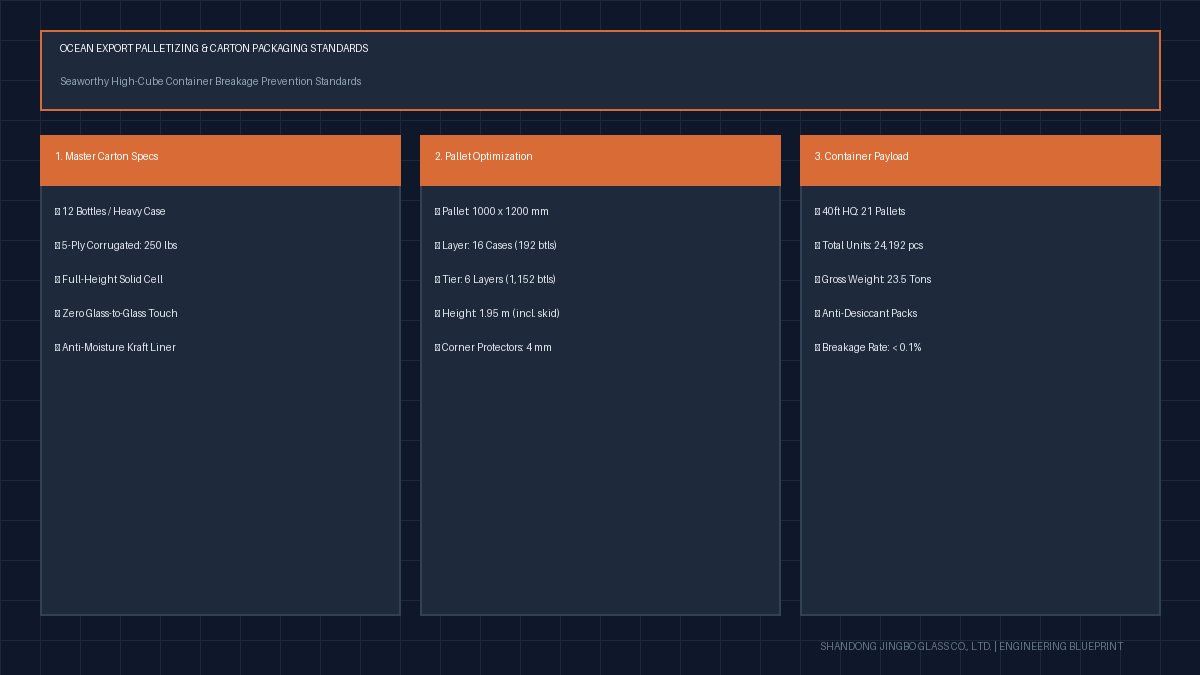
- 5-Ply Heavy Corrugated Master Cartons: We utilize 250 lbs burst-test corrugated outer cartons with full-height cell dividers. Every bottle is isolated inside its own compartment with zero glass-to-glass contact during sea pitching.
- Anti-Scuff Cold-End Chemical Spray: As bottles exit the annealing lehr, an automated overhead spray applies an FDA-approved polyethylene emulsion coating (friction coefficient μ ≤ 0.18). This lubricates the external surface, eliminating abrasion scuffs on high-speed depalletizers.
- ISPM-15 Fumigated Wooden Pallets: Bottles are palletized on heat-treated 1000 × 1200 mm 4-way entry export pallets. Layers are locked with 4 mm perimeter corner angle boards, capped with top wooden protection lids, and wrapped with 7 layers of UV-stabilized stretch film. Container loading utilizes 40ft High Cube containers accommodating 21 full pallets (24,192 units) with an average transit breakage rate below 0.1%.
Frequently Asked Questions: Tequila Bottle Wholesale & Custom Sourcing
What is the standard minimum order quantity (MOQ) for wholesale tequila bottles?
Can Jingbo Glass supply matching synthetic bar-top corks and tamper-evident capsules?
How do you prevent glass chipping on heavy base tequila bottles during shipping?
What secondary decoration options are available for custom tequila bottles?
Request Factory Wholesale Pricing & Free Bottle Samples
Are you launching a new tequila brand or upgrading your current packaging line? Send our engineering team your 2D drawings, 3D CAD files, or target bottle photos for immediate technical feasibility reviews, mold cost estimations, and complimentary physical sample packs.
Contact Glass Engineering Team