

⚡ Quick Procurement Summary: Custom Glass Whiskey Bottles
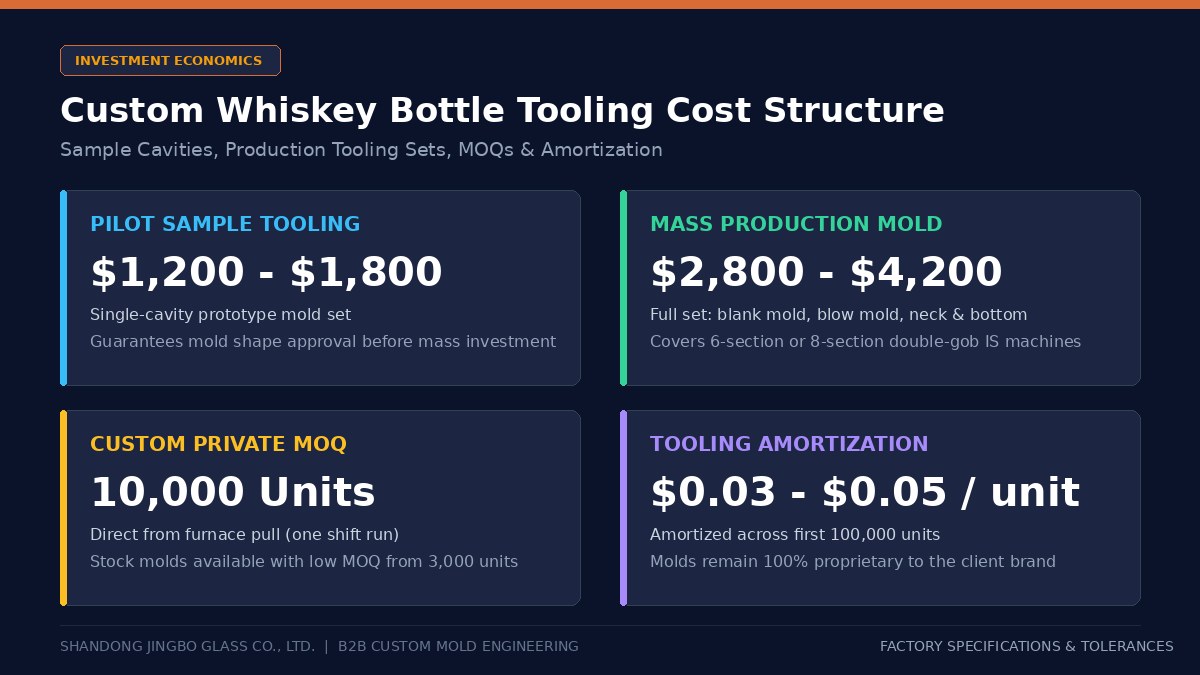
Developing a custom proprietary glass whiskey bottle requires an initial tooling investment of $1,200 to $1,800 for a single-cavity pilot mold (for physical glass samples) and $2,800 to $4,200 for a complete mass-production IS machine mold set. Minimum order quantities (MOQ) for custom private molds start at 10,000 units (equivalent to one standard furnace shift drop).
Development timelines range from 7 to 10 days for 3D engineering CAD & SLA resin mockups, followed by 18 to 25 days for CNC alloy steel mold machining. All custom molds manufactured by Shandong Jingbo Glass remain 100% exclusive and proprietary to the client distillery.
For craft distilleries, independent bottlers, and luxury spirits brands, stock bottles can only take your brand equity so far. On crowded backbars and boutique liquor store shelves, custom bottle geometry—a heavy glass punt, sculpted debossed shoulder emblems, or distinctive non-round cross-sections—is the single most direct visual cue signaling craft authenticity and premium pricing power.
However, many distillery founders and procurement directors hesitate to initiate custom glass tooling due to fears of exorbitant mold costs, multi-month lead times, or intimidating minimum order quantities (MOQs). Having directed glass factory furnace operations and mold tooling shops for over 18 years, I wrote this technical procurement guide to demystify the entire custom glass tooling lifecycle: true mold economics, timeline milestones, engineering tolerances, and export freight standards.
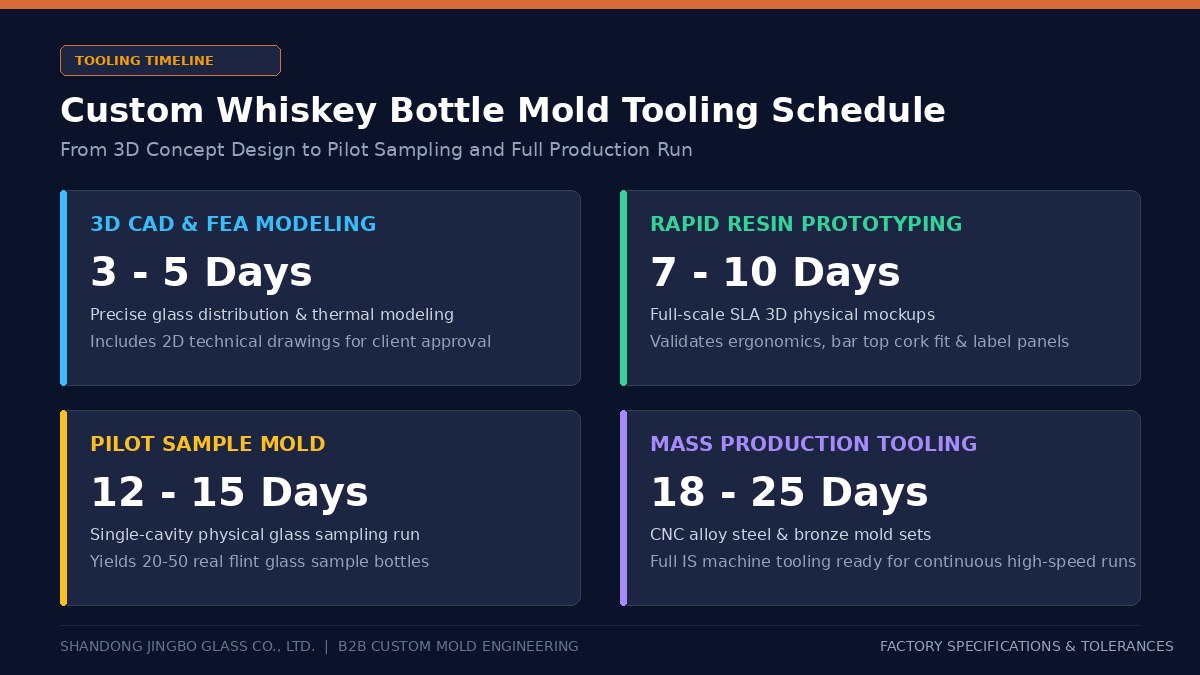
1. Custom Mold Economics: Pilot Cavity vs. Production Tooling
In glass container manufacturing, custom tooling is not a single piece of steel. A complete mold set on an Individual Section (IS) machine consists of multiple synchronized components:
- Blank Mold (Parison Mold): Forms the initial molten gob shape and pre-blows the hollow cavity.
- Blow Mold: Defines the final outer body geometry, shoulder radii, and surface embossing.
- Neck Ring: Precision-cast component defining the GPI 28mm bar top cork bore or screw thread finish.
- Bottom Plate: Forms the heavy base, punt push-up, and mold identification stippling.
- Baffle & Plunger: Internal mechanics controlling wall thickness distribution during blow-and-blow or NNPB (narrow neck press and blow) forming.
💰 Mold Tooling Amortization Formula
Tooling is a one-time capital expense that amortizes rapidly across commercial production runs. The true unit cost impact is calculated as:
Where:
C_tooling = $3,500 (Complete 6-section production mold set)
N = 100,000 units (Expected initial 18-month production volume)
C_glass = $0.78 (Unit price of crystal-white 750ml heavy base bottle)
C_unit = ($3,500 ÷ 100,000) + $0.78 = $0.035 + $0.78 = $0.815 per bottle!
At just 3.5 cents per bottle, a custom proprietary design delivers an ROI that far outweighs the minor initial tooling expense.
| Development Phase | Deliverable & Output | Lead Time | Estimated Investment |
|---|---|---|---|
| Phase 1: Concept & 2D/3D CAD | Technical engineering drawing, volumetric capacity calculation, headspace modeling | 3 – 5 Days | Free (Included in tooling) |
| Phase 2: 3D SLA Resin Mockup | 1:1 physical polymer resin mockup for hand-feel, bar top cork testing & label sizing | 7 – 10 Days | $150 – $250 |
| Phase 3: Pilot Sample Mold | Single-cavity steel mold run producing 20 to 50 physical glass bottles on production lehr | 12 – 15 Days | $1,200 – $1,800 |
| Phase 4: Full Production Mold Set | Complete CNC alloy steel mold sets for 6-section or 8-section double-gob IS machines | 18 – 25 Days | $2,800 – $4,200 |
| Phase 5: Commercial Mass Run | 10,000 to 50,000+ custom bottles packed in export master cartons on GMA pallets | 15 – 20 Days | $0.65 – $1.25 / unit (by weight) |
2. Engineering Geometry & Factory Tolerances
Unlike ordinary wine or beverage bottles, premium whiskey bottles demand extreme aesthetic and structural specifications. Below are the critical engineering tolerances our tooling team controls during CNC mold fabrication:
A. Heavy Punt Base Thickness
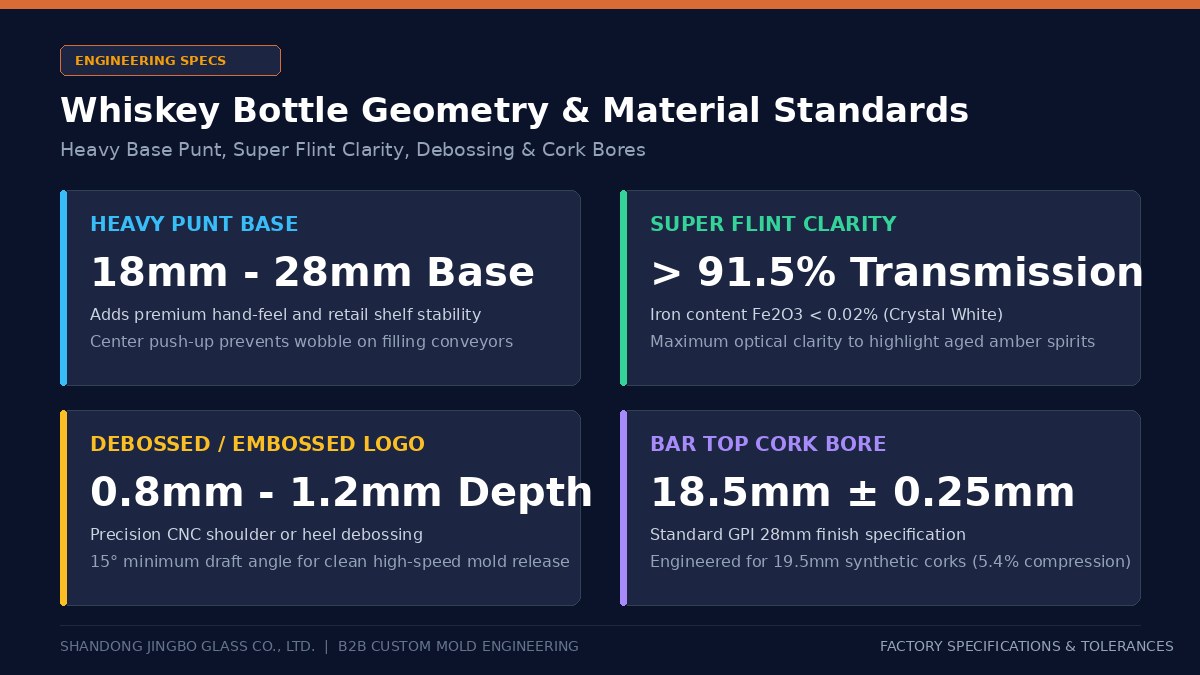
A luxury bourbon or scotch bottle requires a substantial base glass thickness of 18mm to 28mm (0.7 to 1.1 inches). Achieving this without introducing internal thermal stress requires precise cooling wind vents in the mold bottom plate. Our bottom plates incorporate engineered air cooling channels that stabilize the thick base gob, preventing center sagging and conveyor wobble on high-speed filling lines.
B. Embossed & Debossed Logo Relief
To ensure debossed or embossed logos are crisp yet release smoothly from high-speed blow molds:
- Relief Depth: 0.8mm to 1.2mm maximum. Exceeding 1.2mm causes molten glass drag during mold opening.
- Draft Angle: Minimum 15° draft angle on all vertical letter edges.
- Fillet Radii: Corner transitions must maintain a minimum 0.5mm radius to eliminate sharp stress risers that trigger thermal cracking.
C. Bar Top Cork Bore Precision
For standard GPI 28mm Bar Top finishes, our neck rings are CNC-milled to an internal bore diameter (ID) of 18.5mm ± 0.25mm measured at 15mm depth. Paired with a standard 19.5mm synthetic bar top cork shank, this produces an ideal 1.0mm interference fit (5.4% radial compression), guaranteeing airtight transit seals without cork popping.
For volume calculations and standard neck specs across sizes, explore our guides on How Many Ounces in a Fifth of Liquor and 375ml Half Bottle Dimensions.
| Engineering Parameter | Standard Flint Specification | Super Flint (Crystal White) | Factory Quality Tolerance |
|---|---|---|---|
| Iron Oxide (Fe₂O₃) Content | < 0.05% | < 0.02% (Ultra-low iron) | Strict batch spectrophotometer assay |
| Optical Transmission | 88.0% – 90.0% | > 91.5% (Diamond clarity) | Zero greenish tint in thick heavy base |
| Bore Diameter Tolerance | ± 0.40 mm | ± 0.25 mm | Air-gauged go/no-go plug gauge |
| Verticality (Perpendicularity) | ≤ 3.0 mm | ≤ 1.5 mm | Optical rotation dial test indicator |
| Body Diameter Ovality | ≤ 2.0 mm | ≤ 1.0 mm | Maintains automatic rotary labeling speed |
| Thermal Shock Resistance | ΔT ≥ 42°C | ΔT ≥ 45°C | ASTM C149 (100% batch compliance) |
3. Annealing Lehr Stress Control & Burst Testing
A heavy-base custom whiskey bottle is particularly susceptible to residual cooling stresses because the 20mm thick base cools far slower than the 3.5mm sidewall. If cooled unevenly, latent tension creates a “time-bomb” that fractures under light handling or cork insertion.
To eliminate internal stress, freshly molded bottles pass through our continuous 18-meter annealing lehr. Over a 55-minute cycle, temperatures are managed from 550°C (the glass annealing point) down to 80°C along a controlled cooling curve. Every 2 hours, quality inspectors cut sample cross-sections and examine them under a transmission polariscope (ASTM C148). Only bottles achieving an optical path difference below Grade 2 are certified for packaging.
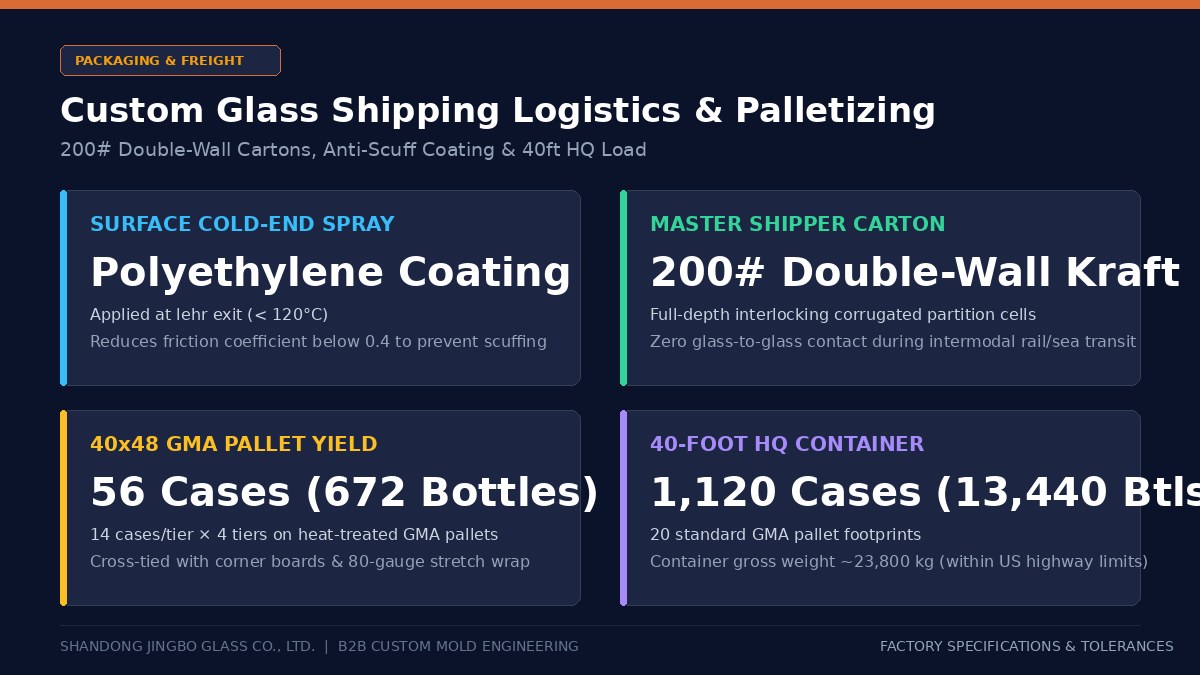
4. Logistics & Freight: Export Protection Standards
Custom glass bottles are high-value assets that must arrive at your bottling plant immaculate and scratch-free. We implement three layers of export packaging protection:
- Cold-End Anti-Scuff Spray: At the exit of the annealing lehr (< 120°C), bottles receive an atomized polyethylene spray. This reduces the glass surface friction coefficient from 0.8 down below 0.35, preventing conveyor micro-abrasions and transit scuffing.
- Partition Corrugated Cartons: Bottles are packed in 200# test double-wall corrugated cartons with full-depth interlocking partition cells. Each bottle is isolated in its own kraft cell, completely preventing glass-to-glass contact during sea transit.
- Standard 40×48 GMA Palletizing: Cartons are stacked 14 cases per tier, 4 tiers high (56 cases / 672 bottles per pallet), secured with heavy-duty corner boards, corrugated top caps, and multiple layers of 80-gauge stretch film. A 40ft High Cube container loads exactly 20 pallets (13,440 bottles).
For brands evaluating frosted finishes or custom deep acid etching, review our detailed guide on the Chemical Acid Etching vs Sandblasting Frosting Process and our comprehensive overview of Wholesale Glass Liquor Bottles.
Start Your Custom Whiskey Bottle Project Today
Shandong Jingbo Glass provides end-to-end custom bottle development for craft distilleries worldwide. With rapid 7-day resin mockups, low 10,000-unit private MOQs, and dedicated mold engineers, we turn your brand vision into glass reality.
Frequently Asked Questions: Custom Glass Whiskey Bottles
What is the minimum order quantity (MOQ) for custom glass whiskey bottles?
For fully custom proprietary private molds, our factory MOQ starts at 10,000 units, which represents one continuous production shift drop from our furnace. If you are looking for lower initial quantities, we offer hundreds of ready-to-ship stock molds with MOQs starting at just 3,000 units.
How much does a custom glass whiskey bottle mold cost?
A single-cavity pilot sample mold costs between $1,200 and $1,800 and produces 20 to 50 real glass sample bottles for final approval. A complete mass-production IS machine mold set (including blank molds, blow molds, neck rings, and bottom plates) costs between $2,800 and $4,200 depending on bottle complexity and embossing details.
How long does it take from design to physical bottle delivery?
The entire development cycle takes approximately 45 to 60 days: 3 to 5 days for 2D/3D engineering drawings, 7 to 10 days for a 1:1 resin mockup, 15 days for sample mold fabrication, and 18 to 25 days for mass production tooling and initial manufacturing run.
Who owns the custom mold tooling once it is paid for?
You own 100% of the mold tooling. Shandong Jingbo Glass signs an exclusive tooling agreement guaranteeing that your private molds will never be used for any other customer or shared without your written authorization.
Can you create custom embossing or debossing on the bottle?
Yes. We can incorporate custom embossed (raised) or debossed (sunken) logos, heralds, or distillery dates on the shoulder, body, or base of the bottle. We engineer these with a 15° draft angle and 0.8mm-1.2mm relief depth to guarantee crisp mold release and flawless high-speed bottling.