

⚡ Quick Answer: 375ml to oz
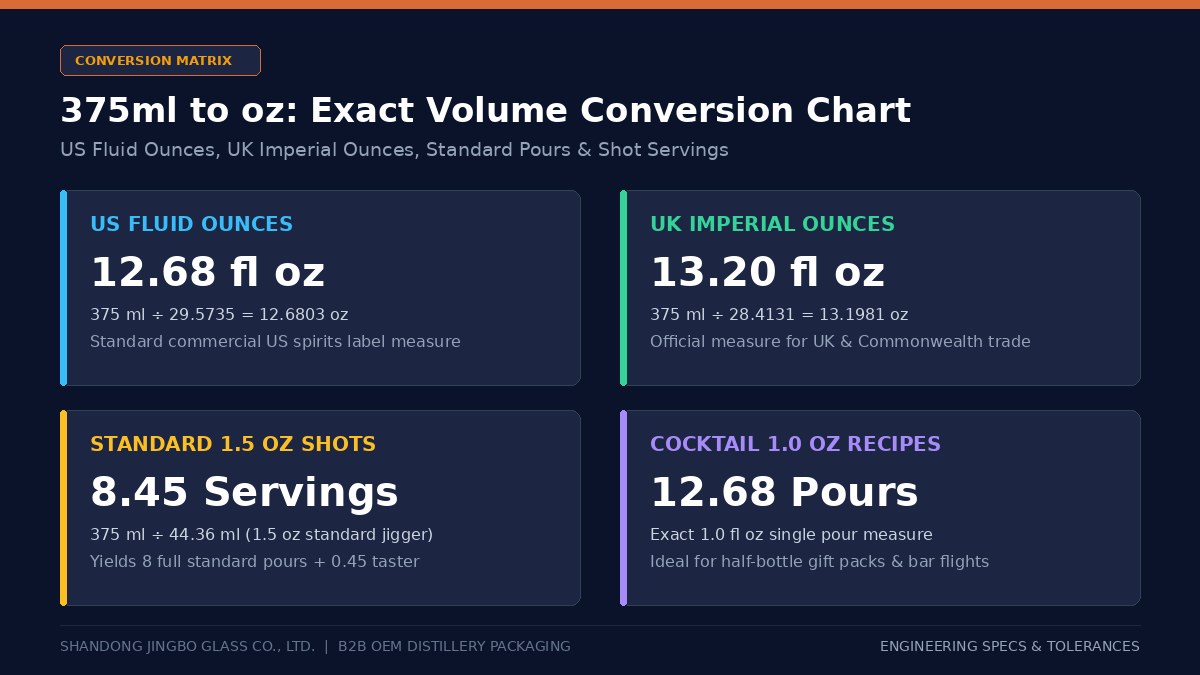
375 milliliters equals exactly 12.68 US fluid ounces (fl oz), commonly rounded to 12.7 fl oz on commercial liquor bottle labels. In British Imperial measure, 375 ml equals 13.20 Imperial fluid ounces.
In standard beverage service, a 375ml bottle holds exactly 8.45 standard 1.5-ounce shots (or 12.68 one-ounce pours). In the distilled spirits and wine trade, this size is universally classified as a “Demi”, “Split”, or “Half Bottle” because its volume is exactly 50% of the standard 750ml fifth.
When distillers, bar managers, or beverage brands look at spirits inventory, unit conversions are rarely just simple arithmetic. If you are calculating recipe costs for a craft cocktail bar, setting up an automatic bottling line, or engineering a custom glass mold, converting 375ml to oz touches every operational stage from alcohol excise tax reporting to shipping carton tolerances.
As a glass container manufacturer with over 18 years on the plant floor managing furnace pulls, IS (individual section) machine gob weights, and annealing lehrs, we frequently consult with emerging craft distilleries that transition from standard 750ml bottles to 375ml demi packaging. Below is the complete engineering breakdown: exact volume calculations, thermal headspace formulas, physical mold tolerances, and commercial pallet logistics.
1. The Exact Math: 375 ml to Ounces Conversion Matrix
The difference between fluid ounces in the United States and the United Kingdom stems from historical definitions of liquid capacity. When planning packaging for domestic distribution or international export, using the wrong constant can cause labeling rejections with regulatory agencies like the US Alcohol and Tobacco Tax and Trade Bureau (TTB).
- US Customary Fluid Ounces: 1 US fl oz = 29.5735295625 ml. Therefore:
375 ml ÷ 29.5735 = 12.6803 US fl oz. - UK Imperial Fluid Ounces: 1 Imperial fl oz = 28.4130625 ml. Therefore:
375 ml ÷ 28.4131 = 13.1981 UK fl oz. - US TTB Labeling Convention: Under 27 CFR § 5.47a, the legal standard of fill must be stated in milliliters or liters, with fluid ounce equivalents stated as a secondary declaration: “375 mL (12.7 FL. OZ.)”.
For cross-reference with other standard packaging formats, examine our comprehensive Liquor Bottle Sizes Chart & Dimensions Guide and our detailed analysis on 750 ml to oz conversion.
| Measurement Unit | Exact Quantity | Commercial Label Rounding | Practical Bar / Distillery Application |
|---|---|---|---|
| US Fluid Ounces (fl oz) | 12.6803 oz | 12.7 fl oz | US spirits label declaration & distributor inventory |
| Imperial Fluid Ounces (UK oz) | 13.1981 oz | 13.2 fl oz | UK, Canada & Commonwealth trade specifications |
| Standard US Shots (1.5 oz) | 8.4535 shots | 8.5 pours | Tasting room flight pours & bar inventory yields |
| Single Cocktail Pours (1.0 oz) | 12.6803 pours | 12.5 pours | High-precision craft cocktail batching & yield auditing |
| Double Pours (2.0 oz) | 6.3402 pours | 6 pours | Neat / on-the-rocks spirit serving calculations |
| Metric Liters (L) | 0.3750 L | 0.375 L | TTB Federal excise tax reporting basis ($13.50/proof gal) |
2. Bottle Engineering: Nominal vs. Brimful Headspace
In glass bottle manufacturing, no bottle holding 375ml of liquid has an internal cavity of only 375ml. Doing so would cause disastrous failure on the bottling line and in intermodal freight containers.
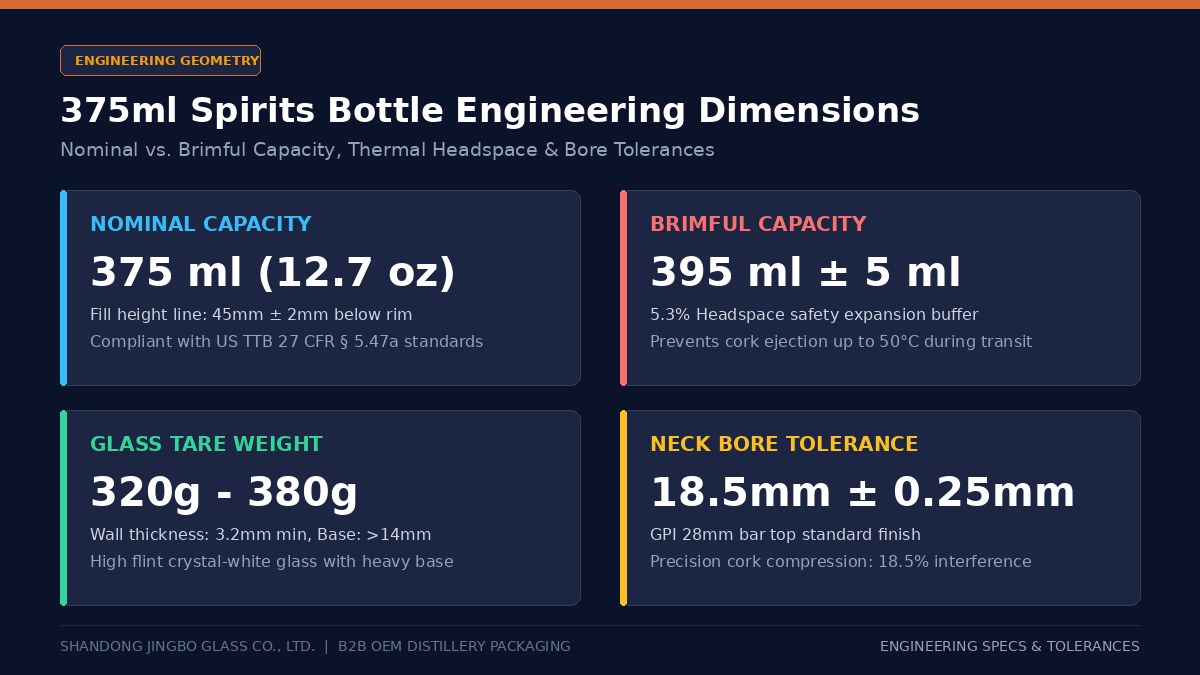
A properly engineered 375ml flint glass spirits bottle is designed with a nominal capacity of 375ml (measured at a specific fill-height line below the finish rim, typically 45mm to 52mm down) and a brimful capacity of approximately 395ml ± 5ml. That extra 20ml represents the critical headspace (or ullage).
🔬 The Thermal Expansion Physics (Why 5.3% Headspace is Non-Negotiable)
Spirits containing 40% to 50% ethanol have a significantly higher volumetric thermal expansion coefficient than water. When ocean freight containers pass through equatorial waters or sit in rail yards during summer, interior container temperatures can spike from 20°C (68°F) to 50°C (122°F).
Liquid expands by nearly 12 milliliters. If your brimful capacity is only 380ml, the expanding spirit consumes all available air, generates severe internal hydrostatic pressure, and either forces the synthetic cork out through the capsules or creates micro-fissures in the glass neck ring. That is why our mold engineers mandate an expansion margin of at least 5.0% to 5.5%.
| Engineering Parameter | Standard 375ml Spirits Bottle | Heavy-Base Craft Bottle | Quality Control Tolerance |
|---|---|---|---|
| Nominal Capacity | 375 ml (12.7 fl oz) | 375 ml (12.7 fl oz) | ± 4.0 ml at 20°C |
| Brimful Capacity | 395 ml | 400 ml | ± 5.0 ml |
| Total Height (OAH) | 205 mm – 225 mm | 190 mm – 215 mm | ± 1.5 mm |
| Body Diameter | 62 mm – 66 mm | 68 mm – 74 mm | ± 1.2 mm |
| Glass Tare Weight | 280 g – 320 g | 380 g – 450 g | ± 15 g |
| Base Glass Thickness | 8 mm – 12 mm | 18 mm – 25 mm (Heavy Punt) | Minimum 6.0 mm at thinnest zone |
| Neck Finish Specification | GPI 28mm Bar Top / Ropp 28×15 | GPI 28mm Bar Top Cork | Bore ID: 18.5 mm ± 0.25 mm |
| Thermal Shock Resistance | ΔT ≥ 42°C (ASTM C149) | ΔT ≥ 42°C (ASTM C149) | Zero structural failure in 10-cycle test |
3. Commercial Strategy: Why Craft Distilleries Bet on the “Demi”
For independent whiskey, gin, and rum producers, launching a 375ml SKU is often the most cost-effective lever to drive brand discovery and maximize gross margins. In our discussions with distillery owners, three primary commercial drivers emerge:
A. Overcoming Consumer Price Resistance
A craft single barrel bourbon priced at $75 for a standard 750ml bottle faces severe retail friction from consumers unfamiliar with the brand. Bottling the identical spirit in a 375ml package allows the distiller to price the bottle at $42 to $45. The consumer spends less than $50 out of pocket to sample an artisanal product, while the distillery realizes a 15% to 20% higher revenue yield per proof gallon.
B. Tasting Room Flights and Gift Sets
375ml bottles are the industry standard for curated multi-expression gift packs (e.g., Bourbon, Rye, and Peated Single Malt). A 3-bottle gift box in 375ml format totals 1.125 liters—an impressive, hefty physical presence that commands $110 to $130 at retail during the holiday season.
C. Maximizing Backbar & Retail Shelf Facings
With an average base diameter of 64mm compared to 78mm for a standard 750ml fifth, a retail liquor store shelf can hold 16 bottles of 375ml spirits in the identical linear footprint that fits only 11 bottles of 750ml. This gives the brand higher visual shelf frequency.
For brands evaluating smaller single-serve formats or mini gift packs, review our guide on 50ml Glass Liquor Bottles Wholesale & Dimensions.
| Commercial Dimension | 375ml Demi / Split | 750ml Standard Fifth | Distillery Strategic Impact |
|---|---|---|---|
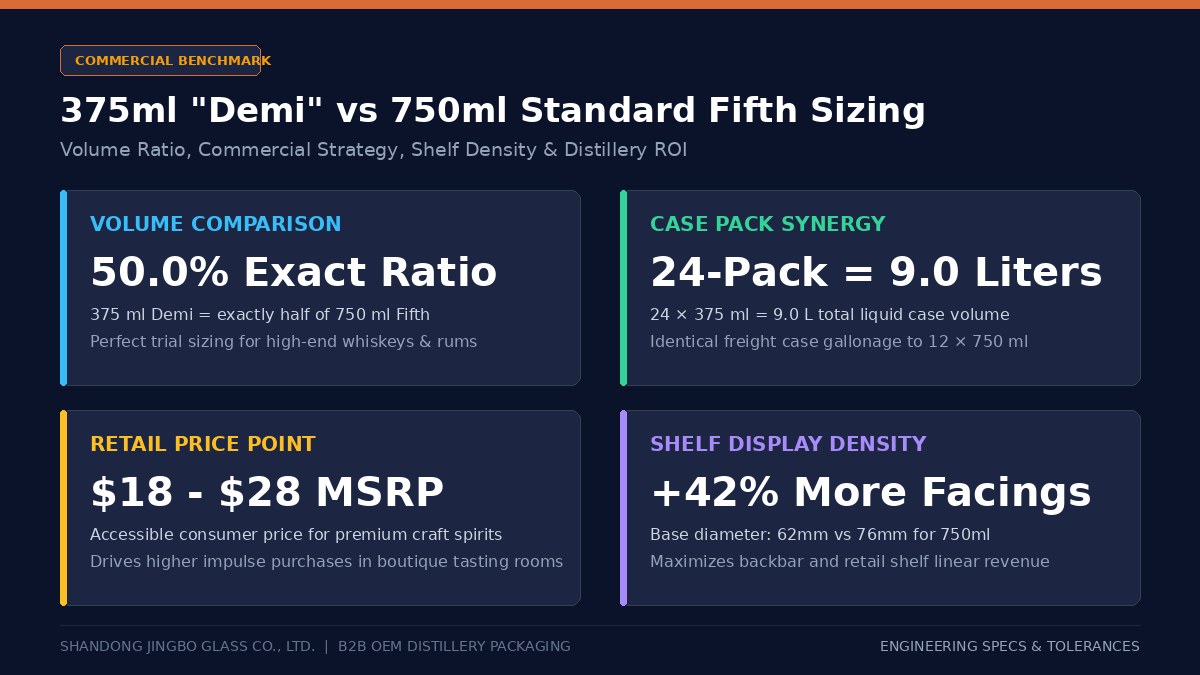
| Liquid Volume | 375 ml (12.7 oz) | 750 ml (25.4 oz) | 50% exact ratio |
| Average Retail MSRP | $26.00 – $45.00 | $48.00 – $85.00 | Sub-$50 impulse buying threshold |
| Retail Margin per Ounce | $2.05 / oz – $3.54 / oz | $1.89 / oz – $3.35 / oz | +8% to +14% higher net margin for producer |
| Glass Packaging Unit Cost | $0.48 – $0.85 / unit | $0.72 – $1.45 / unit | Lower working capital per finished unit |
| Standard Master Case Pack | 24 bottles (9.0 L) | 12 bottles (9.0 L) | Identical case liquid volume simplifies accounting |
| Direct-to-Consumer (DTC) Shipping | Lower dimensional weight tier | Higher glass tare weight | Reduces parcel transit breakage rates by ~35% |
4. Logistics & Freight: The 24-Pack Master Carton Specification
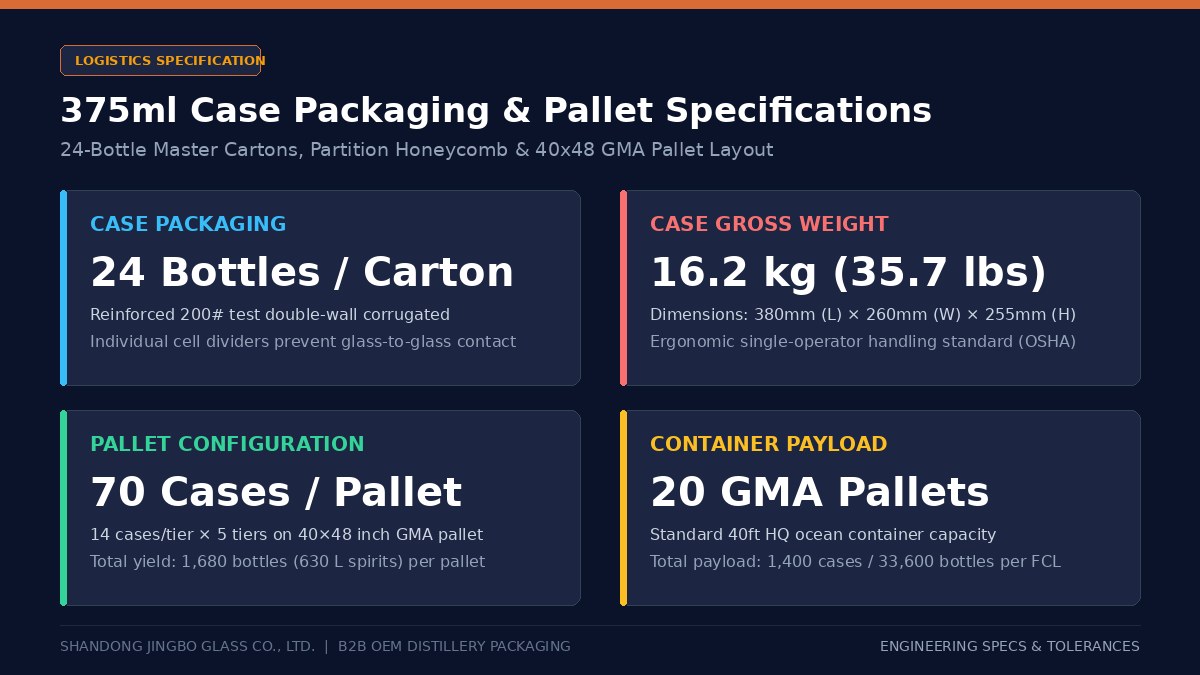
In wholesale glass supply and distillery distribution, standard 375ml bottles are packed 24 bottles per case. This format aligns perfectly with US alcohol distribution laws because 24 bottles × 375ml equals exactly 9.0 liters—the exact same liquid volume contained in a traditional 12-pack case of 750ml bottles.
However, glass packaging requires rigorous attention to corrugated strength and internal partition cells. At our factory, we manufacture master shipping cartons using 200# test double-wall corrugated board with full-depth interlocking dividers. This prevents glass-to-glass contact during automated case packing and ocean freight vibration.
| Logistics Parameter | 24-Bottle 375ml Case | Standard 40×48 GMA Pallet | 40-Foot High Cube (HQ) Container |
|---|---|---|---|
| Carton Dimensions (L × W × H) | 385 mm × 265 mm × 235 mm | 1,219 mm × 1,016 mm × 1,325 mm | Internal container capacity: ~76 m³ |
| Units per Layer / Tier | 24 bottles in individual cells | 14 cartons per tier | 20 GMA pallet footprints |
| Tiers / Stacking Height | Single carton layer | 5 tiers high (70 cases total) | Double stacked with plywood dividers |
| Total Bottle Yield | 24 bottles | 1,680 bottles | 33,600 bottles (1,400 cases) |
| Gross Weight (Filled Spirit) | ~16.4 kg (36.1 lbs) | ~1,175 kg (2,590 lbs) | ~23,500 kg (within US highway weight limits) |
| Carton Bursting Strength | Edge Crush Test (ECT) ≥ 32 lb/in | Stretch-wrapped with 80-gauge film | Desiccant bags + anti-slip pallet sheets |
5. Quality Control: Annealing & Neck Bore Standards
When high-speed rotary filling machines operate at 60 to 120 bottles per minute, neck bore consistency is the difference between a smooth production run and line-stopping downtime.
Our 375ml spirits bottles undergo continuous monitoring at two vital manufacturing checkpoints:
- Annealing Lehr Stress Relieving: Freshly molded bottles pass through an 18-meter annealing lehr where the temperature is controlled from 550°C down to 80°C along a precise cooling curve. Every production batch is inspected with a transmission polariscope under polarized light (ASTM C148) to guarantee an optical path difference (retardation) below Grade 2, eliminating residual cooling stresses that cause filling fractures. For more details on heat curves, read our engineering article on Glass Bottle Annealing Temperature & Line Breakage.
- Bore Diameter Gauging for Synthetic Corks: For standard 28mm bar top finishes, our mold rings maintain a bore internal diameter (ID) of 18.5mm ± 0.25mm measured at a depth of 15mm. Because commercial synthetic bar top corks typically feature a 19.5mm shank diameter, this creates an exact 1.0mm interference fit (5.4% compression). This guarantees an airtight seal that withstands up to 1.5 bar internal pressure without requiring excessive corking force on the packaging line.
If you are planning a proprietary shape with debossed logos or specialized surface frosting, explore our comprehensive technical guides on Custom Glass Bottle Design: Concept to Mass Production and our updated report on the Chemical Acid Etching vs Sandblasting Frosting Process.
Ready to Launch Your 375ml Spirits Project?
Shandong Jingbo Glass delivers export-grade high flint and crystal-white glass packaging for craft distilleries across North America and Europe. From ready-to-ship stock molds to rapid 15-day custom tooling with low MOQs, we provide complete engineering support.
Explore Wholesale Glass Liquor BottlesFrequently Asked Questions: 375ml Spirits Packaging
How many ounces is a 375ml bottle of liquor?
A 375ml bottle of liquor contains exactly 12.68 US fluid ounces. Under United States TTB federal regulations, this is rounded and declared on front labels as 12.7 FL. OZ. If measured in British Imperial fluid ounces, 375ml equals 13.20 Imperial fluid ounces.
How many shots are in a 375ml bottle of whiskey or vodka?
A 375ml bottle contains 8.45 standard 1.5-ounce shots. In practical bar service, this yields eight full standard 1.5 oz cocktails plus a half-shot taster pour. If using 1.0-ounce recipe pours, a 375ml bottle yields exactly 12.68 pours.
What is a 375ml liquor bottle called?
In the distilled spirits and wine industry, a 375ml bottle is most commonly called a “Demi” (from the French word for half) or a “Half Bottle”, because its 375ml capacity is exactly half of a standard 750ml fifth. In wine and champagne, it is also frequently referred to as a “Split”.
How many 375ml bottles come in a standard case?
In commercial spirits distribution, standard 375ml bottles are packaged in 24-bottle master cartons. A 24-pack of 375ml bottles contains 9.0 liters of liquid in total, which perfectly equals the 9.0-liter volume of a standard 12-pack case of 750ml bottles.
Can a 375ml bottle use the same cork size as a 750ml bottle?
Yes. Most commercial 375ml spirits bottles are engineered with the industry-standard GPI 28mm Bar Top finish with an internal neck bore of 18.5mm ± 0.25mm. This matches the standard neck bore of 750ml bottles, allowing distilleries to use identical 19.5mm shank synthetic bar top corks and identical corking heads across both bottle sizes without changing tooling.