

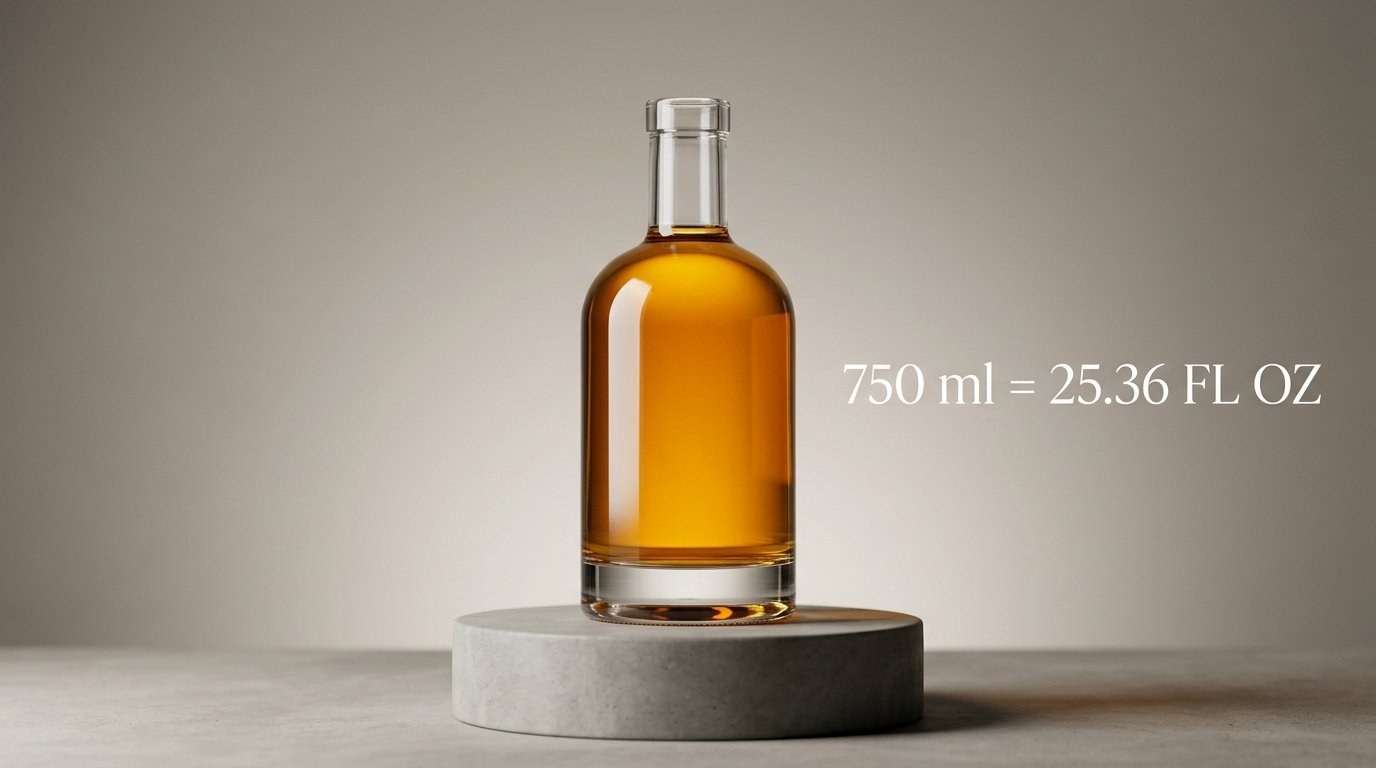
If you are looking to convert 750 ml to oz, a standard 750 milliliter bottle contains exactly 25.36 US fluid ounces (25.3605 fl oz). If you are measuring in British Imperial fluid ounces, 750 ml converts to 26.40 Imperial fluid ounces. Whether you are formulating commercial bottling yields for a distillery, managing inventory pour costs across an on-premise beverage program, or configuring CAD mould drawings for custom glass packaging, understanding the exact 750 ml to oz formula is the cornerstone of beverage manufacturing.
Quick 750 ml to oz Conversion Summary
• 750 ml to US Fluid Ounces: 25.36 fl oz (Exact formula: 750 ÷ 29.573529)
• 750 ml to UK Imperial Ounces: 26.40 Imperial fl oz (Exact formula: 750 ÷ 28.41306)
• Standard US Shots (1.5 oz pour): Exactly 16.9 standard shots per bottle
• Standard Wine Glasses (5 oz pour): Exactly 5 full servings per bottle
• Volume Difference vs. 700ml Bottle: +50 ml (+1.69 US fl oz) more volume than the European standard
The Mathematical Formula: How to Convert 750 ml to oz Exactly
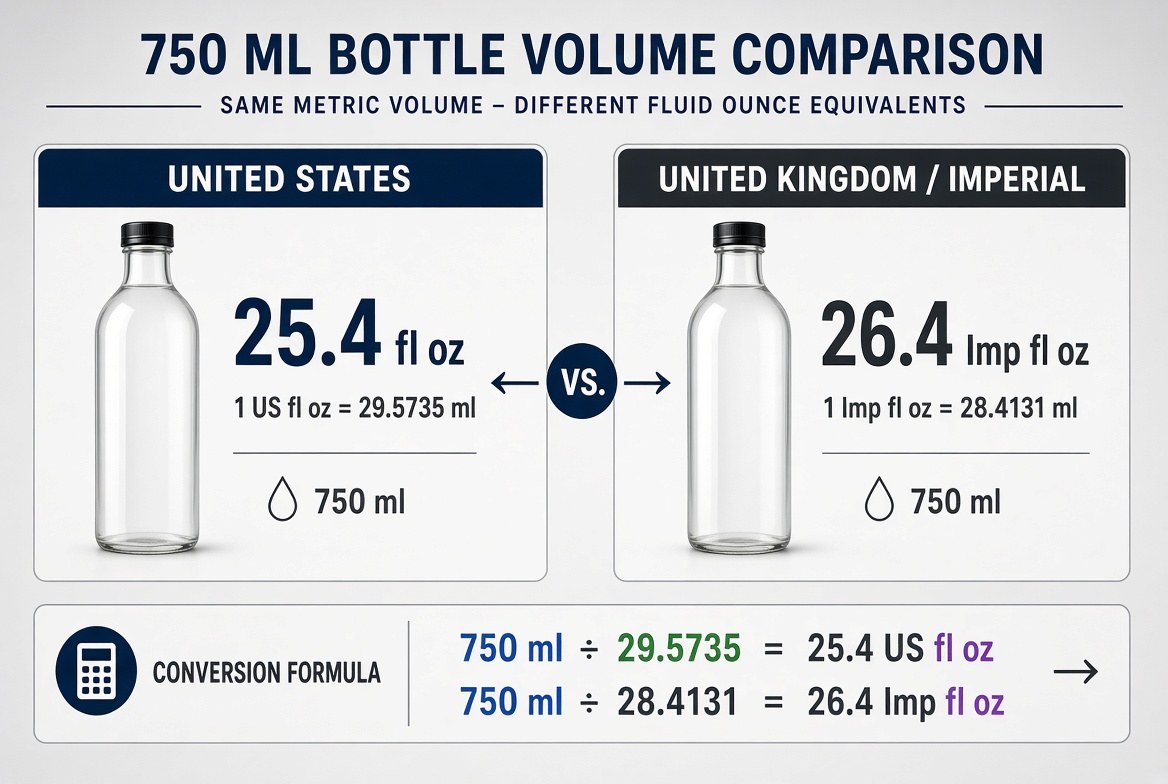
To accurately calculate 750 ml to oz, packaging engineers must account for the statutory difference between the US Customary fluid ounce and the British Imperial fluid ounce. Fluid ounces measure volume (liquid capacity), whereas dry ounces measure avoirdupois weight—a distinction that frequently confuses new distillers.
In the United States, the National Institute of Standards and Technology (NIST) establishes that 1 US fluid ounce equals exactly 29.5735295625 milliliters. Performing the division:
750 ml ÷ 29.573529 = 25.360517 US Fluid Ounces
Commercially rounded to 25.36 fl oz for retail label compliance.
Conversely, the British Imperial system defines 1 Imperial fluid ounce as exactly 28.4130625 milliliters. When exporting spirits to the United Kingdom or Commonwealth territories measuring in Imperial fluid units:
750 ml ÷ 28.413063 = 26.396316 Imperial Fluid Ounces
Commercially rounded to 26.40 Imperial fl oz.
Why Is 750 ml Called a “Fifth” in American Liquor Lore?
In American distillery history, the term “Fifth” has become synonymous with a standard 750ml bottle of whiskey, rum, or vodka. However, modern bottles contain 750 milliliters, not an imperial or customary vulgar fraction. Where did this nomenclature originate?
Throughout the late 19th and early 20th centuries, commercial distilled spirits in the United States were sold by the gallon. However, purchasing an entire gallon was impractical for retail consumers. Distillers introduced wholesale bottles containing exactly one-fifth of a US gallon (four-fifths of a quart), which equated to 25.6 US fluid ounces (757.08 milliliters). These bottles were legally stamped and taxed as a “commercial fifth.”
In 1979, the United States Department of the Treasury’s Bureau of Alcohol, Tobacco, and Firearms (now the TTB) enacted mandatory metrication for all distilled spirits sold in America under 27 CFR Part 5. Rather than adopting an unfamiliar round number, federal regulators selected 750 milliliters (25.36 fl oz) because it was within 1% of the historical 25.6 oz Fifth. As detailed in our breakdown of American whiskey brand packaging standards, this legacy sizing continues to govern 750ml bourbon, rye, and Tennessee whiskey tooling today.
Global Spirits Bottle Size Reference & Pour Yield Table
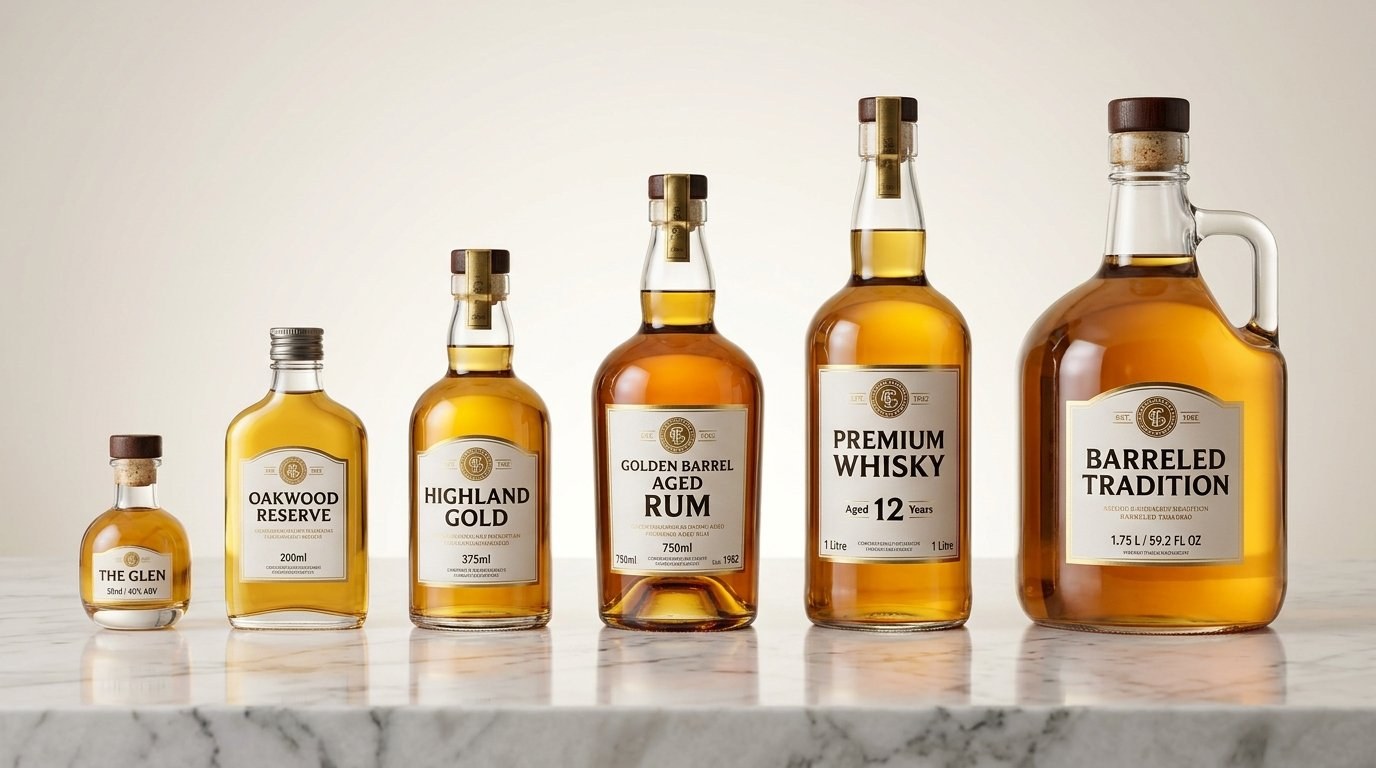
When selecting standard bottle moulds or planning warehouse palletization for domestic and overseas distribution, reference this master metric-to-fluid-ounce comparative table:
| Metric Volume | US Fluid Ounces (fl oz) | UK Imperial Ounces | Standard 1.5 oz Shots | Commercial Packaging Role |
|---|---|---|---|---|
| 50 ml | 1.69 fl oz | 1.76 fl oz | 1.1 shots | Miniature / Hotel minibar / Airline sampler |
| 200 ml | 6.76 fl oz | 7.04 fl oz | 4.5 shots | Flask / Half-pint equivalent / Gift set |
| 375 ml | 12.68 fl oz | 13.20 fl oz | 8.4 shots | Pint equivalent / Demi bottle / Craft tasting |
| 700 ml | 23.67 fl oz | 24.64 fl oz | 15.8 shots | European & UK statutory standard; TTB global size |
| 750 ml | 25.36 fl oz | 26.40 fl oz | 16.9 shots | US Standard Spirits Fifth; International Wine Benchmark |
| 1,000 ml (1 L) | 33.81 fl oz | 35.20 fl oz | 22.5 shots | Duty-Free Travel Retail / High-volume speed rail |
| 1,750 ml (1.75 L) | 59.17 fl oz | 61.59 fl oz | 39.4 shots | Handle / Value retail format |
Planning international spirit exports? Compare this format directly with our complete technical guide on 700 ml to oz conversion and European spirit packaging regulations to evaluate transatlantic supply chain optimization.
750 ml vs. 700 ml: Which Size Should Modern Distilleries Tool?
Until December 2020, foreign spirit brands selling in the United States were legally barred from selling standard European 700ml bottles, forcing distillers to carry double inventory. However, with the TTB’s modernization ruling authorizing 700ml alongside 750ml, spirits brand owners now face a strategic decision:
1. Consumer Perception in the US: For American consumers, 750ml remains the deeply ingrained standard. Brands transitioning to 700ml in US retail must clearly articulate their craft positioning, as uninformed shoppers may perceive 700ml as “shrinkflation” unless counterbalanced with luxury custom glass design.
2. Production & Liquid Yield Savings: Moving to 700ml reduces liquid volume per bottle by 50ml (6.67%). For long-aged bourbon, rare single malt, or high-ester aged rum (see our engineering review of custom glass rum bottle packaging), bottling in 700ml allows a single barrel to yield 15 to 20 additional sellable bottles without altering retail SRP.
3. Unified Global Logistics: Craft distilleries aiming for simultaneous distribution across North America, Europe, Australia, and Asia can now tool a single 700ml mould family, eliminating redundant tooling fees and simplifying automated packaging line setups.
Factory Engineering: Nominal 750 ml vs. Brimful Capacity & Headspace
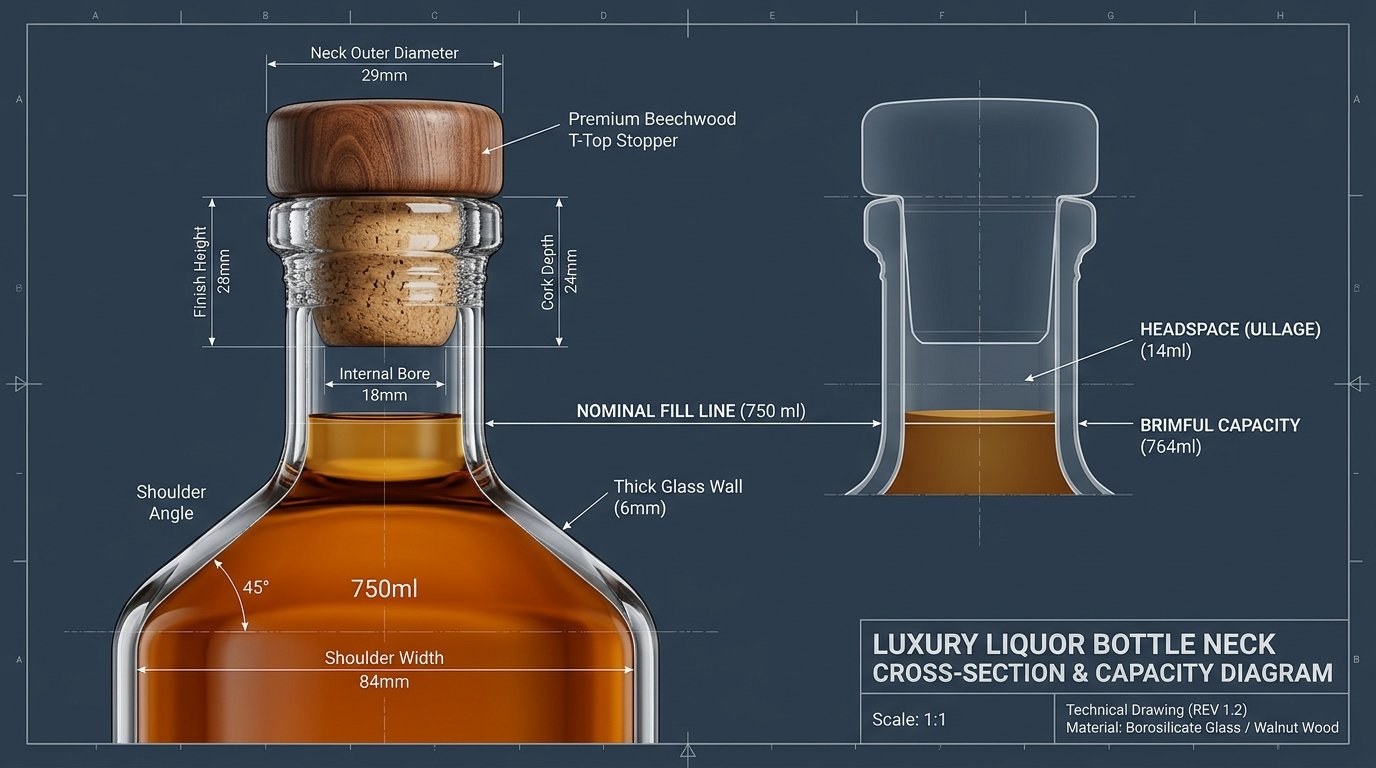
When custom tooling a 750ml flint glass bottle, a common engineering misconception is designing a mould cavity that holds exactly 750 milliliters. In commercial glass container manufacturing, nominal capacity and brimful capacity must never be identical.
Nominal capacity (750 ml / 25.36 fl oz) represents the commercial fill volume measured at 20°C (68°F). However, high-proof spirits possess a thermal expansion coefficient of approximately 0.001 per °C. During summer shipping in non-refrigerated intermodal ocean containers, temperatures inside container holds routinely hit 45°C (113°F). A 25°C temperature rise will expand 750ml of liquid ethanol by 18 to 22 milliliters.
Furthermore, inserting a standard synthetic or natural bar-top T-cork (18.5mm to 19.5mm bore) displaces an additional 6 to 9 ml of internal volume upon sealing. Without sufficient air space (ullage), hydrostatic pressure spikes inside the container, forcing the closure out or fracturing the bottle shoulder.
At Shandong Jingbo Glass, our CAD engineers calculate a strict brimful capacity of 775 ml to 785 ml (26.2 to 26.5 fl oz) for all 750ml spirits moulds. This provides a precise 3.5% to 5.0% expansion buffer, ensuring hermetic sealing integrity from sub-zero railway transit down to tropical maritime shipping.
Engineering a Custom 750ml or 700ml Glass Spirits Bottle?
Shandong Jingbo Glass Co., Ltd. provides ISO 9001 certified super-flint glass manufacturing, precision CNC mould making, custom heavy-base forming, and worldwide export shipping for award-winning distilleries.
Request a Factory Feasibility Review
[…] our detailed analysis answering how many ounces in 750 ml, as well as our global sizing guides on 750 ml to oz and 700 ml to oz […]