

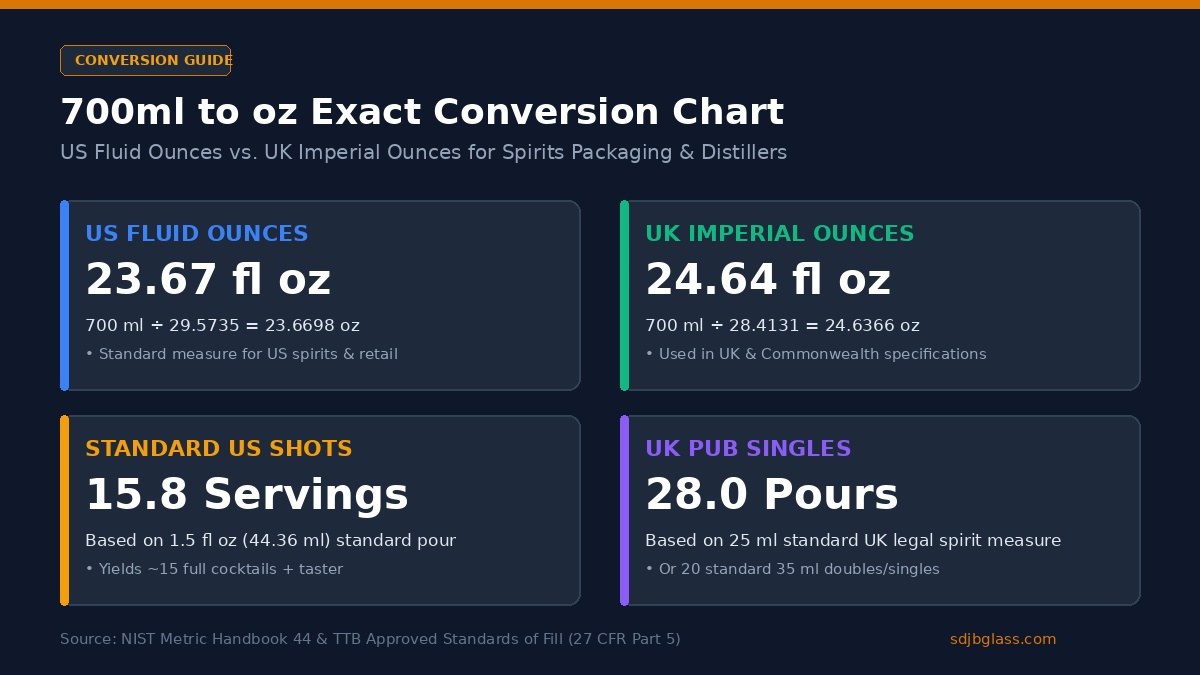
If you are looking to convert 700ml to oz, 700 ml equals exactly 23.67 US fluid ounces (23.6698 fl oz). In the British Imperial measurement system, 700 ml converts to 24.64 Imperial fluid ounces (24.6366 fl oz). Whether you are an artisanal craft spirits distiller engineering a new export bottle line, an on-premise bar manager calculating exact pour cost margins, or an international beverage importer navigating transatlantic spirits packaging regulations, understanding the exact 700ml to oz relationship is essential for compliance and brand profitability.
Quick 700ml to oz Conversion Summary
• 700 ml to US Fluid Ounces: 23.67 fl oz (Formula: 700 ÷ 29.5735)
• 700 ml to UK Imperial Ounces: 24.64 Imperial oz (Formula: 700 ÷ 28.4131)
• Standard US Shots (1.5 oz pour): ~15.78 shots per bottle
• Standard UK Pub Pours (25 ml measure): Exactly 28 single measures
• Difference vs. 750ml Fifth: Holds exactly 50 ml (1.69 US fl oz) less liquid than a traditional 750ml bottle.
How to Convert 700ml to oz: US vs. Imperial Fluid Ounces
To calculate 700ml to oz accurately, you must first distinguish between the United States Customary system and the British Imperial system. Specifically, while both systems employ the term “fluid ounce”, their volumetric definitions diverge significantly due to historical trade statutes established in the 19th century.
In the United States, one fluid ounce is legally defined by the National Institute of Standards and Technology (NIST) as exactly 29.5735295625 milliliters. Therefore, dividing 700 ml by 29.5735 yields 23.6698 US fluid ounces, which round commercially to 23.67 fl oz.
Conversely, the British Imperial fluid ounce is defined based on the volume of 28.4130625 milliliters. When dividing 700 ml by 28.4131, you arrive at 24.6366 Imperial fluid ounces, which rounds to 24.64 Imperial fl oz. Consequently, a British bartender measuring in Imperial ounces calculates nearly one whole ounce higher on paper than an American bartender, despite handling the identical physical volume of liquid.
700ml to oz Quick Reference & Standard Servings Table
When engineering custom glass moulds or formulating retail cocktail menus, beverage professionals routinely reference standard milliliter-to-ounce milestones. Below is a comprehensive reference breakdown detailing exact conversions across global spirit bottle formats:
| Metric Bottle Size | US Fluid Ounces (fl oz) | Imperial Fluid Ounces | Standard US 1.5 oz Shots | Primary Regional Application |
|---|---|---|---|---|
| 50 ml | 1.69 fl oz | 1.76 fl oz | 1.1 shots | Miniature / Airplane bottle sampler |
| 200 ml | 6.76 fl oz | 7.04 fl oz | 4.5 shots | Pocket flask / Tasting gift pack |
| 375 ml | 12.68 fl oz | 13.20 fl oz | 8.4 shots | Half bottle / Demi format |
| 700 ml | 23.67 fl oz | 24.64 fl oz | 15.8 shots | European & UK Standard; TTB Approved Global Size |
| 750 ml | 25.36 fl oz | 26.40 fl oz | 16.9 shots | Traditional US Standard Fifth / Wine standard |
| 1,000 ml (1 Liter) | 33.81 fl oz | 35.20 fl oz | 22.5 shots | Travel Retail Duty Free / Commercial bar pour |
For an in-depth analysis of the traditional North American spirits benchmark, explore our companion guide on how many ounces are in a 750ml bottle and why bottle designers specify headroom capacity.
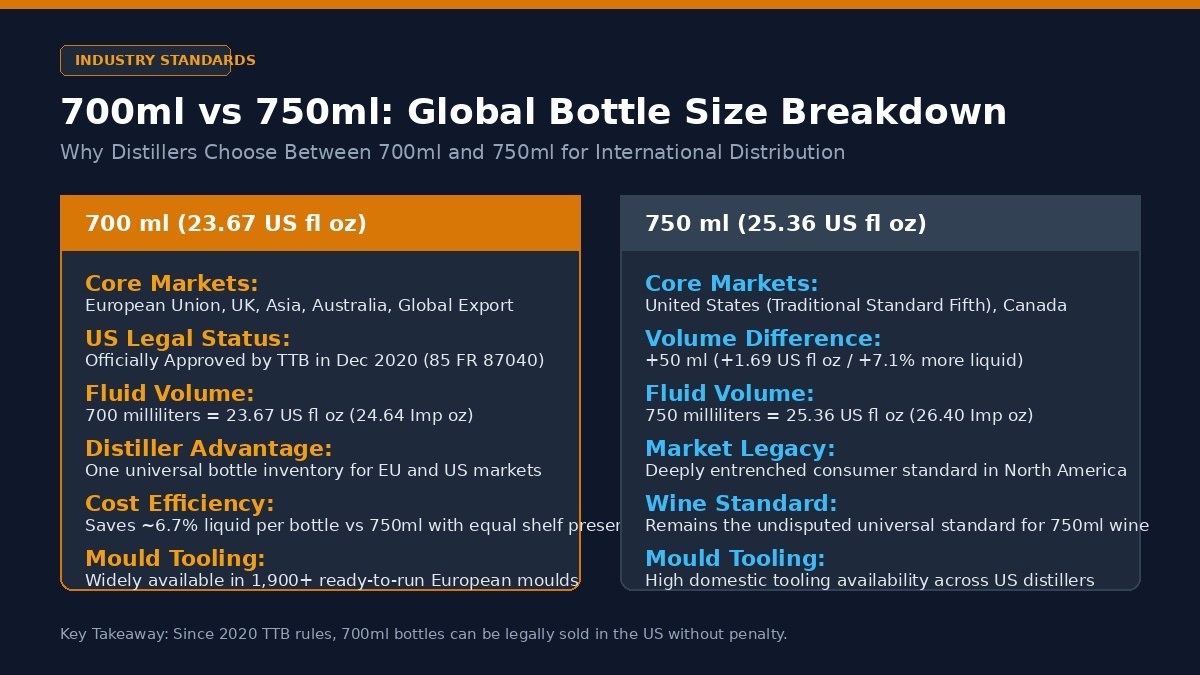
700ml vs 750ml: Why the Global Spirits Industry Uses Two Bottle Standards
One of the most persistent questions distillers ask our engineering department is: Why does 700ml exist alongside 750ml? Understanding this historical divide requires examining European Union trade harmonization directives from the 1970s.
Originally, European nations bottled spirits in a chaotic variety of regional sizes ranging from 680ml to 720ml. In 1975, the European Community enacted Directive 75/106/EEC to establish standardized packaging volumes, specifically selecting 700ml as the mandatory spirits standard across Western Europe. In contrast, the United States metricated its distilled spirits packaging in 1979 under Title 27 of the Code of Federal Regulations, fixing the standard spirits bottle at 750ml—a direct metric adaptation of the pre-metric American “Fifth” (one-fifth of a US gallon, or 25.6 fl oz), as seen in modern American whiskey brand packaging lines.
Consequently, for over four decades, international spirits brands faced a costly logistics nightmare. Distillers wishing to sell both in Europe and the United States were forced to manufacture two separate glass bottles, maintain dual bottling lines, and print duplicate label inventories simply to satisfy regulatory standards of fill.
TTB Legal Approval: Can You Sell 700ml Spirits Bottles in the United States?
Fortunately, the regulatory landscape shifted permanently in late December 2020. The United States Alcohol and Tobacco Tax and Trade Bureau (TTB) issued Treasury Decision TT-158 (Docket No. TTB-2019-0004, 85 FR 87040), officially amending 27 CFR Part 5 to add 700 mL as an authorized standard of fill for distilled spirits sold in the US.
This landmark regulatory amendment unlocked substantial competitive advantages for craft distillers and multinational spirit houses alike:
• Universal Inventory Harmonization: Distillers can now produce a single 700ml glass bottle inventory that ships seamlessly to the US, EU, UK, Japan, Australia, and Canadian markets without re-tooling.
• Liquid Cost Savings: Transitioning from 750ml to 700ml reduces liquid volume by approximately 6.67% (50 ml) per unit. For high-value aged bourbon, single malt scotch, or artisanal rum (see our guide to custom glass rum bottle packaging), this volume difference yields dramatic production savings while preserving equivalent retail price points.
• Optimal In-Hand Proportion: Because a 700ml bottle requires slightly less inner cavity volume, glassmakers can allocate additional glass weight into a thicker, luxurious heavy solid base, elevating the tactile consumer experience without increasing total shipping mass.
Glass Bottle Engineering: Nominal 700ml vs. Brimful Capacity
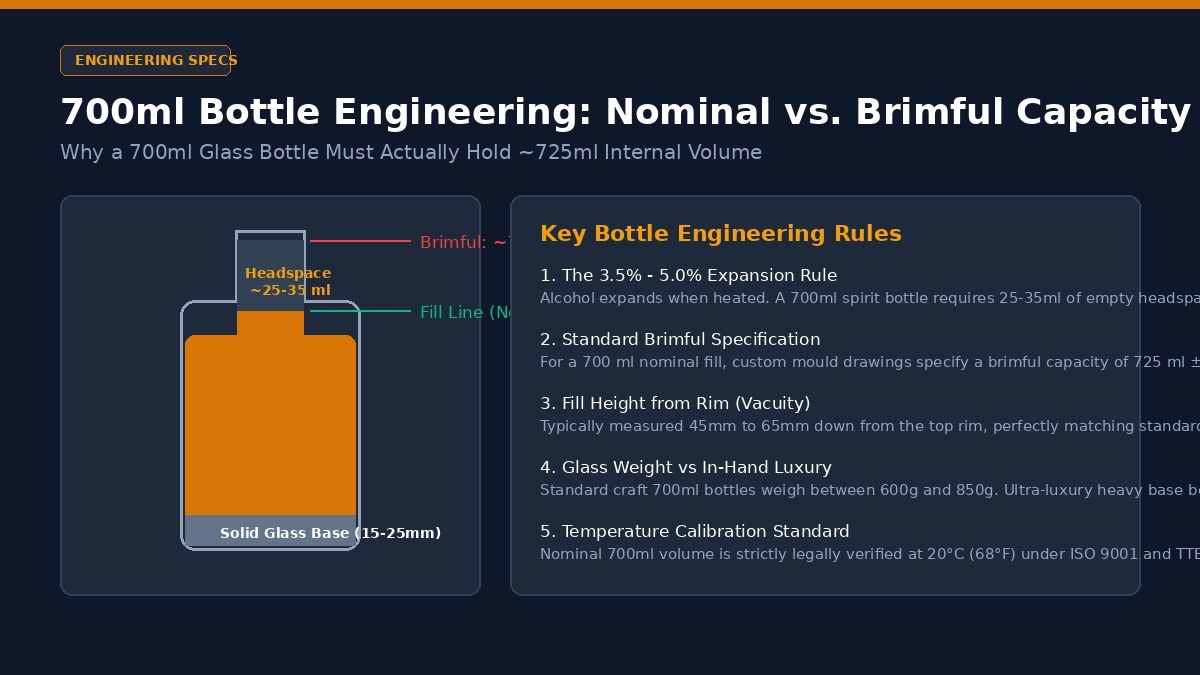
When custom tooling a glass bottle, packaging designers frequently commit a critical blunder: designing a mould cavity that holds exactly 700 milliliters. In industrial glass bottle manufacturing, nominal capacity and brimful capacity represent two entirely separate technical specifications.
Nominal capacity represents the stated legal commercial volume (700 ml, or 23.67 fl oz) measured at a standard reference temperature of 20°C (68°F). However, liquid ethanol expands significantly as ambient temperature rises during intermodal container transit or warehouse storage. Specifically, spirits expand by roughly 0.1% per degree Celsius. If a container filled at 15°C reaches 40°C inside a freight container, the liquid volume expands by nearly 18 to 22 milliliters.
Therefore, professional glass bottle engineering requires incorporating headspace (ullage) of 3.5% to 5.0% above the nominal fill line. For a standard 700ml glass spirits bottle, our engineers at Shandong Jingbo Glass specify a brimful capacity of 725 ml ± 5 ml (equivalent to 24.5 to 24.8 fl oz). This 25ml vacuity ensures sufficient air cushion to absorb thermal expansion, accommodates standard 27mm bar-top cork displacement, and completely prevents cork push-out or hermetic seal failure.
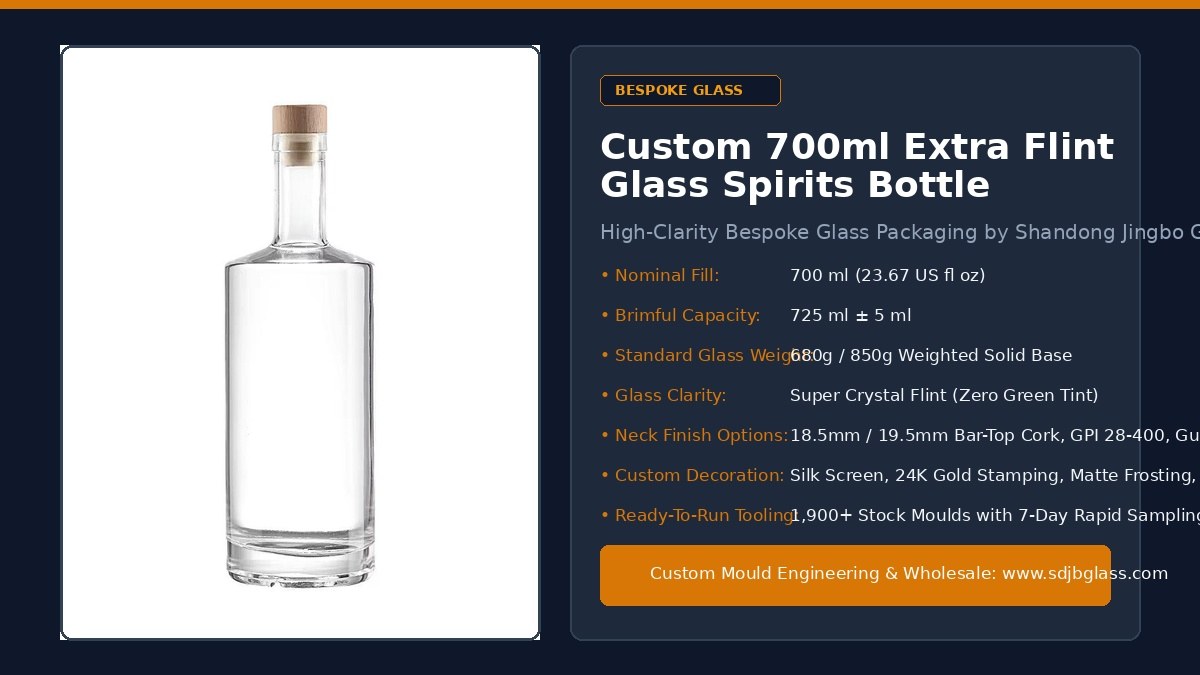
How to Spec Your Next Custom 700ml Glass Bottle Project
When ordering custom 700ml glass bottles from an established manufacturer, specifying clear technical parameters ensures rapid prototyping and zero factory defects. Consider these key engineering checkpoints during your mould design phase:
1. Glass Flint Clarity: Specify Super Crystal Flint Glass rather than standard high flint. Super flint silica formulations eliminate unsightly greenish or yellowish undertones, ensuring your amber bourbon, crystal gin, or deep rum illuminates naturally on retail back-bars.
2. Solid Base Thickness: Premium spirits bottles typically incorporate a weighted solid glass bottom (push-up or solid plate) measuring between 15mm and 28mm thick. This lowers the center of gravity and delivers the commanding in-hand heft modern consumers associate with top-shelf spirits.
3. Neck Finish & Closure Compatibility: Determine your closure mechanism prior to cutting CNC mould cavities. Common neck finishes include standard 18.5mm or 19.5mm internal bores for synthetic bar-top T-corks, GPI 28-400 continuous thread finishes for aluminum screw caps, or specialized Ropp tamper-evident necks.
4. Secondary Surface Finishing: Evaluate tactile surface enhancements such as 3D relief mould embossing, velvet matte acid frosting, hot-foil 24K real gold stamping, or high-temperature ceramic silk screen printing cured at 600°C for lifetime scratch resistance.
Designing a Bespoke 700ml Glass Spirits Bottle?
Shandong Jingbo Glass is an ISO 9001 certified manufacturer with over 1,900+ ready-to-run bottle moulds, 7-10 day rapid 3D prototyping, and dedicated export logistics serving award-winning craft distilleries worldwide.
Connect With Our Engineering Team