

Walk into any liquor store in Louisville, Austin, or Chicago, and watch how people actually shop for whiskey. Nobody pulls out a laboratory refractometer. Nobody asks the retail clerk to run a gas chromatography scan on the barrel char.
Instead, they scan the wooden shelves, lock onto a silhouette, and reach out. The very first physical interaction between a consumer and an American whiskey brand isn’t the aroma of vanilla or toasted oak—it is the cold, hefty weight of the glass bottle in their hand. If that bottle feels thin, insubstantial, or rattles against the glass next to it like a soda bottle, the mental valuation of the liquid drops instantly.
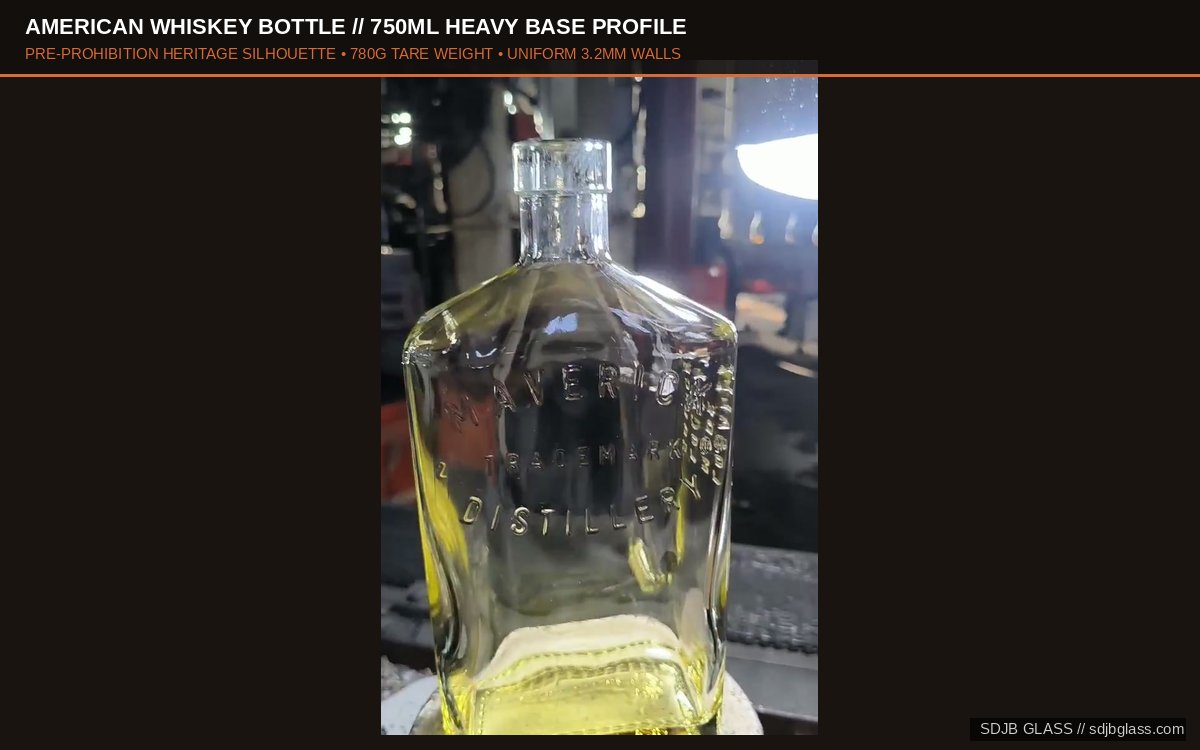
1. The Four Iconic Silhouettes Defining American Whiskey Brands
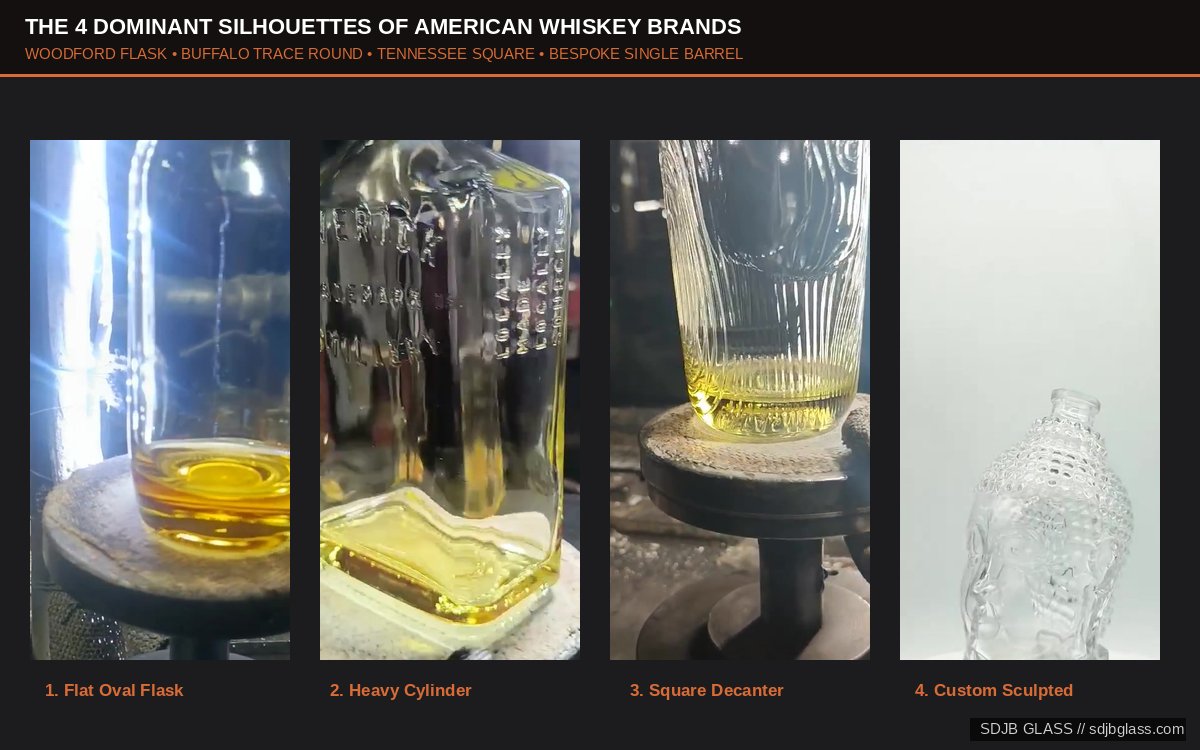
Unlike Scotch, which historically leaned on tall, slender, green or amber cylindrical bottles, American whiskey packaging has always had a rebellious, blue-collar, yet artisanal character. Over two centuries, four distinct bottle geometries have emerged as the gold standards of the American market:
A. The Wide-Shoulder Flat Flask (The Pre-Prohibition Apothecary Heritage)
Think of iconic brands like Woodford Reserve. The flat oval flask design harkens back to pocket flasks carried by travelers, frontiersmen, and medicinal apothecaries in the 1800s. From a merchandising standpoint, the wide front face creates a massive visual “billboard” on the retail shelf. When light passes through amber whiskey in an oval cross-section, the center appears darker and richer, while the tapered edges glow with a golden refraction.
B. The Heavyweight Straight Cylinder (The Kentucky Straight Bourbon Workhorse)
Popularized by Buffalo Trace, Eagle Rare, and historic distilleries along the Kentucky River, the tall, hefty cylinder is all about honest, unpretentious American strength. It features a broad, confident shoulder and a thick, pronounced neck collar. In industrial bottling, this shape runs effortlessly on high-speed filling lines at 120+ bottles per minute without jamming.
C. The Broad-Shouldered Square Decanter (The Tennessee & Bonded Classic)
Made legendary by Jack Daniel’s and modern expressions like Old Forester 1920, the square decanter commands absolute authority. Beyond aesthetics, the square profile offers practical advantages: it packs with zero wasted space into corrugated shipping cases, preventing carton rattling during rough pallet transport across state lines.
D. The Multi-Faceted Collector’s Decanter
Look at Blanton’s single barrel or High West’s textured blown-glass style. These bottles intentionally step away from smooth industrial glass. By cutting geometric facets or replicating pre-industrial bubble textures into the mold, the bottle catches ambient bar lighting like a cut-crystal whiskey tumbler.
2. Behind the Lehr: The Engineering Challenges of Whiskey Glass
Distillers often sketch a gorgeous 3D rendering on a computer and wonder why glass factories quote long lead times or high mold tooling fees. Glass is not plastic; you cannot simply squeeze molten silica into an extreme corner without respecting the laws of fluid thermodynamics and thermal stress.
The Flat-Flask Thickness Dilemma
When forming a flat oval flask on an IS (Individual Section) machine, molten glass naturally follows the path of least resistance. It tends to bunch up in the narrow side radii while thinning out in the center of the front and back panels. If your mold engineer does not calculate the parison pre-blow expansion and mold vacuum suction properly, you end up with a bottle that has 6mm thick sides and a dangerously fragile 1.8mm front panel. In our furnace lines, we run computational fluid simulations on every custom flask mold to guarantee a uniform minimum wall thickness of 3.2mm across the entire face.
The 850-Gram Thermal Annealing Curve
American whiskey distillers love deep, thick glass bottoms (punts) measuring 15mm to 25mm of solid super-flint glass. That solid block of glass holds heat far longer than the 3mm sidewalls. If the bottle exits the mold and cools too quickly in ambient air, the differential contraction creates severe internal shear stresses. When shipped into cold climates, that bottle can spontaneously fracture right at the base seam.
To eliminate this, heavy whiskey bottles must undergo an extended annealing cycle inside a 45-meter continuous Lehr oven. We slowly step the temperature down from 560°C through the critical transformation zone (520°C to 480°C) over 150 minutes, verifying zero residual stress using cross-polarized photoelastic polariscopes before packing.
| Silhouette Style | Average Tare Weight (750ml) | Base Punt Thickness | Typical Closure Finish | High-Speed Line Stability | Ideal Retail Positioning |
|---|---|---|---|---|---|
| Flat Oval Flask | 680g – 780g | 12mm – 18mm | 18.5mm T-Top Cork | Moderate (Requires guide rails) | Craft Bourbon & Small-Batch Rye (\$55–\$85) |
| Heavyweight Round Cylinder | 750g – 880g | 18mm – 25mm | 21.5mm Wood T-Top | High (Zero rotation jamming) | Single Barrel & Cask Strength (\$65–\$120) |
| Square Decanter | 720g – 820g | 14mm – 20mm | GPI 33-400 / Bar-Top | Good (Needs orientation sensor) | Bottled-in-Bond & Heritage Reserves (\$45–\$75) |
| Mass-Market Round | 420g – 500g | 4mm – 8mm | ROPP / GPI Aluminum Cap | Exceptional (Maximum line speed) | Value Blend & Rail Spirits (\$15–\$25) |
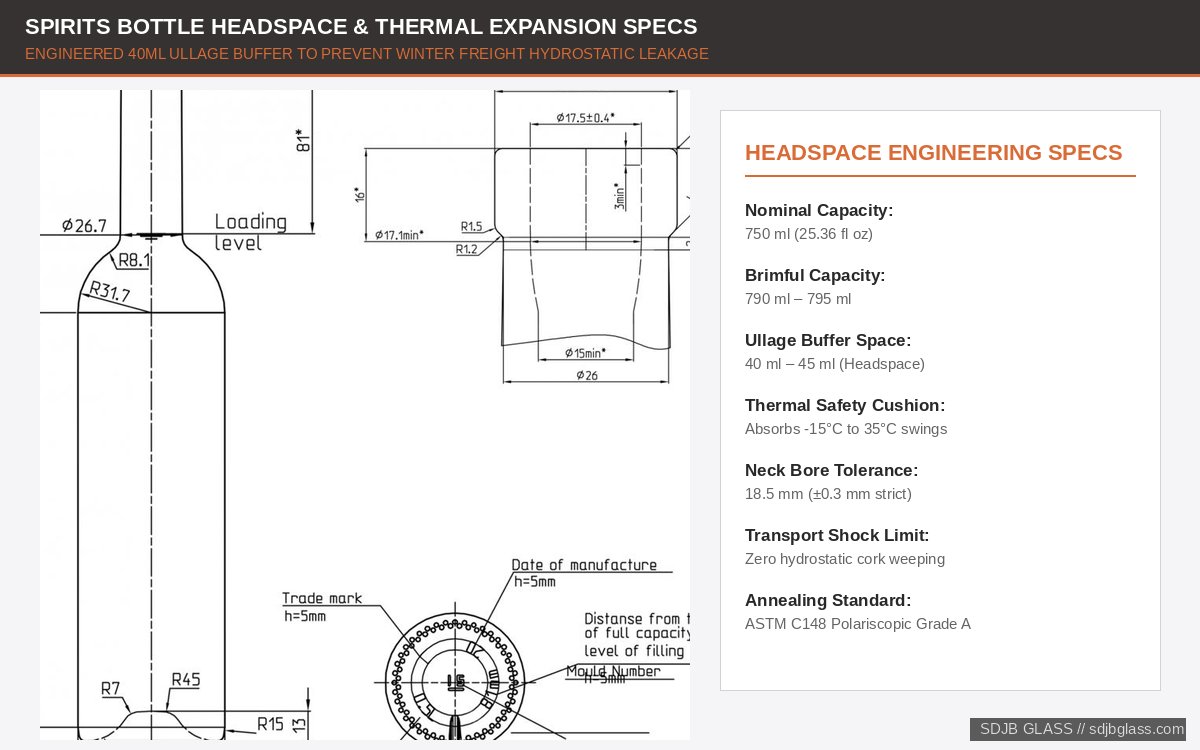
3. Winter Rail Freight & The Headspace Safety Factor
A detail that many emerging American whiskey brands overlook until their first winter shipment is hydrostatic liquid expansion and contraction.
Bourbon barrels are dumped, proofed, and bottled at a standard 20°C (68°F). But when those palletized cases are loaded onto freight trailers or railcars passing through Nebraska or North Dakota in mid-January, internal temperatures plunge to -15°C (5°F). Whiskey is approximately 40% to 60% ethanol and 60% to 40% water. While alcohol does not freeze at these temperatures, it experiences substantial thermal density changes.
When the shipment subsequently arrives at a heated retail distribution warehouse in Los Angeles or Miami, the rapid thermal rise creates violent internal hydrostatic pressure. If the glass bottle was engineered with inadequate headspace (less than 30ml of ullage above nominal fill level), that expanding liquid has nowhere to go. It forces itself past the cork shank, weeping down the neck and ruining expensive velvet or paper labels.
At our plant, every custom 750ml mold designed for North American spirits incorporates a minimum of 38ml to 45ml brimful headspace allowance. This provides an engineered air cushion that absorbs thermal pressure spikes without stressing the closure.
4. Neck Bore Precision: Protecting 100-Proof High Spirits
American whiskey commands high alcohol content—standard 80-proof (40% ABV), 100-proof Bottled-in-Bond (50% ABV), and uncut cask strengths reaching up to 130-proof (65% ABV). Ethanol is a volatile organic solvent. If the inner diameter of the bottle neck is out of round by even 0.4mm, the cork stopper will not achieve a hermetic seal.
- Inner Bore Tolerance: Standard beverage bottles allow ±0.8mm variance. For premium American whiskey cork finishes, we hold CNC-machined neck rings to ±0.3mm strict tolerance.
- Synthetic vs Natural Cork: While traditionalists love natural Portuguese cork, high-proof cask strength whiskey degrades natural cork tannins over years of upright storage. We engineer dual-ring internal retention ribs inside the neck glass that lock synthetic T-top shanks firmly in place without slippage.
- Anti-Drip Lip Geometry: A sharp, slightly flared bead around the outer lip ensures that when a bartender pours a 2-ounce pour into a rocks glass, the final droplet shears cleanly off the rim instead of running down the front label.
Frequently Asked Questions About American Whiskey Bottle Packaging
In blind retail studies, consumers perceive whiskey in bottles weighing 700g to 900g as significantly older, richer, and more authentic than identical spirits in 450g lightweight bottles. The hefty glass base also lowers the center of gravity, preventing accidental tip-overs on crowded bar rails.
The industry standard for premium American whiskey is an 18.5mm or 21.5mm cork finish designed for synthetic or natural wooden bar-top T-corks. The inner bore must hold a strict ±0.3mm tolerance to prevent liquid leakage and premature alcohol oxidation.
In flat oval glass molds, molten parisons tend to cool unevenly—bunching into the narrow side corners while stretching thin across the wide front and rear label panels. Achieving consistent wall thickness requires specialized mold vacuum suction and micro-calibrated cooling airflow.
Whiskey bottles transported by rail or road across North American winters experience extreme temperature swings from -20°C to heated distribution warehouses. Glassmakers must engineer at least 35ml to 45ml of headspace (4% to 5% expansion volume) to prevent hydrostatic pressure from popping cork stoppers.
Yes. Most glass factories offer interchangeable mold inserts that allow distillers to emboss custom logos, distillery founding dates, or batch monograms onto the shoulder, base ring, or neck collar of existing mold chassis without paying the full cost of a brand-new mold set.
Ready to Build a Top-Shelf American Whiskey Bottle?
From custom pre-prohibition flask silhouettes to super-flint 850g heavy base decanters, our engineering team provides complete 2D technical drawings, 3D mold prototyping, and pilot sample runs.
Get A Free Factory Feasibility Assessment
[…] Representing roughly 70% of North American commercial distilled spirits volume, the 750ml Fifth (25.36 fl oz) provides exactly 16.9 standard 1.5 oz shots. For craft distillers targeting premium liquor store shelves, this format pairs best with our extra-flint glass formulations featuring a solid 18mm to 25mm base punt. Discover how top distilleries leverage this geometry in our breakdown of American whiskey brand packaging secrets. […]