

⚡ Quick Answer: How Many Ounces in a Fifth of Liquor?
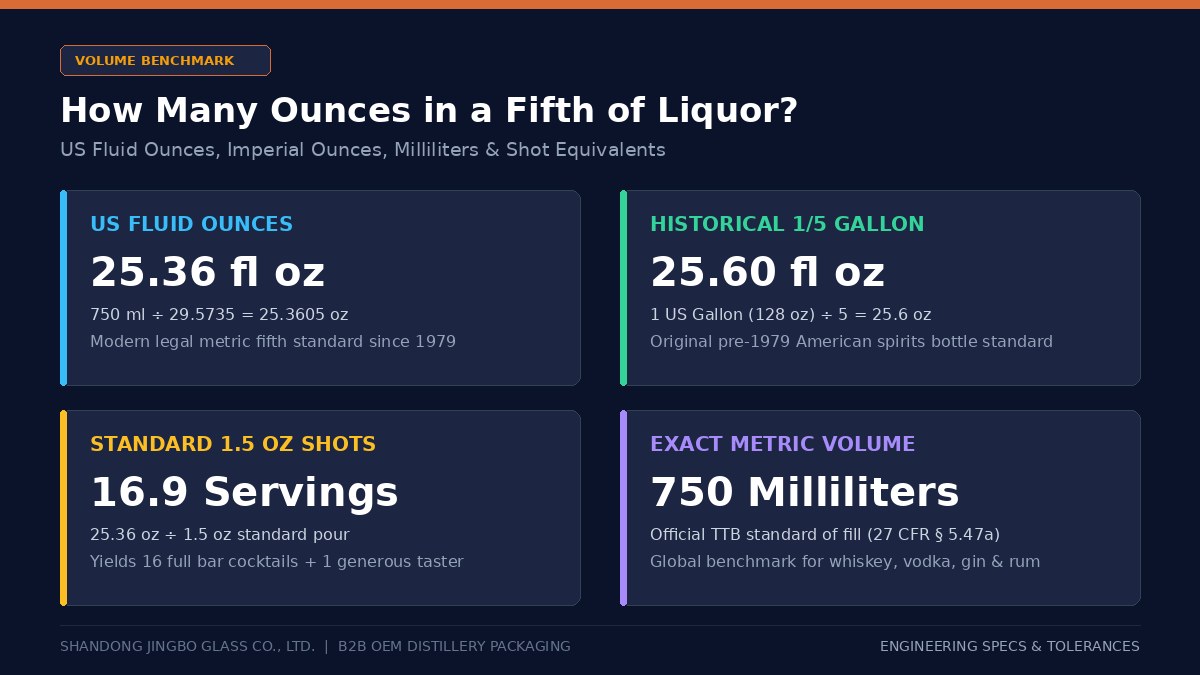
A modern standard “fifth” of liquor contains 25.36 US fluid ounces (fl oz), which equals exactly 750 milliliters (ml). On commercial bottle labels across the United States, federal TTB regulations require this to be declared as 750 mL (25.4 FL. OZ.).
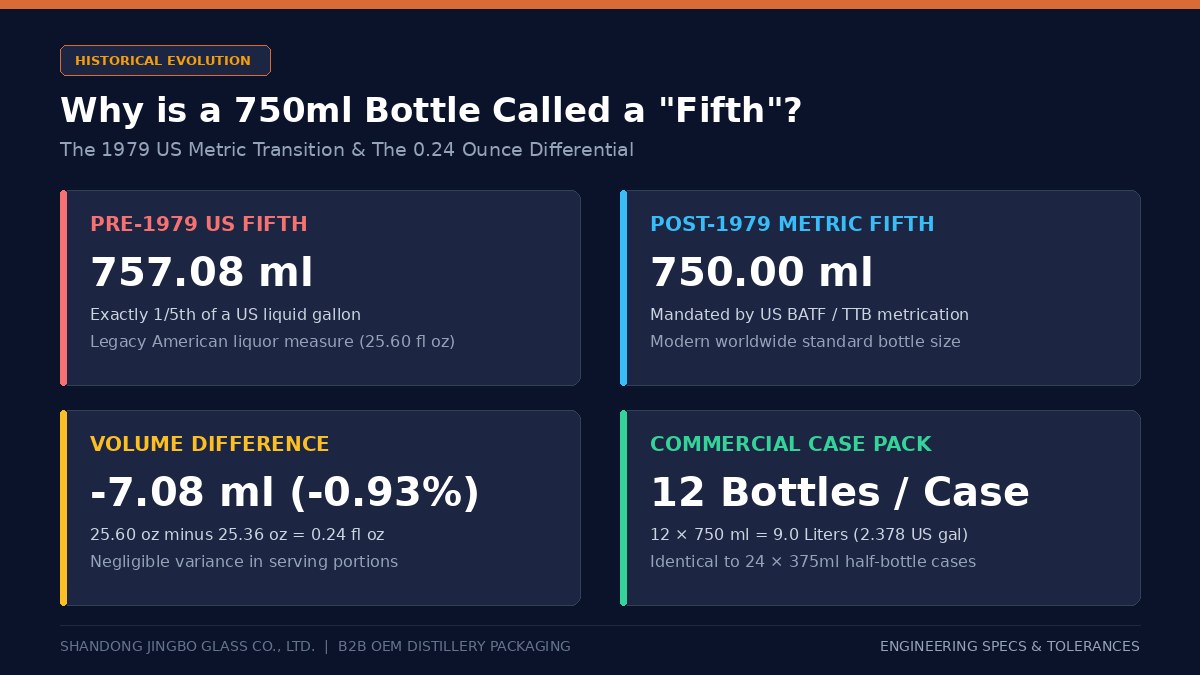
In practical bar service, a fifth delivers 16.9 standard 1.5-ounce shots (or approximately 17 drinks). Historically, before the 1979 US metric conversion, an American fifth was literally one-fifth of a US liquid gallon (128 oz ÷ 5), containing 25.60 fluid ounces (757.08 ml). Modern metric fifths are smaller by only 0.24 fluid ounces (7.08 ml)—a variance of less than 1%.
In the distilled spirits sector, few terminology quirks create as much operational curiosity as the word “fifth.” Whether you are a bar manager calculating pour-cost percentages, a spirits brand founder designing label proofs, or a master distiller setting up volumetric filling equipment, knowing the exact liquid geometry of a fifth is foundational.
As a container glass manufacturer operating high-precision IS (individual section) machines with over 18 years on the plant floor, we mold tens of millions of 750ml fifth bottles annually. Below is the definitive factory insider guide: mathematical conversion matrices, the fascinating historical shift from US gallons to metric liters, thermal headspace engineering, and master carton freight specifications.
1. Mathematical Breakdown: Modern 750ml Fifth to Ounces
Fluid ounces are defined differently under the US customary system and the British Imperial system. Using the wrong conversion factor can compromise international shipping declarations or distributor inventory logs:
- US Customary Fluid Ounces: 1 US fl oz = 29.5735295625 ml. Therefore:
750 ml ÷ 29.5735 = 25.3605 US fl oz. - UK Imperial Fluid Ounces: 1 Imperial fl oz = 28.4130625 ml. Therefore:
750 ml ÷ 28.4131 = 26.3963 UK fl oz. - Commercial Labeling Standard (TTB): Under Title 27 of the Code of Federal Regulations (27 CFR § 5.47a), distilled spirits bottles must declare nominal metric volume with optional fluid ounce equivalents rounded to one decimal place: “750 mL (25.4 FL. OZ.)”.
To cross-reference with other common spirits bottle capacities, review our industry benchmark Liquor Bottle Sizes Chart & Dimensions Guide and our specific guide on 375ml to oz conversion for half bottles.
| Capacity Measure | Exact Value | Commercial Rounding | Commercial Application |
|---|---|---|---|
| US Fluid Ounces (fl oz) | 25.3605 oz | 25.4 fl oz | Standard US distilled spirits label declaration |
| UK Imperial Fluid Ounces (UK oz) | 26.3963 oz | 26.4 fl oz | UK, Canada & Commonwealth trade specifications |
| Standard US 1.5 oz Shots | 16.9070 shots | 17 drinks | Bar inventory tracking & cocktail pour cost control |
| Cocktail Recipe 2.0 oz Pours | 12.6803 pours | 12.5 drinks | Neat / Rocks bourbon or double cocktail batching |
| Tasting Room 1.0 oz Flights | 25.3605 pours | 25 pours | Distillery visitor flight pours & festival sampling |
| Metric Volume | 750.00 ml | 0.750 L | Federal excise tax reporting basis ($13.50/proof gal) |
2. The Origin: Why Is a 750ml Bottle Called a “Fifth”?
The term “fifth” originated in late 19th-century America. Under historical federal statutes, selling distilled spirits in quantities smaller than one standard US gallon (128 fluid ounces) required commercial packaging partitions. Distillers began bottling liquor in vessels containing precisely one-fifth of a gallon (0.20 gallons):
📜 The 1979 Federal Metrication Transition
Before 1979, an American fifth contained:
On January 1, 1979, the Bureau of Alcohol, Tobacco, and Firearms (BATF, now the TTB) officially transitioned the United States spirits industry to the international metric system. To standardize global export containers, the legal standard of fill was set at 750 milliliters (25.36 fl oz).
The difference between the historical 1/5th gallon and the modern metric fifth is only 7.08 milliliters (0.24 fl oz), or less than one teaspoon of liquor. Because the bottle looked virtually indistinguishable on retail shelves and bar rails, consumers and bartenders continued calling the 750ml container a “fifth”—a term that has remained universal for nearly half a century.
3. Bar Operations: How Many Drinks Are in a Fifth?
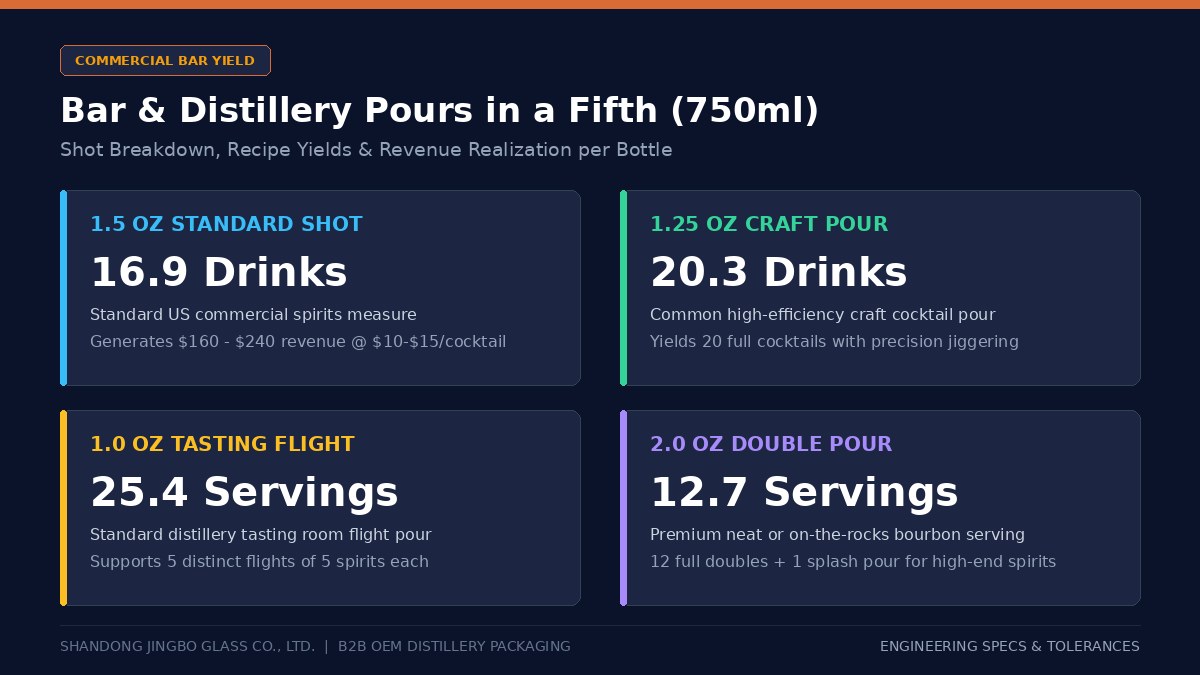
For on-premise hospitality operators and craft distilleries managing tasting room cocktail bars, understanding bottle yield directly drives profitability and loss prevention:
| Drink / Pour Format | Serving Size | Drinks per Fifth | Gross Revenue per Bottle ($12/Cocktail) |
|---|---|---|---|
| Standard US Shot (Jigger) | 1.5 fl oz (44.36 ml) | 16.9 drinks | $202.80 |
| Craft Cocktail Single | 1.25 fl oz (36.97 ml) | 20.3 drinks | $243.60 |
| High-Proof Bourbon Double | 2.0 fl oz (59.15 ml) | 12.7 drinks | $152.40 |
| Tasting Room Flight Pour | 0.75 fl oz (22.18 ml) | 33.8 pours | $236.60 (@ $7/flight sample) |
4. Container Engineering: 750ml Fifth Mold Dimensions & Headspace
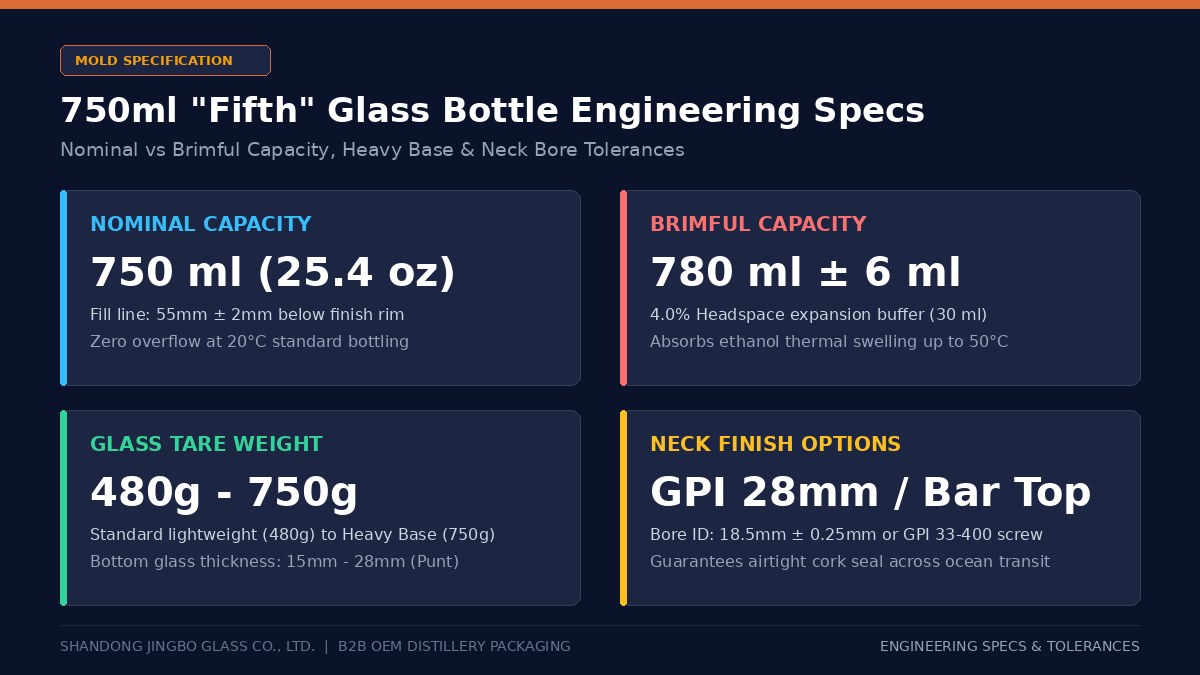
In glass container manufacturing, molding a 750ml fifth requires balancing structural rigidity, thermal shock resistance, and thermal expansion headspaces. A 750ml nominal capacity bottle is engineered with a brimful capacity of 780ml ± 6ml, providing a critical 30ml (4.0%) expansion buffer.
🔬 Headspace Volumetric Expansion Equation
Spirits with 40% ABV expand significantly when ambient shipping temperatures increase from 20°C (68°F) bottling hall temperatures to 48°C (118°F) inside sealed ocean shipping containers. The volume increase is calculated as:
Where:
V₀ = 750 ml
β = 0.00105 / °C (Thermal expansion coefficient of 40% ethanol solution)
ΔT = 28 °C (Temperature shift)
ΔV = 750 × 0.00105 × 28 = 22.05 ml volumetric expansion!
With an expansion of over 22 ml, a bottle with insufficient headspace will generate massive internal hydrostatic pressure, causing synthetic bar top corks to pop or fracturing the neck finish. That is why Shandong Jingbo Glass engineers all 750ml fifth molds with a fill point set at 55mm ± 2mm below the rim, providing at least 30ml of air headspace buffer.
| Engineering Parameter | Standard 750ml Fifth | Heavy Base Luxury Fifth | Manufacturing Tolerance |
|---|---|---|---|
| Nominal Fill Capacity | 750 ml (25.4 fl oz) | 750 ml (25.4 fl oz) | ± 6.0 ml at 20°C |
| Brimful Capacity | 780 ml | 785 ml | ± 7.0 ml |
| Overall Height (OAH) | 285 mm – 315 mm | 295 mm – 330 mm | ± 2.0 mm |
| Body Diameter | 76 mm – 82 mm | 78 mm – 86 mm | ± 1.5 mm |
| Glass Tare Weight | 480 g – 550 g | 650 g – 850 g (Heavy Punt) | ± 20 g |
| Bottom Thickness | 10 mm – 14 mm | 20 mm – 32 mm | Minimum 8.0 mm at center |
| Finish Standard | GPI 28mm Bar Top Cork | GPI 28mm Bar Top / GPI 33-400 | Bore ID: 18.5 mm ± 0.25 mm |
| Annealing Lehr Curve | 540°C → 85°C in 45 min | 550°C → 80°C in 65 min | Grade 2 Polariscopic Residual Stress |
5. Packaging & Pallet Logistics: The 12-Pack Case Standard
In wholesale distillery supply, 750ml fifth bottles are universally packaged in 12-bottle partitioned master cartons. A 12-pack contains exactly 9.0 liters (2.378 US gallons) of finished liquor, standardizing alcohol excise accounting across federal and state reporting tiers.
Key logistics benchmarks for 750ml fifth cases include:
- Master Carton Dimensions: 340 mm (L) × 260 mm (W) × 325 mm (H) with 200# test double-wall corrugated partitions.
- Pallet Configuration: 56 cases per standard 40×48 inch GMA pallet (14 cases per tier × 4 tiers high), delivering 672 bottles per pallet.
- Ocean Container Payload: A standard 40-foot High Cube (HQ) container holds 20 pallet positions (1,120 cases / 13,440 fifth bottles).
For procurement directors seeking competitive bulk glass packaging, inspect our dedicated Glass Liquor Bottles Wholesale resource, our technical report on Custom Glass Bottle Design & Tooling, and our deep-dive into Chemical Acid Etching vs Sandblasting Frosting.
Sourcing Custom 750ml “Fifth” Glass Bottles?
Shandong Jingbo Glass manufactures crystal-white high flint 750ml spirits bottles for top distilleries worldwide. With hundreds of ready-to-ship stock molds and full private mold tooling services, we offer low MOQs and dedicated engineering support.
Frequently Asked Questions: Fifth of Liquor (750ml)
How many ounces is a fifth of liquor?
A modern fifth of liquor contains exactly 25.36 US fluid ounces, which equals 750 milliliters. On United States commercial liquor labels, this is officially rounded and declared as 750 mL (25.4 FL. OZ.).
Why is a 750ml bottle called a fifth?
The name originates from the late 19th century when standard American spirits bottles held exactly one-fifth of a US liquid gallon (128 oz ÷ 5 = 25.60 fl oz). When the US converted to the metric system in 1979, the bottle was standardized to 750ml (25.36 fl oz). The 0.24 oz difference was so small that consumers and distillers continued using the traditional term “fifth.”
How many shots can you get from a fifth of liquor?
A standard 750ml fifth yields 16.9 standard 1.5-ounce shots. In practical bar service, bartenders estimate approximately 17 single cocktails or 12 to 13 double pours (2.0 oz each) per bottle.
What is the difference between a fifth and a 750ml bottle?
In modern usage, there is no difference—they refer to the exact same bottle size. “750ml” is the legal metric volume, while “fifth” is the traditional American industry term for that capacity.
How many fifths come in a standard case of liquor?
A standard wholesale case of 750ml fifth bottles contains 12 bottles. The total liquid volume in a 12-pack case is 9.0 liters (2.378 US gallons), which is also the exact same volume as a 24-pack case of 375ml half-bottles.