

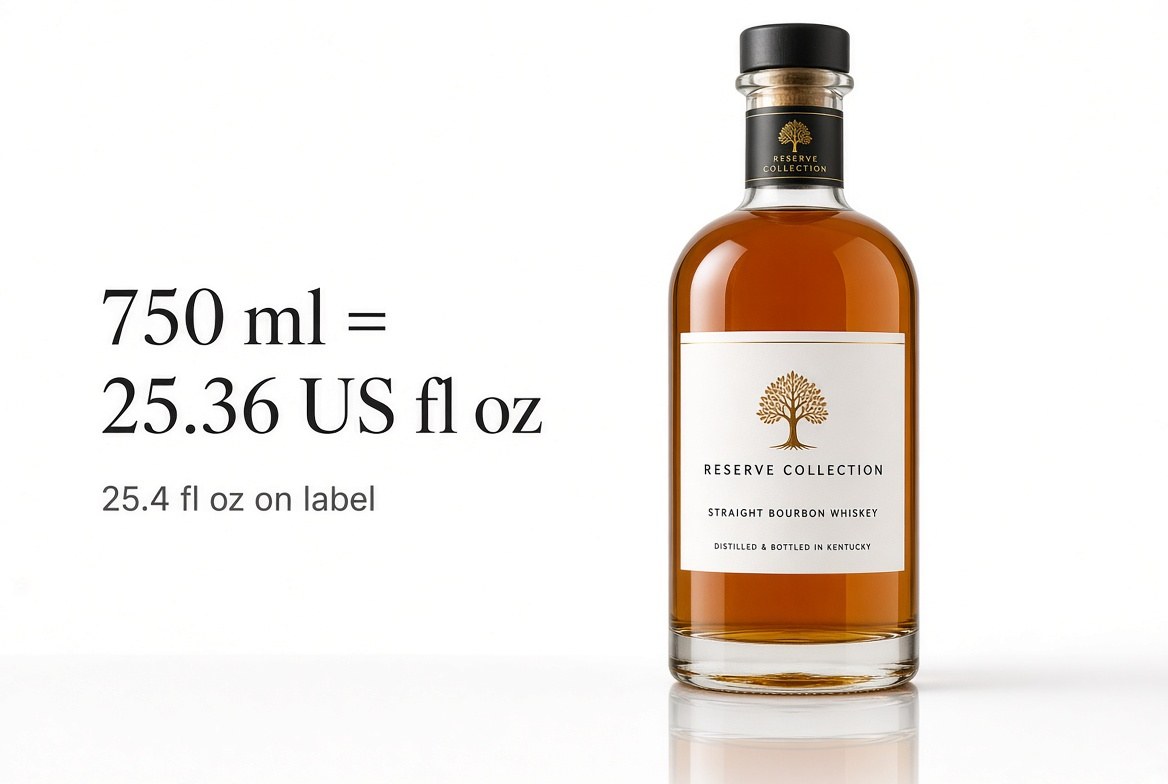
If you are wondering how many ounces in 750 ml, a standard 750 milliliter bottle contains exactly 25.36 US fluid ounces (25.3605 fl oz). In the British Imperial measurement system, 750 ml converts to 26.40 Imperial fluid ounces. Whether you are a craft spirits distiller calculating bottle fill line tolerances, a beverage director budgeting cocktail pour costs, or a procurement manager ordering container-load packaging from a wholesale glass liquor bottle manufacturer, knowing the exact how many ounces in 750 ml ratio is essential for legal compliance and operational margin control.
Quick Answer: How Many Ounces in 750 ml?
• 750 ml in US Fluid Ounces: 25.36 fl oz (Exact formula: 750 ÷ 29.573529)
• 750 ml in UK Imperial Ounces: 26.40 Imperial fl oz (Exact formula: 750 ÷ 28.413063)
• Standard US Shots (1.5 oz pour): Exactly 16.9 shots per 750 ml bottle
• Standard Cocktail Pours (2.0 oz pour): Exactly 12.6 full drinks
• Standard Wine Servings (5.0 oz glass): Exactly 5 full 5-oz glasses
How Many Ounces in 750 ml: Mathematical Derivation & Ounce Systems
When asking how many ounces in 750 ml, confusion often arises because the United States and the United Kingdom historicized two distinct volumetric definitions for the term “fluid ounce.” Crucially, fluid ounces measure volumetric liquid capacity, whereas dry ounces (avoirdupois) measure gravimetric mass.
According to the US National Institute of Standards and Technology (NIST), one US Customary fluid ounce is legally set at exactly 29.5735295625 milliliters. Performing the conversion:
750 ml ÷ 29.573529 = 25.360517 US Fluid Ounces
Standardized commercially on spirit bottle labels to 25.36 fl oz.
In contrast, the British Imperial fluid ounce is derived from the volume occupied by one imperial ounce of water at 62°F, which equates to 28.4130625 milliliters. Calculating for international export shipments:
750 ml ÷ 28.413063 = 26.396316 Imperial Fluid Ounces
Commercially rounded to 26.40 Imperial fl oz.
Consequently, when British bartenders or European distillers convert 750 ml, their imperial calculation registers approximately one fluid ounce higher than the American figure, despite dispensing the identical volume of ethanol.
Why Is 750 ml Known as a “Fifth” in American Distilling Culture?
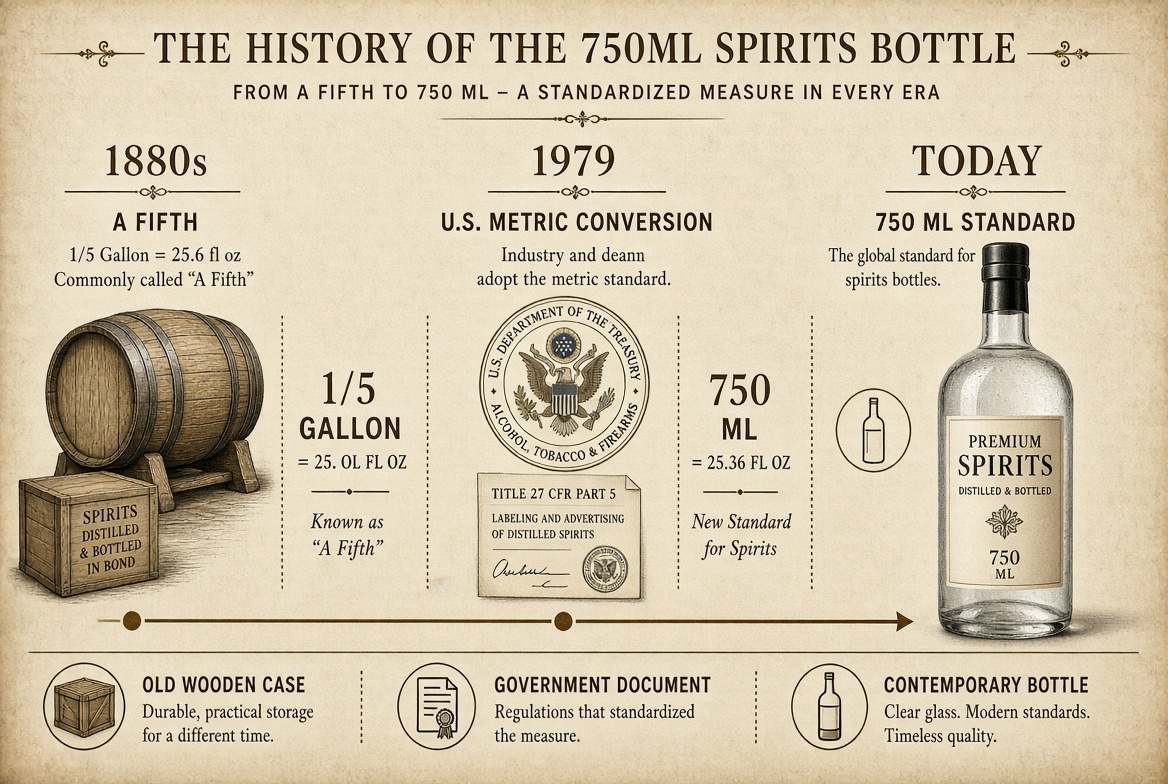
In North American retail and wholesale trade, a 750 ml bottle is universally referred to as a “Fifth.” To understand why, one must look back to 19th-century commercial liquor laws in the United States.
Prior to federal metrication, commercial whiskey and spirits were regulated by the gallon. However, buying an entire US gallon (128 fl oz) was cost-prohibitive for average tavern patrons. Distillers began bottling in containers holding precisely one-fifth of a gallon (four-fifths of a US quart), which equaled 25.6 US fluid ounces (757.08 milliliters).
In 1979, the Bureau of Alcohol, Tobacco, and Firearms (now the TTB) passed federal regulations under 27 CFR Part 5 mandating that all distilled spirits packaging adopt the metric system. Federal authorities selected 750 ml (25.36 fl oz) as the statutory standard of fill because it was within 0.9% of the traditional 25.6 oz Fifth. As examined in our study of American whiskey brand packaging secrets, this size remains the undisputed sales backbone of Kentucky bourbon, Tennessee whiskey, and rye spirits.
Comprehensive Spirits Bottle Conversion & Commercial Pour Yields
Whether formulating a new spirits line or auditing wholesale glass inventory, reference this master matrix comparing volume in milliliters, US fluid ounces, and commercial bar pour yields:
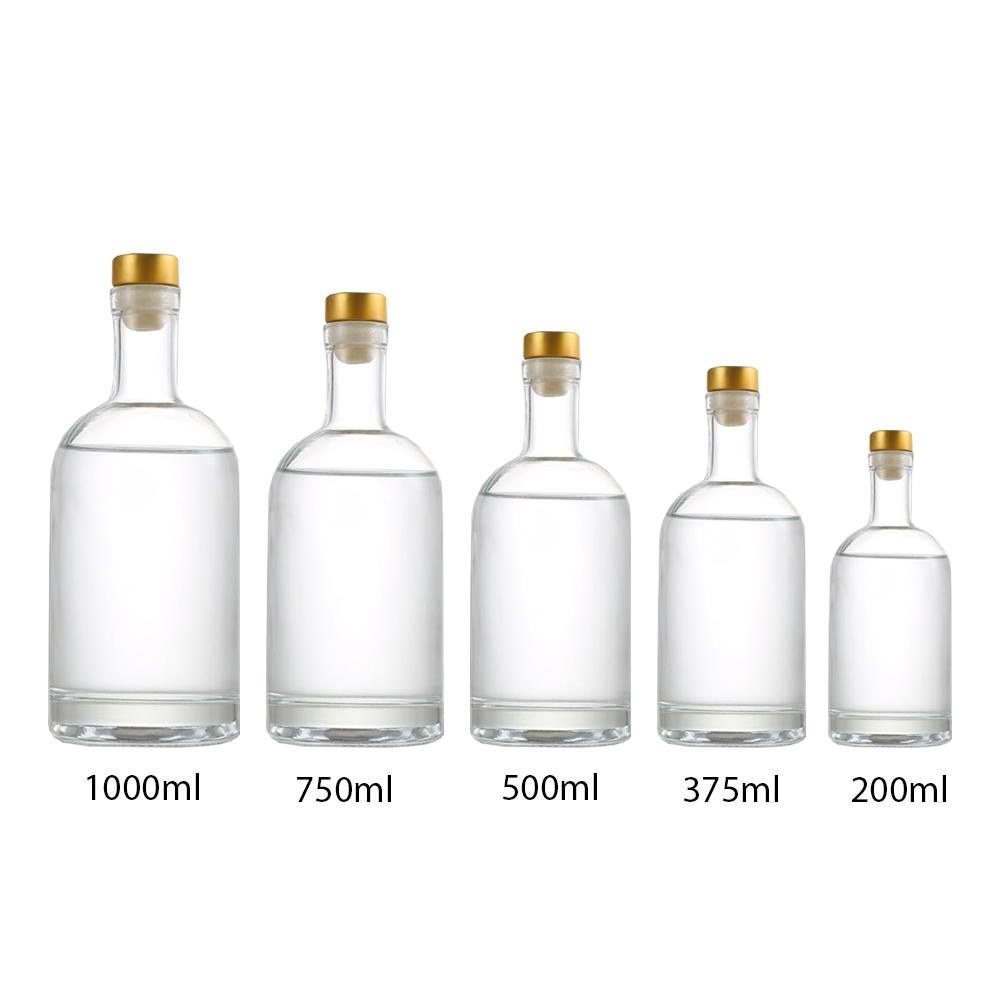
| Metric Bottle Size | US Fluid Ounces | Imperial Ounces | 1.5 oz Standard Shots | Industry Role & Packaging Type |
|---|---|---|---|---|
| 50 ml | 1.69 fl oz | 1.76 fl oz | 1.1 shots | Miniature / Hotel minibar / Airline sampler |
| 200 ml | 6.76 fl oz | 7.04 fl oz | 4.5 shots | Pocket flask / Tasting gift pack / Half-pint |
| 375 ml | 12.68 fl oz | 13.20 fl oz | 8.4 shots | Demi / Pint equivalent / Premium craft sampler |
| 700 ml | 23.67 fl oz | 24.64 fl oz | 15.8 shots | European & UK statutory standard; TTB approved |
| 750 ml | 25.36 fl oz | 26.40 fl oz | 16.9 shots | US Standard Spirits Fifth / Global Wine Benchmark |
| 1,000 ml (1 L) | 33.81 fl oz | 35.20 fl oz | 22.5 shots | Travel retail duty-free / Speed rail bar pouring |
| 1,750 ml (1.75 L) | 59.17 fl oz | 61.59 fl oz | 39.4 shots | Handle / High-volume commercial value pack |
For international distillers balancing export compliance, compare this data directly with our technical guide on 700 ml to oz conversion and European spirit packaging regulations, as well as our foundational engineering analysis on 750 ml to oz conversion factors.
Engineering Reality: Nominal 750 ml vs. Brimful Headspace (Ullage)
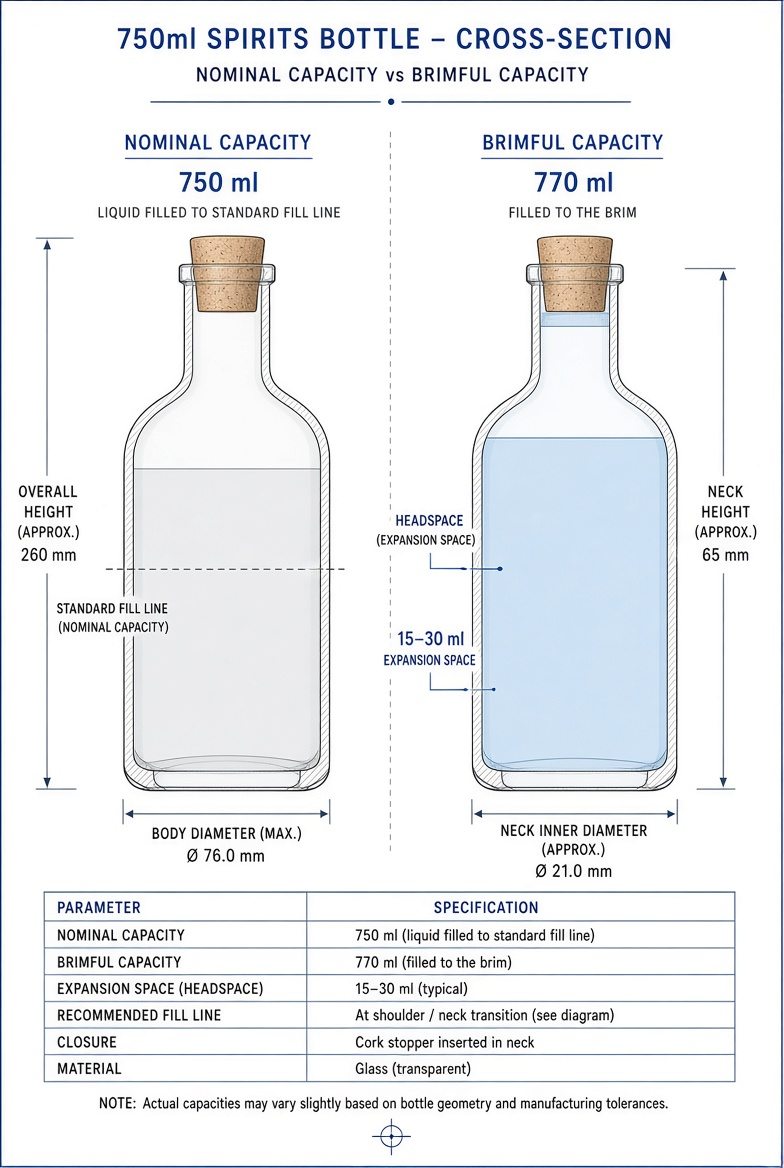
When custom tooling a glass mould, packaging designers often assume that a 750 ml bottle cavity should hold exactly 750 ml of liquid. In industrial glass bottle manufacturing, designing a mould with zero headspace creates a catastrophic failure risk.
Nominal capacity represents the legal commercial volume (750 ml / 25.36 fl oz) filled at a standardized temperature of 20°C (68°F). However, high-proof spirits expand significantly as ambient temperature fluctuates. Specifically, ethanol has a volumetric thermal expansion coefficient of approximately 0.001 per °C. During summer shipping in non-climate-controlled ocean freight containers, internal container temperatures routinely surpass 45°C (113°F). This 25°C temperature rise causes 750 ml of liquid to expand by 18 to 22 milliliters.
Additionally, inserting a standard synthetic or natural bar-top T-cork (18.5mm bore) displaces between 6 ml and 9 ml of liquid upon sealing. If the bottle lacks adequate air headspace (ullage), internal hydrostatic pressure spikes dramatically, pushing corks out of the neck finish or causing glass fracture along the bottle shoulder.
At Shandong Jingbo Glass, our CAD engineers specify a brimful capacity of 775 ml to 785 ml (26.2 to 26.5 fl oz) for all custom 750ml spirits moulds. This 25ml to 35ml vacuity ensures a reliable 3.5% to 5.0% thermal cushion, maintaining airtight hermetic seals from sub-zero winter freight down to tropical export docks.
How to Source 750 ml Glass Bottles at Factory-Direct Wholesale Rates
For growing distilleries and beverage brands scaling up production, transitioning from local packaging distributors to direct manufacturing unlocks substantial cost savings. When evaluating wholesale glass liquor bottle suppliers, verify the following core manufacturing criteria:
• Glass Optical Clarity: Require Super Crystal Flint Glass formulated from ultra-low iron silica to eliminate greenish or yellowish tints, ensuring your amber bourbon, clear vodka, or dark rum displays true color brilliance.
• Solid Base Thickness: Premium 750ml bottles typically feature a weighted 18mm to 28mm solid base (600g to 850g total bottle weight), conveying top-shelf luxury in the consumer’s hand.
• Lehr Annealing Quality: Insist on certified ASTM C148 polarized light stress testing to verify complete thermal stress relief through the 540°C–580°C annealing lehr zone, as detailed in our guide on glass bottle annealing temperature and thermal shock resistance.
Ready to Source Custom 750ml Glass Liquor Bottles?
Shandong Jingbo Glass Co., Ltd. is an ISO 9001 certified manufacturer offering 1,900+ ready-to-run spirits moulds, custom 3D mould tooling, fast 7-day prototyping, and worldwide container shipping for craft distilleries.
Request a Factory Feasibility Quote