

Plant Director’s Quick Answer: Wholesale Vodka Bottles
Wholesale Procurement Benchmarks: Sourcing wholesale vodka glass bottles directly from a primary manufacturing furnace requires choosing between Tall Slender Cylinders (550g–600g, 31.5mm ROPP or bar-top finish, optimized for 120+ bpm filling speeds) and Heavy Nordic Craft Decanters (850g–920g, 20mm–24mm thick solid base punt, low-profile craft styling).
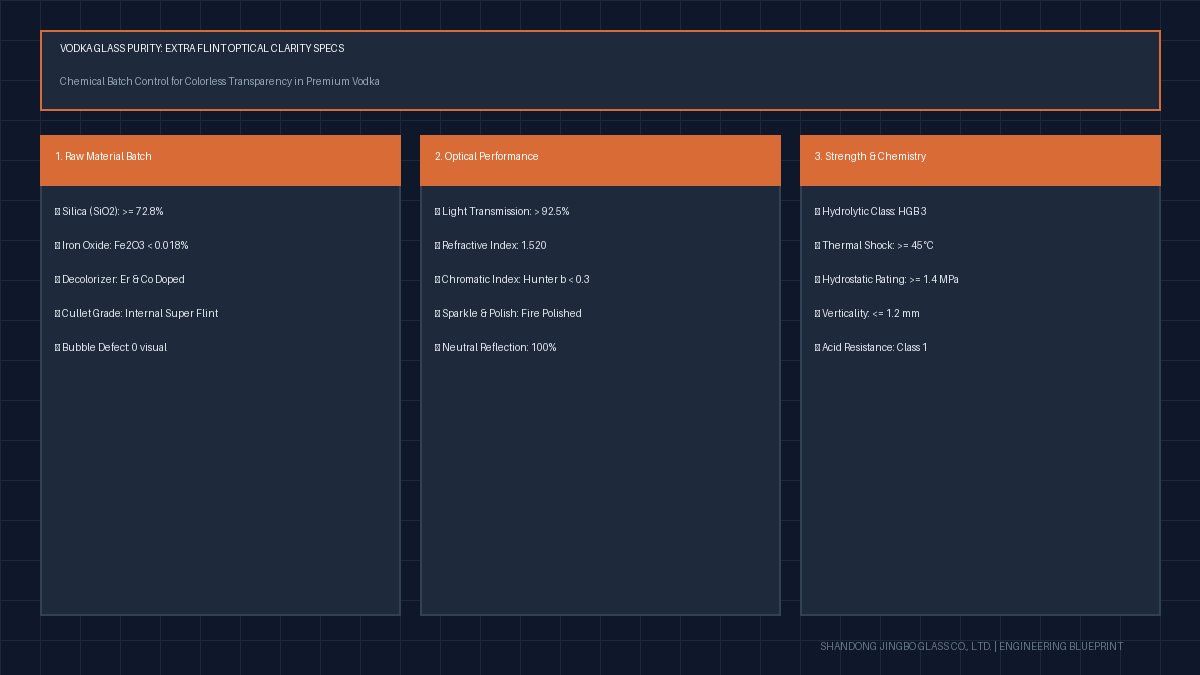
Optical & Engineering Redlines: Because vodka is a clear, unaged spirit, any glass tinting or bubble defects immediately degrade retail perception. Bottles must be melted with Super Flint (Extra Flint) glass (Fe2O3 < 0.018%, light transmission > 92.5%, Hunter b chromatic index < 0.3). Production MOQs start from 3,000–5,000 units for ready stock molds, and 10,000 units for custom CNC private molds.
The Neutral Spirit Imperative: Why Vodka Demands Ultra-Pure Super Flint Glass
Unlike whiskey, dark rum, or añejo tequila, unaged vodka contains zero cask tannins, caramel coloring, or wood particulates to mask container imperfections. The liquid inside is water-white, brilliantly clear, and visually unforgiving. If a distillery bottles premium neutral grain spirit or artisanal potato vodka in commercial glass containing residual iron contamination, the spirit appears dull, murky, or slightly greenish under bar downlighting.
In glass furnace chemistry, ordinary packaging glass (often termed High White or Soda-Lime Flint) permits iron oxide levels up to 0.04%–0.06%. While acceptable for beer or table wine, it destroys the pure refractive brilliance demanded by super-premium vodka brands. At Shandong Jingbo Glass, our dedicated vodka production lines utilize Super Flint (Crystal Flint) batch metallurgy:
- Iron Oxide Limitation: Fe2O3 is strictly controlled below 0.018% through the use of washed, low-iron quartz sands from certified domestic deposits.
- Erbium & Cobalt Decolorizing: Micro-dosed rare-earth decolorizers neutralize trace yellow wavelengths, delivering a Hunter colorimetric b-value under 0.3.
- Optoelectronic Laser Sorting: Every bottle passing through the cold end is scanned by multi-angle optoelectronic cameras that reject micro-seeds, blisters, and cord lines larger than 0.3 mm.
If your brand also bottles aged spirits, you can compare these flint purity standards in our deep-dive analysis of custom glass whiskey bottles and our comprehensive liquor bottle sizes chart and dimension guide.
Dimensional Standards & Bottle Geometries: Slender Tall Cylinders vs. Heavy Base Nordic Carafes
Vodka packaging design splits into two distinct visual identities, each dictating specific bottling line conveyor setup and pallet stacking parameters:
1. Iconic Tall Slender Cylindrical Bottles
Pioneered by classic Polish and Russian heritage brands, the tall cylindrical silhouette (height: 305–320 mm, diameter: 72–76 mm) conveys purity, frost, and vertical architectural elegance. The extended cylindrical body provides a massive continuous billboard panel for multi-color ceramic screen printing or full-height frosted acid baths. From a packaging engineering standpoint, the high aspect ratio (height-to-diameter ratio > 4.0) requires precise mold air evacuation to maintain sidewall verticality within ±1.2 mm, preventing bottle wobble on high-speed depalletizers.
2. Heavy Nordic Craft Decanters
Modern craft distillers focusing on botanical distillations and organic grain spirits increasingly choose squat, broad-shouldered Nordic carafes (height: 235–250 mm, diameter: 86–90 mm). These bottles feature a massive 20mm to 24mm solid glass base and a low center of gravity. Blown on press-and-blow forming machinery, they provide supreme weight in hand (850g to 920g finished weight) and superior thermal shock resistance (ΔT ≥ 45°C) during freezer chilling before serving.
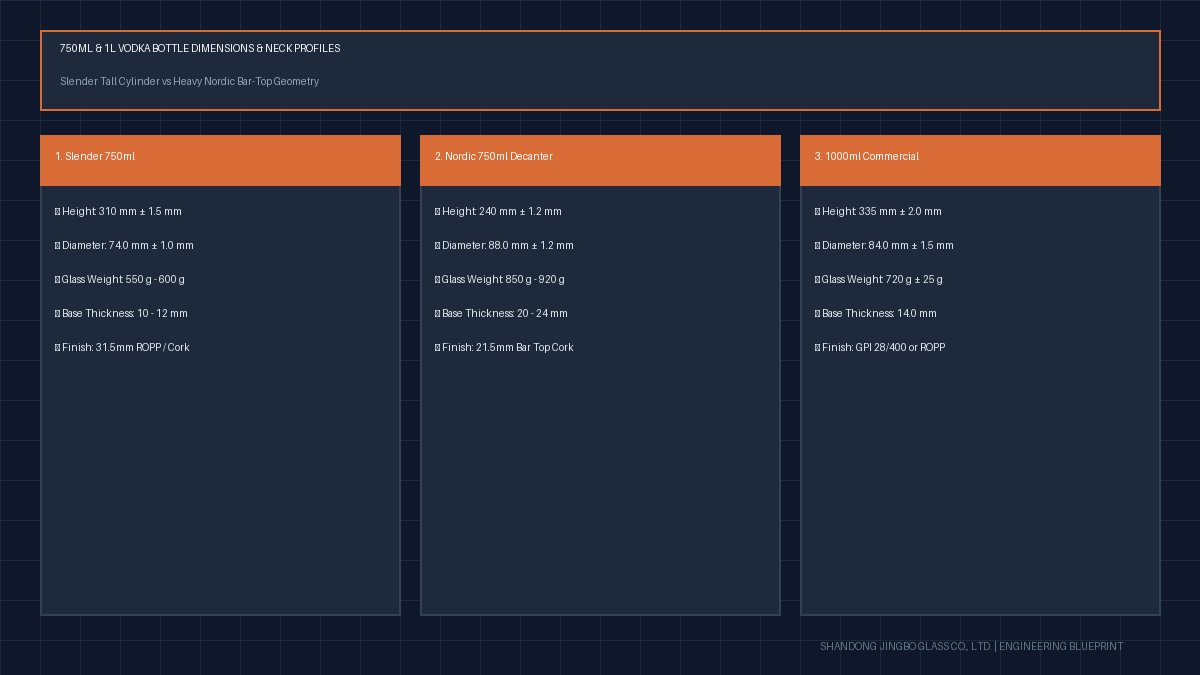
Engineering Specification Comparison Table: Wholesale Vodka Bottle Profiles
To assist packaging engineers and contract bottling managers, the table below compares technical dimensions, line speeds, and weight tolerances across our primary wholesale vodka container profiles:
| Engineering Spec | 750ml Tall Slender Cylinder | 750ml Nordic Heavy Base Decanter | 1000ml Commercial Well Bottle |
|---|---|---|---|
| Nominal Volume | 750 ml (25.36 fl oz) | 750 ml (25.36 fl oz) | 1,000 ml (33.81 fl oz) |
| Brimful Volume | 780 ml ± 5 ml | 785 ml ± 5 ml | 1,040 ml ± 8 ml |
| Finished Glass Weight | 580 g ± 15 g | 880 g ± 25 g | 720 g ± 25 g |
| Total Height | 310.0 mm ± 1.5 mm | 240.0 mm ± 1.2 mm | 335.0 mm ± 2.0 mm |
| Body Diameter | 74.0 mm ± 1.0 mm | 88.0 mm ± 1.2 mm | 84.0 mm ± 1.5 mm |
| Base Glass Thickness | 12.0 mm | 22.0 mm | 14.0 mm |
| Closure Finish | 31.5mm ROPP or 21.5mm Cork | 21.5mm Bar Top Cork | GPI 28/400 or 31.5mm ROPP |
| Thermal Shock (ΔT) | ≥ 45°C | ≥ 45°C | ≥ 42°C |
| Max Line Speed | 140 bpm | 80 bpm | 120 bpm |
| Pallet Quantity | 1,296 btls / pallet | 1,008 btls / pallet | 1,056 btls / pallet |
For operations bottling agave or sugarcane spirits alongside grain spirits, see our companion guides on wholesale tequila bottles and rum bottle packaging design.
Hydraulic Line Pressure & Neck Concentricity Dynamics
High-speed commercial vodka bottling lines operate at 100 to 160 bottles per minute. In automated rotary filling carousels, bottles experience rapid downward nozzle sealing pressure followed by centrifugal acceleration on discharge starwheels.
F_topload ≥ P_capping × A_neck + F_safety
Where:
• P_capping (Automated ROPP / Cork Sealing Pressure) = 1.2 MPa
• A_neck (Cross-Sectional Glass Area of 31.5mm Neck) ≈ 280 mm²
• Downward Force Applied = 336 N (approx. 34.2 kgf)
• Factory Minimum Certified Top-Load Rating: ≥ 2,500 N (≥ 255 kgf)
To eliminate neck splitting or shoulder crushing under automated cording equipment, all Shandong Jingbo vodka bottles are annealed with continuous wall thickness gradients (≥ 3.2 mm sidewall minimum) and certified to withstand vertical top-loads exceeding 2,500 N. Neck concentricity is verified to within 0.5 mm Total Indicator Reading (TIR), ensuring filling nozzles enter the bore smoothly without striking glass finishes.
Secondary In-House Decoration: Ceramic Screen Printing & Acid Frosting
Vodka bottles frequently forgo traditional paper labels in favor of direct-to-glass decoration that will not wrinkle or peel inside ice buckets or commercial bar freezers:
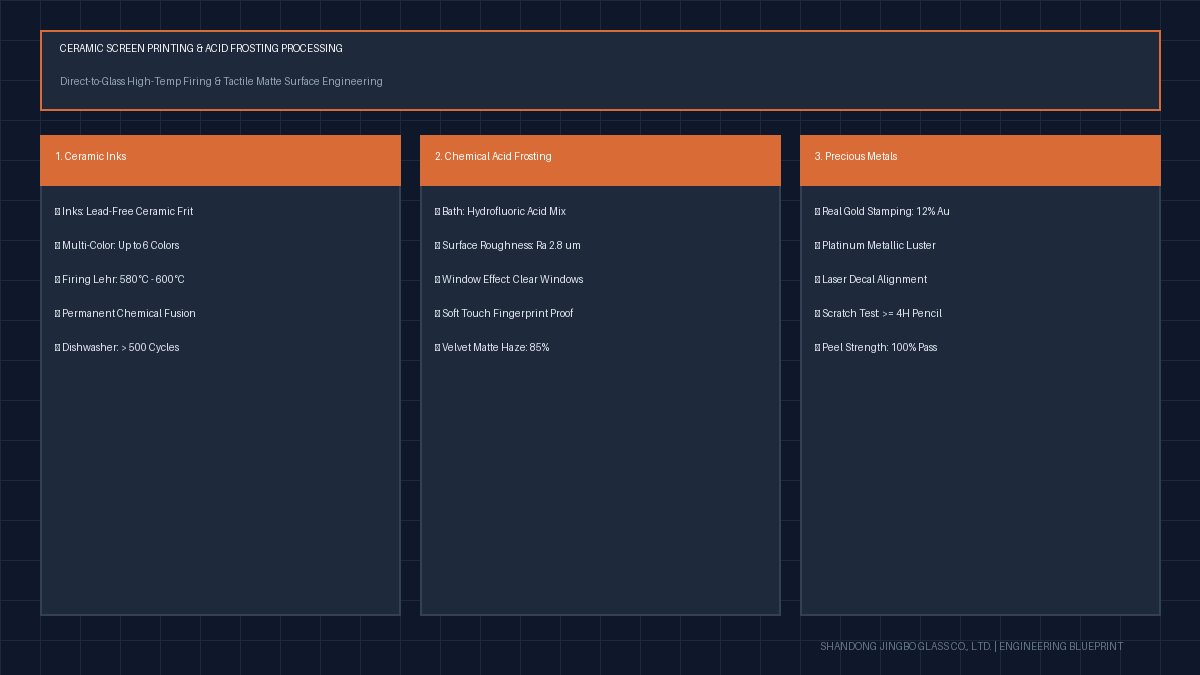
1. High-Temperature Ceramic Screen Printing (Fired at 580°C)
We operate fully automated multi-color screen printing machines capable of laying down up to 6 ceramic ink colors in a single pass. Unlike UV organic inks that scratch off under rough handling, our ceramic enamel frit fuses directly into the glass matrix inside an 8-meter decorating lehr heated to 580°C–600°C. The artwork becomes an integral part of the bottle, impervious to alcohol solvents, scratch tests (≥ 4H pencil hardness), and commercial bar dishwashers exceeding 500 wash cycles.
2. Full-Body Acid Etched Frosting & Clear Window Masking
To create the frosted ice effect synonymous with Nordic and Slavic vodkas, bottles are immersed in automated acid etching baths that chemically micro-corrode the silica surface to an average roughness of Ra 2.4 to 3.2 μm. By applying protective peelable vinyl masks prior to etching, we create crystal-clear optical viewing windows on the front or rear panels, allowing consumers to look through frosted glass into the liquid. To learn more about etching chemistry, read our technical article on glass bottle frosting and surface etching.
Seaworthy Master Cartons & Bulk Ocean Container Logistics
Delivering pristine vodka glass across long ocean freight voyages requires rigorous logistics engineering:
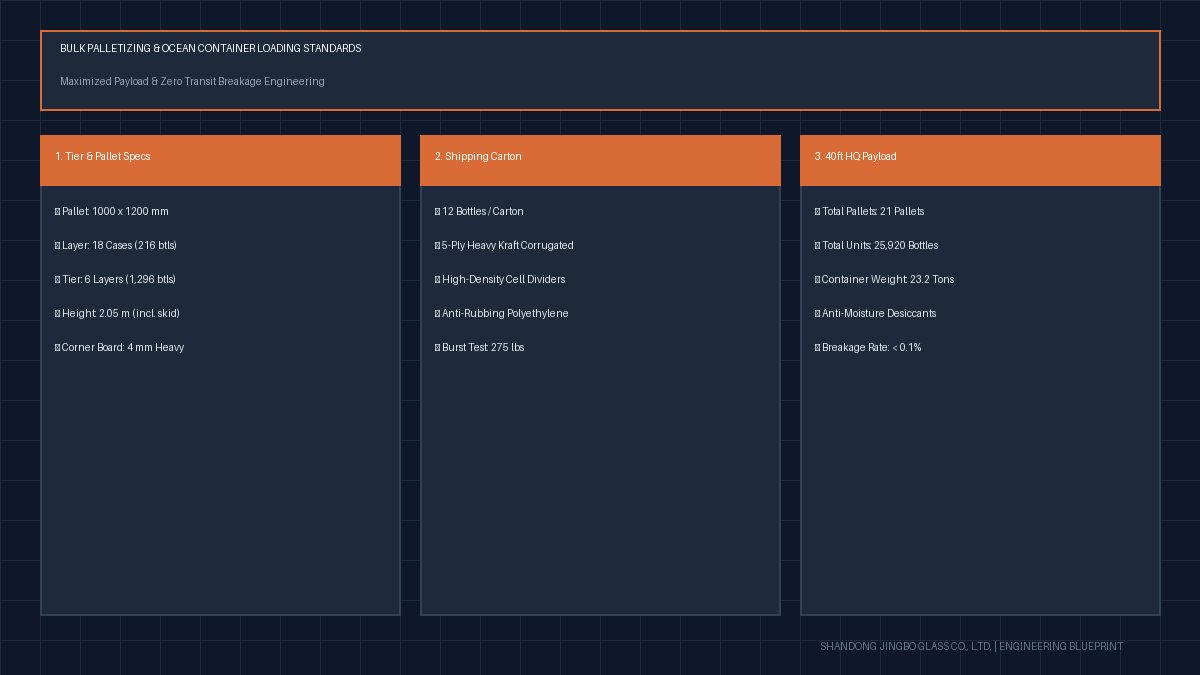
- 5-Ply Heavy Export Cartons: 275 lbs burst-test corrugated master cartons fitted with full-height double-wall cell partitions. Every bottle remains completely isolated to prevent glass-to-glass friction during sea transit.
- Bulk Pallet Stacking Efficiency: Tall cylindrical 750ml bottles are packed 18 cases per layer, 6 layers high (1,296 bottles per pallet) on heat-treated 1000 × 1200 mm export skids. Pallets are secured with 4 mm heavy cardboard edge angle protectors and machine-wrapped in 7 layers of stretch film.
- 40ft High Cube Container Utilization: A 40ft HQ container carries 21 full pallets (25,920 bottles, 23.2 metric tons gross weight). Every container is lined with container desiccants and moisture-barrier floor liners to prevent maritime humidity damage. Average transit breakage remains certified below 0.1%.
Frequently Asked Questions: Wholesale Vodka Bottles & Custom Tooling
What is the minimum order quantity (MOQ) for wholesale vodka glass bottles?
Will direct ceramic screen printing withstand freezer storage and ice buckets?
Can you supply matching 31.5mm aluminum ROPP caps and bar-top corks?
How do you ensure zero color tinting in unaged vodka bottles?
Request Factory Direct Wholesale Pricing & Free Samples
Are you scaling a high-volume vodka brand or launching an artisanal craft expression? Contact our engineering team with your volume targets, closure requirements, or CAD concepts for instant factory direct quotations, mold engineering reviews, and free physical sample sets.
Contact Glass Engineering Team