

Plant Director’s Quick Answer: Rum Bottle Packaging
Structural Packaging Criteria: Commercial rum bottle packaging spans two primary categories: Standard High-Speed Cylindrical Bottles (600g–650g, continuous GPI 28/400 or GPI 33/400 screw caps, filling speeds up to 120 bpm) and Super-Premium Craft Decanters (850g–980g, 18mm–24mm heavy base punt, 21.5mm ±0.25mm bar-top synthetic cork finish).
Distillery Engineering Requirements: High-ester and overproof craft rums (54% to 69% ABV) demand chemical-resistant barrier liners (PTFE or Saranex-faced closures) to eliminate aromatic terpene absorption, extra brimful headspace (35ml–40ml) to mitigate thermal hydraulic expansion during tropical transit, and Super Flint glass purity (Fe2O3 < 0.020%) to showcase rich mahogany and amber aging hues.
The Craft Rum Renaissance: Why Premium Packaging Commands Higher Retail Shelves
The global rum sector is undergoing a rapid structural transformation mirroring the single-malt scotch and bourbon booms. Historically pigeonholed as a low-cost commodity spirit destined for blending with colas, rum has emerged as an artisanal powerhouse. Discerning consumers and spirit collectors actively seek out single-cask expressions, pot-still agricultural rums (rhum agricole), and long-aged solera rums with complex flavor profiles.
For independent distilleries and blender brands, this premiumization shift creates an immediate packaging challenge: how to break away from generic commercial bottles and signal luxury pedigree at first glance. A dark aged rum aged for twelve years in ex-cognac casks demands glass that conveys weight, heritage, and uncompromising craftsmanship. In this eighteen-year glass plant guide, we break down the engineering fundamentals behind custom rum bottle packaging—from heavy base forming to neck bore sealing mechanics and CNC relief embossing.
If your distillery portfolio also includes agave spirits, make sure to read our companion engineering guide on wholesale tequila glass bottles and cork finishes, or explore our technical analysis of custom glass whiskey bottles.
Silhouette Engineering: Caribbean Cylindrical Bottles vs. Heavy Base Decanters
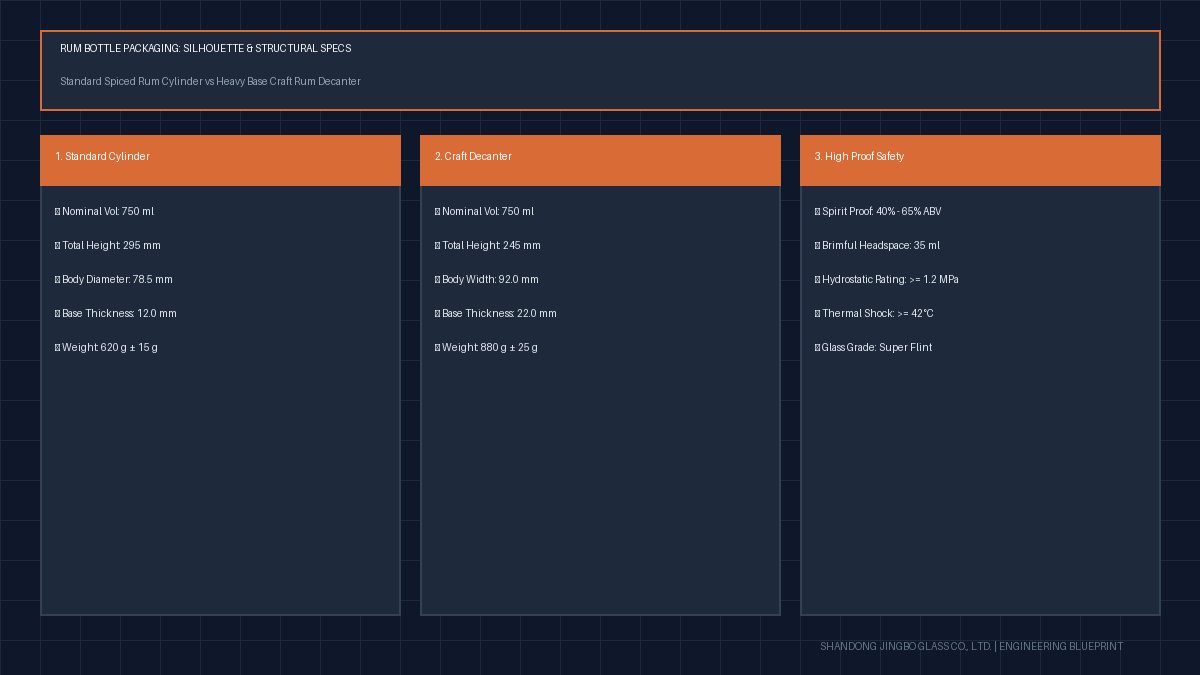
When engineering a rum bottle silhouette, container physics and filling line mechanics dictate wall thicknesses, center of gravity, and label panel design. Distillers primarily choose between two structural formats:
1. Traditional Caribbean Cylindrical Profiles
Classic nautical and Caribbean rums often utilize tall, round cylindrical profiles (height: 290–305 mm, diameter: 76–80 mm). These bottles offer high conveyor stability and continuous 360-degree cylindrical label panels ideal for high-speed wrap-around paper or pressure-sensitive labeling lines. Because the cylindrical shape distributes internal hydrostatic stress evenly, finished bottle weights can be engineered between 580g and 650g, lowering ocean freight expenses while maintaining excellent mechanical impact resistance.
2. Heavy Base Craft Rum Decanters & Carafes
For reserve releases and XO expressions, distillers increasingly favor squat decanters, conical carafes, or oval silhouettes featuring an unmistakable 18mm to 24mm solid glass base. A low center of gravity provides immense tactile presence in hand and prevents tip-overs on rocking ship bars or crowded tavern shelves. However, thick bottom plates require our press-and-blow forming machines to maintain precise blank mould timing, preventing vacuum sinks or cold wrinkles on the base surface.
Closure Mechanics: 21.5mm Bar-Top Synthetic Corks vs. Continuous Thread GPI Standards
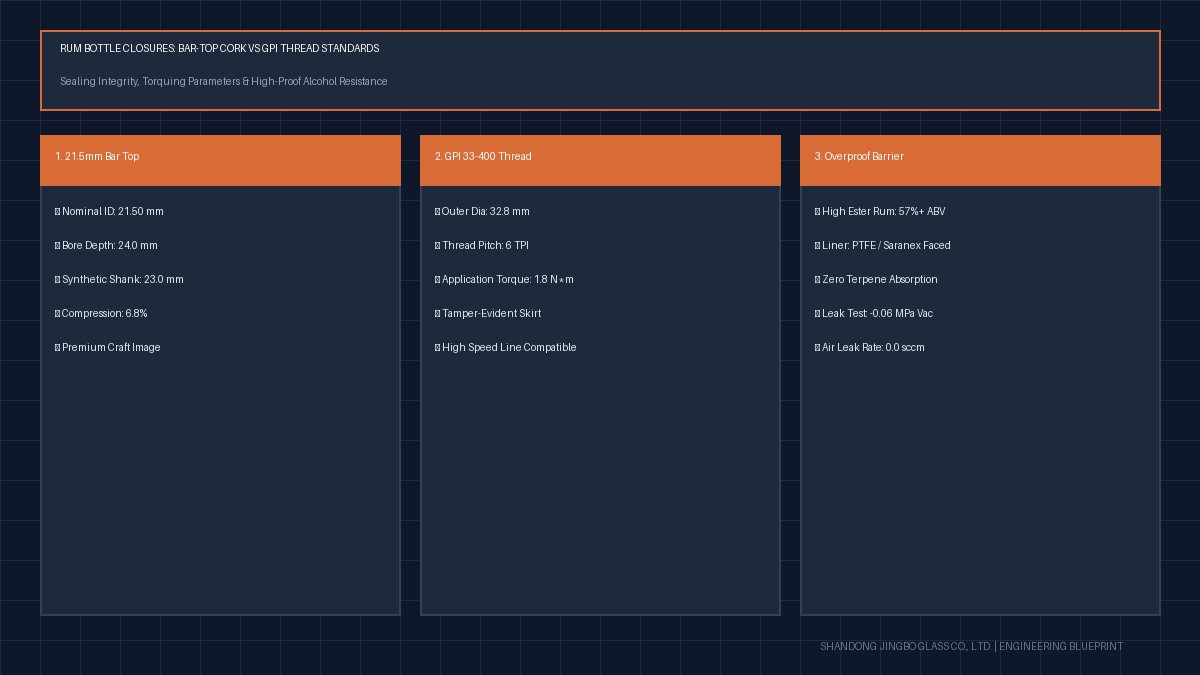
The closure finish defines both brand perception and chemical sealing efficacy. Selecting the correct neck finish requires balancing market positioning against filling equipment infrastructure:
1. 21.5mm Bar-Top Synthetic Cork Finish
Top-shelf artisanal rums almost universally adopt T-bar top corks. At Jingbo Glass, our CNC neck rings form an entrance inner diameter of 21.50 mm ± 0.25 mm with a minimum sealing depth of 24.0 mm. For spirits with high alcohol strength (overproof rums), synthetic injection-moulded corks or micro-agglomerated natural corks coated with food-grade polyurethane are strongly recommended. Unlike raw natural cork, synthetic shanks will not dry out, shrink, or crumble when exposed to alcohol vapor during multi-year storage.
2. Continuous Thread GPI 33/400 & GPI 28/400 Finishes
For high-volume spiced rums and commercial bar wells, continuous thread GPI finishes remain the gold standard. A GPI 33/400 finish accommodates heavy aluminum screw caps or wooden over-caps fitted with plastic threaded liners. This provides rapid tamper-evident sealing, eliminates cork taint risks, and allows high-speed automated cording at speeds up to 140 bpm. Application torque must be calibrated to 1.6–2.0 N·m to compress the liner without stripping the aluminum threads.
Overproof Spirits Barrier & Headspace Expansion Dynamics
High-ester Caribbean rums (such as Jamaican pot-still rums or Navy-strength bottlings) often exit the still at 54.5% to 69% ABV. Concentrated ethanol vapors expand significantly under shipping heat, and high-proof alcohol acts as a powerful solvent against weak plastic liners and glue seals.
ΔV = V_nominal × β_rum × ΔT
Parameters for 60% ABV Navy Strength Rum:
• Nominal Fill: 750 ml
• β (Ethanol-Water Volumetric Expansion Coeff @ 60% ABV) ≈ 0.00105 / °C
• ΔT (Bottled @ 18°C, Transit In Ocean Container @ 56°C) = 38°C
Thermal Expansion:
ΔV = 750 × 0.00105 × 38 = 29.9 ml
Because a 60% ABV rum expands by nearly 30 ml inside a sealed bottle under tropical container conditions, designing a bottle with only 20 ml of headspace will cause hydraulic pressure spikes, cork lifting, or seam weeping. That is why all Shandong Jingbo 750 ml rum bottles feature an engineered brimful capacity of 785 ml to 790 ml, guaranteeing a safe vapor headspace buffer of 35 ml to 40 ml.
Custom Relief Embossing & CNC Mold Tooling Specifications
Embossing a pirate emblem, nautical anchor, compass rose, or distillery founding date directly onto the glass shoulder creates an indelible tactile signature that label paper cannot match. However, successful glass embossing requires strict CAD engineering parameters:
1. Relief Depth & Demolding Draft Angles
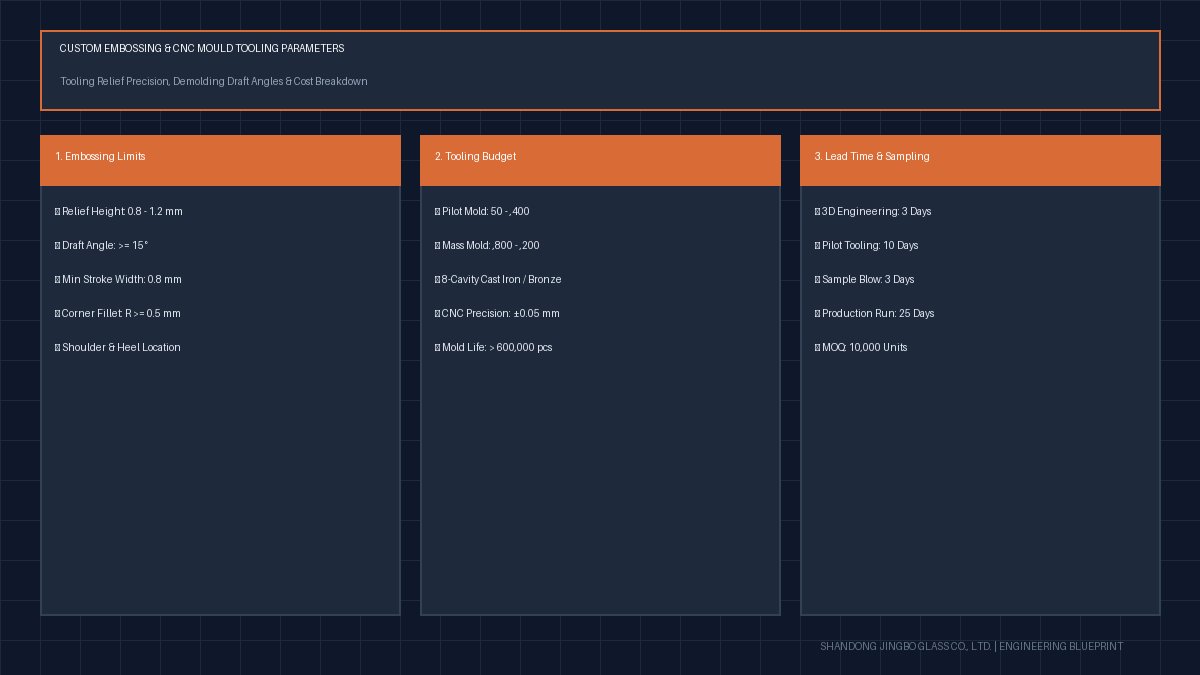
To ensure molten glass flows completely into the mold engraving without trapping air pockets, embossed features must be engineered with a relief height of 0.8 mm to 1.2 mm. More crucially, all sidewall edges must incorporate a draft angle ≥ 15° and minimum corner radius of 0.5 mm. If draft angles are too vertical (approaching 90°), the glass will bind to the mold cavity during IS machine opening, causing torn glass defects or surface chill marks.
2. Tooling Budgeting: Pilot CNC vs. Mass 8-Cavity Sets
- CAD Feasibility & 3D Simulation (3 Days): We review your vector logo and simulate mold filling dynamics to verify that glass thickness will remain uniform across embossed zones.
- Single-Cavity Pilot Mould (50–,400): We machine a CNC pilot mould to produce 25 to 50 real glass sample decanters, allowing you to test label fit, cork pull force, and visual clarity before investing in full production tooling.
- Production Mould Set (,800–,200): Precision-milled cast iron or aluminum-bronze alloy mould sets engineered for automated double-gob or single-gob IS machine banks with a lifespan exceeding 600,000 units.
Technical Specification Comparison Table: Rum Packaging Profiles
The table below provides factory engineering benchmarks across our three core rum container profiles:
| Technical Spec | Spiced Rum Cylinder | Navy Rum Flask | Artisanal XO Decanter |
|---|---|---|---|
| Nominal Volume | 750 ml (25.36 fl oz) | 750 ml (25.36 fl oz) | 750 ml (25.36 fl oz) |
| Brimful Capacity | 782 ml ± 5 ml | 785 ml ± 5 ml | 790 ml ± 6 ml |
| Finished Glass Weight | 620 g ± 20 g | 750 g ± 25 g | 920 g ± 30 g |
| Base Glass Thickness | 12.0 mm | 16.0 mm | 22.0 mm |
| Neck Finish | GPI 28/400 or GPI 33/400 | 21.5mm Bar Top Cork | 21.5mm Bar Top Cork |
| Bore Tolerance | ±0.30 mm | ±0.25 mm | ±0.25 mm |
| Annealing Lehr Range | 525°C – 545°C | 530°C – 550°C | 535°C – 550°C |
| Thermal Shock (ΔT) | ≥ 45°C | ≥ 42°C | ≥ 42°C |
| Wholesale Pallet Pack | 1,296 btls / pallet | 1,152 btls / pallet | 1,008 btls / pallet |
To review capacity conversions between standard 750ml fifths and 375ml half-bottles, see our guide on 375ml to oz conversion and case volume specs.
Seaworthy Master Cartons & Pallet Export Standards
Shipping heavy flint rum bottles across international waters requires careful packing design to avoid transit attrition:
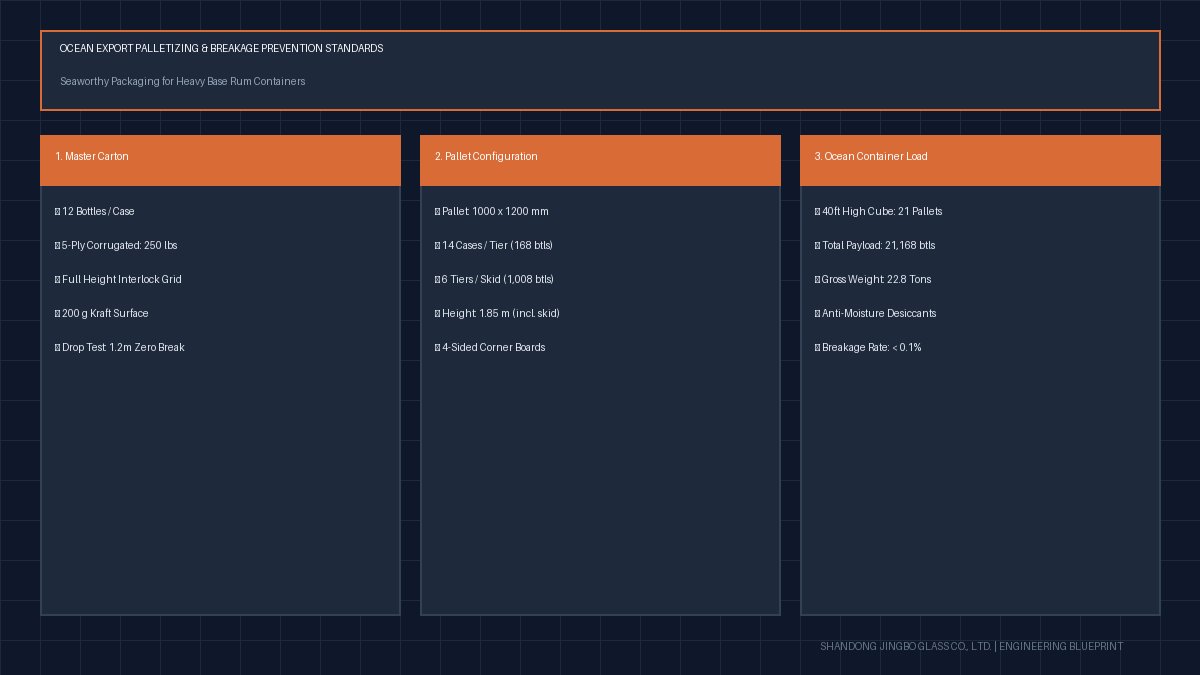
- Full-Height Double-Wall Partitions: Master cartons feature 250 lbs burst-test kraft corrugated boxes with interlocking corrugated cell dividers. Every bottle sits in its own protective pocket, completely eliminating bottle-to-bottle contact during severe maritime rolling.
- Cold-End Anti-Scratch Lubricant: All bottles receive an FDA-compliant micro-thin polyethylene spray at the lehr exit (friction coefficient μ ≤ 0.18). This prevents line abrasion, clouding, and scratching on automated bottling lines.
- ISPM-15 Fumigated Treated Pallets: Palletized on heat-treated 1000 × 1200 mm export skids with 4 mm heavy cardboard edge angle protectors, top weather caps, and 7-layer stretch wrap. A 40ft High Cube container carries 21 full pallets (21,168 heavy decanters) with a factory-guaranteed breakage rate under 0.1%.
Frequently Asked Questions: Rum Bottle Packaging & Custom Sourcing
What is the minimum order quantity (MOQ) for custom rum bottle manufacturing?
How do you ensure closures do not leak with high-proof overproof rums?
Can Jingbo Glass apply decorative finishes like matte black coating or gold hot stamping?
What is the typical lead time from CAD drawing to final bottle delivery?
Get Factory Direct Quotes & Custom Rum Bottle Samples
Ready to upgrade your rum brand’s shelf presence with heavy flint glass and precision custom tooling? Send our engineering team your concept sketches, CAD files, or reference bottles for free technical feasibility feedback, mold pricing, and physical sample shipments.
Contact Glass Engineering Team