

i Plant Director’s Briefing: Sourcing Brandy Glass Bottles Wholesale
In craft brandy, cognac, and aged armagnac distillation, the container is not merely a vessel—it is an optical stage. High-proof barrel aging produces deep amber and mahogany spirits whose color brilliance depends entirely on low-iron glass clarity (Fe₂O₃ < 0.015%) and heavy base decanter geometry. Sourcing brandy bottles wholesale directly from an industrial manufacturing plant requires navigating structural trade-offs between extreme base thickness (24–28 mm solid punt) and thermal stress in annealing lehrs. This engineering guide details mould tooling constraints, bar-top cork neck bore tolerances (±0.25 mm), custom relief embossing rules, and container palletization economics for commercial distilleries.
1. Anatomy of Luxury Brandy Bottles: XO Decanters vs. Slender European Profiles
Brandy packaging falls into two distinct engineering archetypes: wide-shouldered, ultra-heavy XO decanters (typified by Cognac prestige releases) and tall, architectural slender bottles favored by contemporary fruit brandies and artisanal Armagnacs. Choosing the proper silhouette impacts production line runnability, bottle handling in automated rinser-filler blocks, and overall packaging mass.
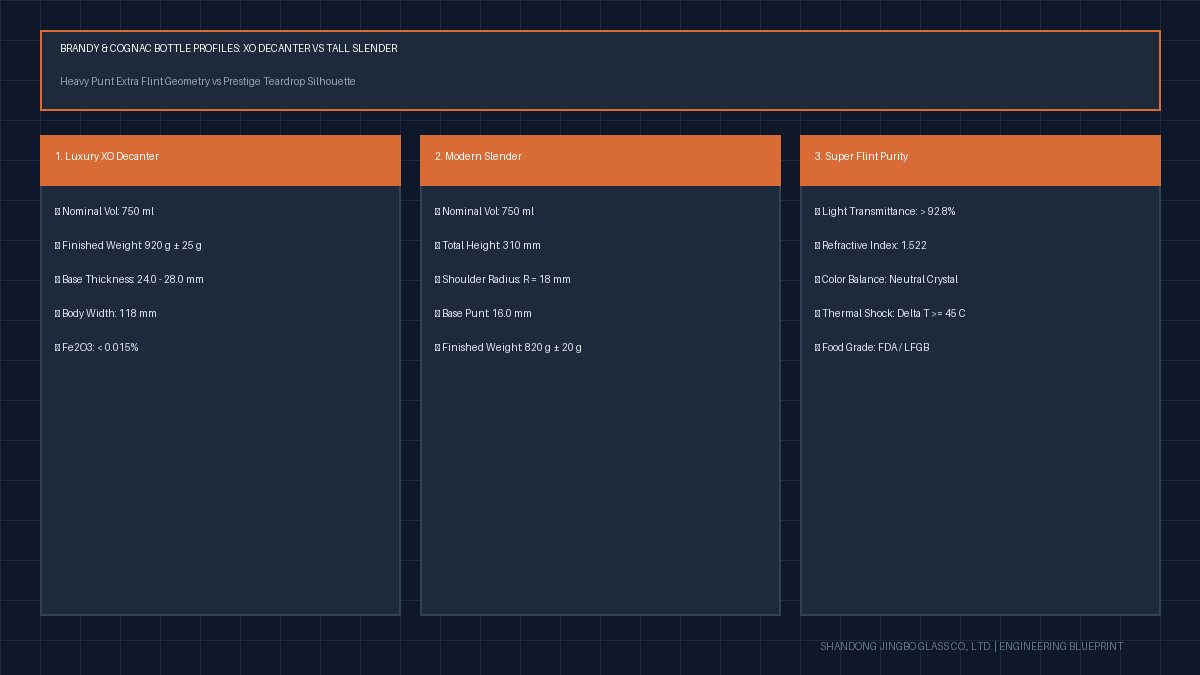
When displaying deep copper and golden amber spirits, minor glass impurities completely degrade shelf appeal. Standard container glass with ferric oxide concentrations above 0.04% imparts an olive-green hue. Jingbo Glass employs ultra-purified quartz sand with electric furnace boosting to maintain Fe₂O₃ under 150 ppm (0.015%), yielding a refractive index of 1.522 and over 92.8% total visible light transmittance. Discover our raw material formulation in our technical review of crystal white glass vs high white glass.
2. Mould Tooling Physics: Heavy Base Punt & Thermal Dissipation
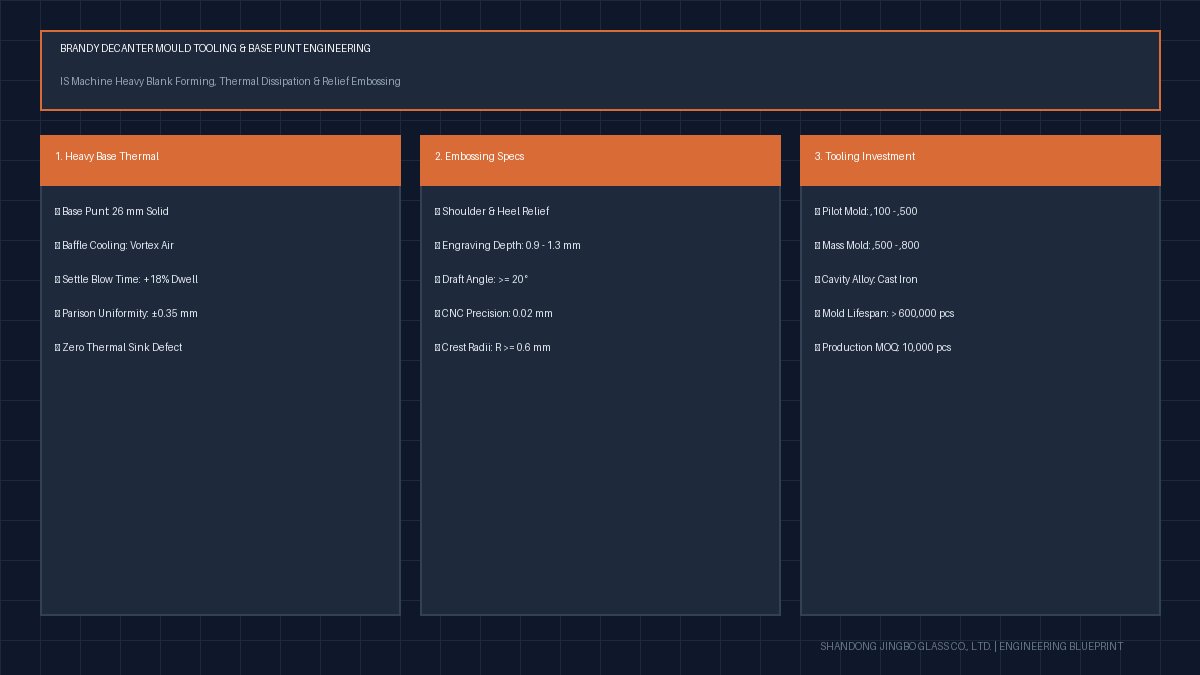
Forming a 900+ gram brandy decanter on automated blow-and-blow or press-and-blow Individual Section (IS) machines introduces extreme thermodynamic hurdles. Glass at 1,180°C enters the blank mould as a molten gob. As the base accumulates 24 to 28 mm of solid glass, heat retention creates differential contraction between the rapidly cooling outer sidewall and the molten core of the base punt.
Volumetric Thermal Shrinkage in Heavy Base Decanters:
Where V₀ is molten base volume (cm³), β is the volumetric thermal expansion coefficient of high-potash flint glass (approx. 27 × 10⁻⁶ K⁻¹), and ΔT is the rapid thermal drop (~600°C) from the blank mould to the takeout arm. Without specialized vortex air cooling channels engineered into the mould bottom plates, this volumetric differential creates bottom suck-in (“sink marks”) and tensile hoop stresses exceeding 35 MPa.
To eliminate micro-striae and base thermal fractures, Jingbo Glass routes decanters through 48-meter, 8-zone computerized annealing lehrs. Temperature is gradually stepped down from 545°C to 70°C over 120 minutes, verified with polarized strain viewers according to ASTM C148 polariscopic standards (retaining residual optical retardation under 15 nm/cm). Read our full engineering guide on glass bottle annealing temperature and thermal shock resistance.
3. Neck Finish Engineering: 21.5mm & 23mm Bar-Top Cork Tolerances
High-proof brandy spirits (40% to 58% ABV) contain volatile aromatic esters, vanillin, and wood lactones that deteriorate under air infiltration. Sourcing brandy bottles wholesale requires strict internal neck bore tolerances. A bore that is 0.5 mm too loose causes leakage during trans-oceanic shipping; a bore that is 0.5 mm too tight causes cork shearing during unseating.
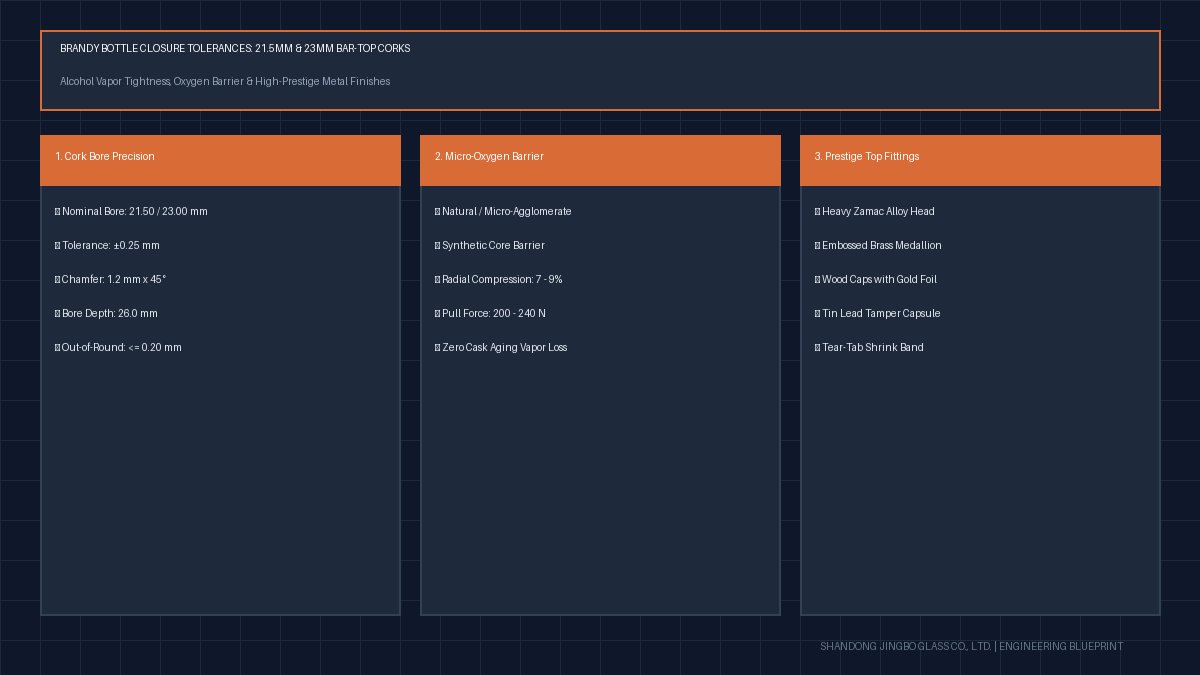
Our factory machines neck finish tooling using high-precision CNC lathes to maintain the entrance inner diameter (ID) strictly at 21.50 mm ± 0.25 mm for standard corks, or 23.00 mm ± 0.25 mm for large-mouth prestige decanters. The internal bore profile incorporates a 1.2 mm × 45° entrance lead-in chamfer that guides automated corking heads without shaving synthetic elastomer or natural cork flanks. Explore similar sealing mechanisms in our reviews of custom glass whiskey bottles and tequila glass bottle wholesale sourcing.
4. Custom Relief Embossing & Secondary Surface Decoration
Prestige brandy and cognac decanters demand bespoke visual and tactile branding directly in the glass mold. Jingbo Glass supports custom bottle design with the following engineering capabilities:
- CNC Mold Relief Embossing: Crests, vineyard emblems, and distillery founding dates engraved directly onto the shoulder or bottle heel. Recommended relief height is 0.8 mm to 1.2 mm with a minimum 18° draft angle to guarantee clean mould parting without glass drag marks.
- High-Temperature Ceramic Enamel Screen Printing: Inorganic mineral inks silk-screened and baked at 560°C inside the annealing lehr, fusing permanently with the silicate matrix to resist abrasion and alcohol solvents.
- Chemical Acid Frosting & Sandblasting: Controlled hydrofluoric acid etching creates a silky satin finish (Ra 1.2–2.4 μm) that diffuses light while leaving high-gloss windows for clear liquid inspection.
- Vacuum Metallization & Heavy Base Color Spraying: Environmental water-based organic lacquers applied to the base punt create gradient amber or smoked gray halos that accentuate liquid depth.
5. Ocean Freight Crating, Palletization & Sourcing Economics
Heavy decanters cannot be shipped using standard bulk pallet partitions without risking scuffing and impact chipping during trans-Pacific or trans-Atlantic sea voyages. For high-end brandy bottles wholesale, Jingbo Glass enforces an export-certified packing configuration:
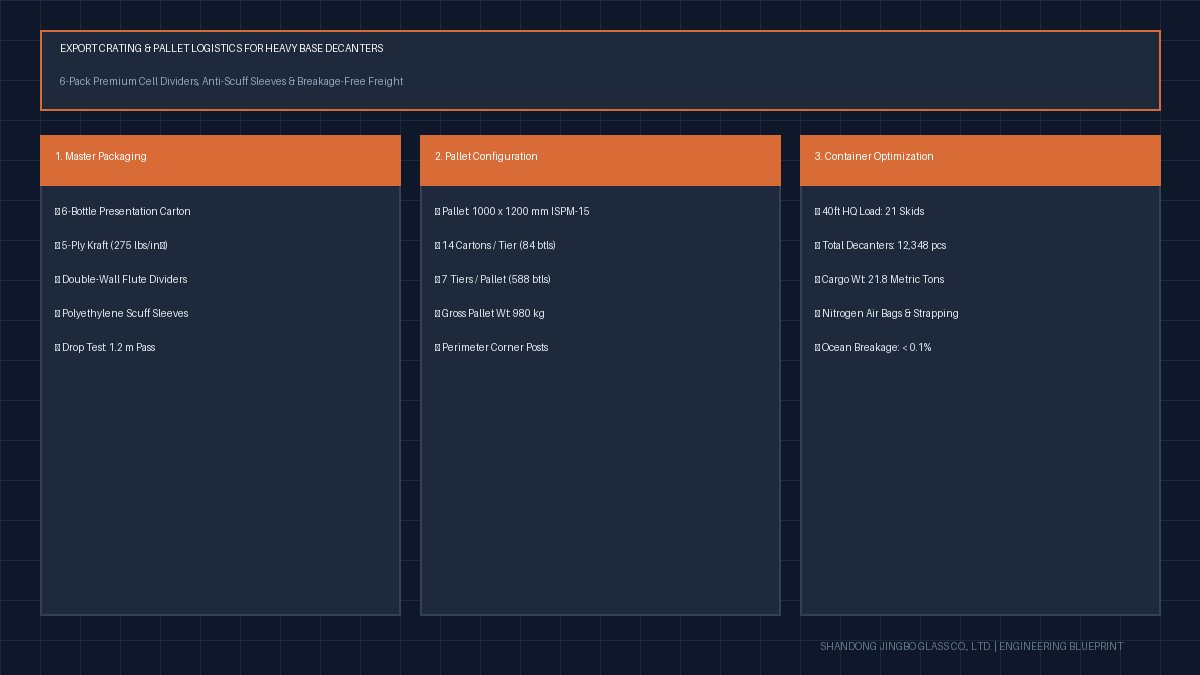
Our export standard utilizes 6-bottle heavy presentation cartons constructed from 5-ply kraft board (275 lbs/in² burst test) with full-height double-wall corrugated cell dividers. Every bottle is individually shielded with an anti-scuff polyethylene net. Cartons are stacked on ISPM-15 fumigated heat-treated pallets (1000 × 1200 mm), reinforced with full-height heavy corner posts, and wrapped in 5 layers of 25-micron stretch film.
A standard 40ft High Cube (HQ) shipping container accommodates 21 pallets carrying approximately 12,348 to 14,112 heavy decanters (total gross weight ~22 metric tons). Our containerized breakage rate across over 450 distillery shipments remains under 0.1%. For commercial order calculations and complete liquor packaging options, visit our central portal for glass liquor bottles wholesale or explore companion spirit categories including custom rum bottle packaging, wholesale vodka bottles, and gin glass bottle wholesale guides.
Frequently Asked Questions: Wholesale Brandy Glass Bottles
What is the minimum order quantity (MOQ) for custom vs. standard brandy decanters? +
How much does a custom brandy decanter mould set cost, and what is the lead time? +
Can Jingbo Glass supply matching bar-top corks, zamac capsules, and gift boxes? +
How do you prevent glass scratching and breakage during sea freight? +
Are your super flint glass decanters compliant with FDA and European food contact laws? +
Engineering Your Custom Brandy Decanter Mould
Whether you are developing a new XO cognac release, craft grape brandy, or small-batch apple eau-de-vie, Shandong Jingbo Glass provides end-to-end tooling, sampling, and container freight from our world-class manufacturing facility in Shandong, China.
Request Technical CAD Drawings & Factory Quotation