

Plant Director’s Quick Answer: Gin Glass Bottle Wholesale
Wholesale Sourcing Parameters: Commercial procurement of gin glass bottles requires balancing ready stock catalog molds (MOQ: 3,000–5,000 units, 7–10 days dispatch) against custom private tooling (MOQ: 10,000 units, CNC pilot mold cost: 50–,400, mass 8-cavity tooling: ,800–,200).
Core Technical Benchmarks: Craft gin demands Super Flint glass clarity (Fe2O3 < 0.018%, light transmission > 92.5%) to highlight delicate botanical macerations, precision 21.5mm ±0.25mm bar-top cork bores (internal roughness Ra ≤ 1.6 μm) to prevent volatile juniper terpene evaporation, and 16mm–22mm heavy base punts annealed in 8-zone lehrs (525°C–550°C) with thermal shock resistance ΔT ≥ 45°C.
The Craft Gin Boom: Why Distinctive Glass Drives Shelf Velocity
The global gin renaissance has evolved far beyond traditional London Dry profiles. Today’s craft distillers infuse local botanicals ranging from Japanese yuzu and Mediterranean rosemary to Nordic cloudberries and pink peppercorns. Because gin is primarily an aromatic spirit driven by delicate monoterpenes (pinene, limonene, linalool), packaging must perform two simultaneous duties: it must establish an unmistakable artisan presence on back bars, and it must provide an uncompromising chemical and hermetic barrier.
From an eighteen-year glass plant perspective, gin packaging commands greater geometric variety than almost any other spirits category. Distillers move fluidly between vintage Victorian apothecary bottles, heavy fluted Art Deco decanters, and minimalist Nordic cylinders. However, complex geometries introduce mold flow challenges—such as uneven glass distribution along fluted ribs, air entrapment on embossed shoulder crests, and cork bore out-of-roundness.
Whether you are distilling small-batch botanical spirits or scaling global contract packaging, understanding container physics, CNC tooling tolerances, and closure mechanics is essential. If your facility also packages neutral grain spirits, you can compare these specifications in our companion guide on wholesale vodka glass bottles, or review our technical teardown of rum bottle packaging design.
Silhouette Engineering: Victorian Apothecary Rounds vs. Modern Fluted Decanters
In retail packaging design, gin bottles primarily fall into two structural paradigms, each impacting bottling line handling and pallet loading:
1. Traditional Victorian Apothecary Silhouettes
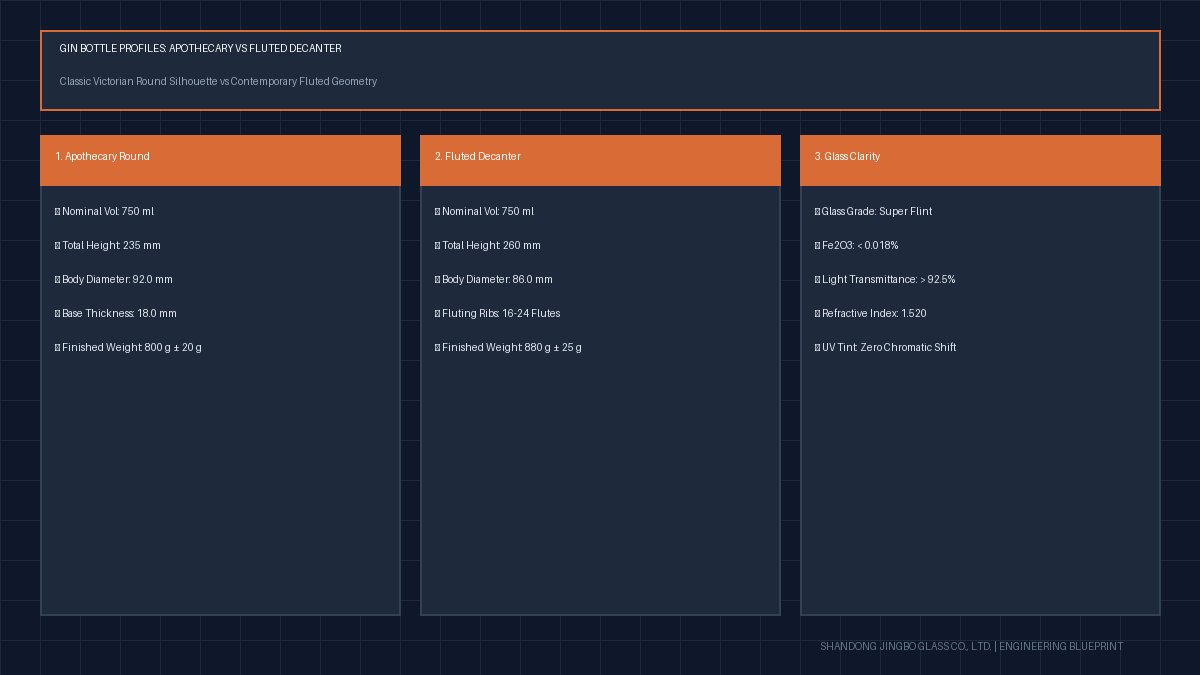
The apothecary silhouette (height: 225–240 mm, body diameter: 88–94 mm) features a stout, rounded shoulder, short neck, and generous label area. The squat geometry lowers the center of gravity, delivering substantial tactile stability in hand (780g to 850g finished glass weight). The wide cylindrical label panel allows paper labels, pressure-sensitive labels, or full 360-degree ceramic silk screening without distortion.
2. Contemporary Fluted & Ribbed Decanters
To capture modern premium retail positioning, distillers increasingly commission fluted bottles featuring 16 to 24 vertical architectural ribs. Fluting catches ambient light on retail shelves, creating visual prism refractions that emphasize spirit clarity. However, fluted bottles require precise blow-blow mold timing. If molten glass is blown too rapidly, corner chill lap defects appear in the fluting valleys; if blown too slowly, ribs fail to achieve full dimensional sharpness.
CNC Mold Tooling: Botanical Embossing & Vertical Fluting Parameters
Custom embossed botanical branches, juniper berries, or brand mottos on the bottle shoulder provide permanent, counterfeit-proof tactile branding. Manufacturing sharp glass embossing requires strict CAD tooling parameters:
1. Relief Depth & Draft Angle Rules
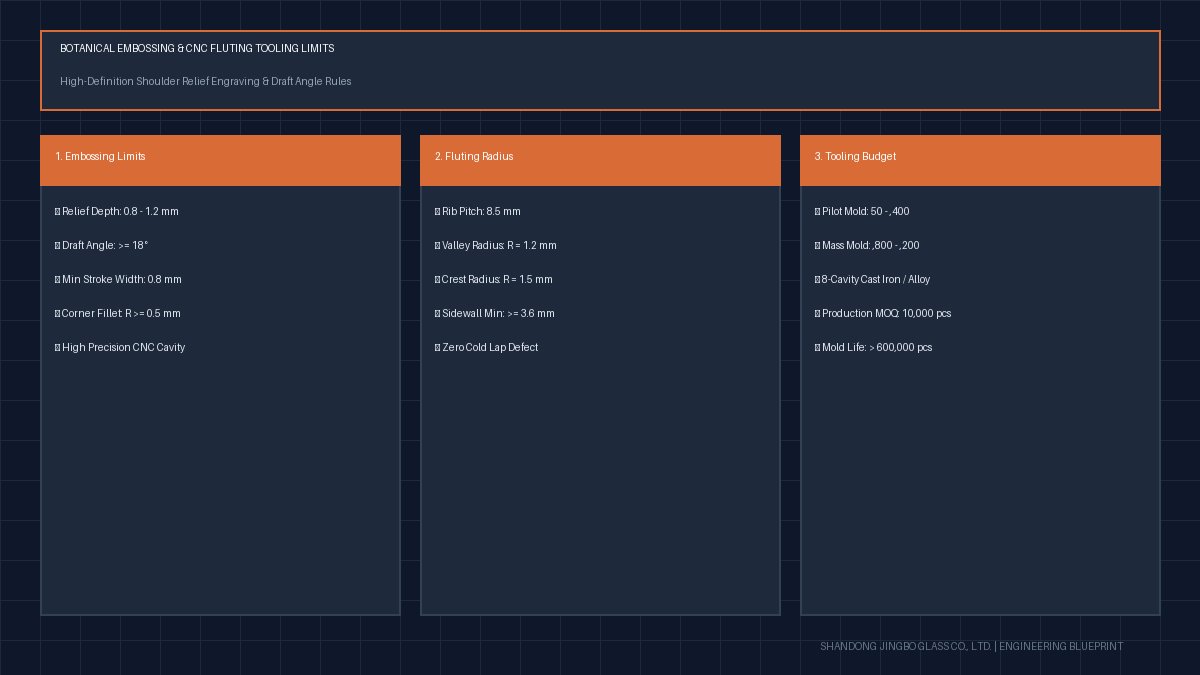
To ensure clean mold release at production speeds of 60 to 90 bpm, embossed relief features must be calibrated to a depth of 0.8 mm to 1.2 mm. Crucially, all relief sidewalls must incorporate a draft angle ≥ 18° with a root fillet radius \ge 0.5 ext{ mm}$. If draft angles are vertical, molten glass creates microscopic vacuum pockets and hangs up on the mold cavity during IS machine opening, leaving torn glass checks or cloudiness.
2. Precision CNC Tooling Budgets
- 3D Engineering CAD & Mold Flow Simulation (3 Days): We analyze glass wall distribution to ensure fluting valleys maintain a certified minimum wall thickness ≥ 3.6 mm.
- Single-Cavity Pilot Mold (50–,400): We machine a CNC pilot mold to produce 25 to 50 real glass sample bottles for cork sealing trials and line stability verification.
- Mass 8-Cavity Production Tooling (,800–,200): Fabricated from wear-resistant cast alloy for double-gob or single-gob IS machine banks with a certified lifespan exceeding 600,000 bottles.
Terpene Retention & Sealing Mechanics: 21.5mm Bar-Top Cork Tolerances
Unlike neutral vodka, botanical gins carry concentrated aromatic oils that are highly susceptible to oxidation and terpene evaporation. A sub-par neck finish will cause aroma scalping and cork weeping during ocean shipping:
1. 21.5mm Precision Bar-Top Cork Finish
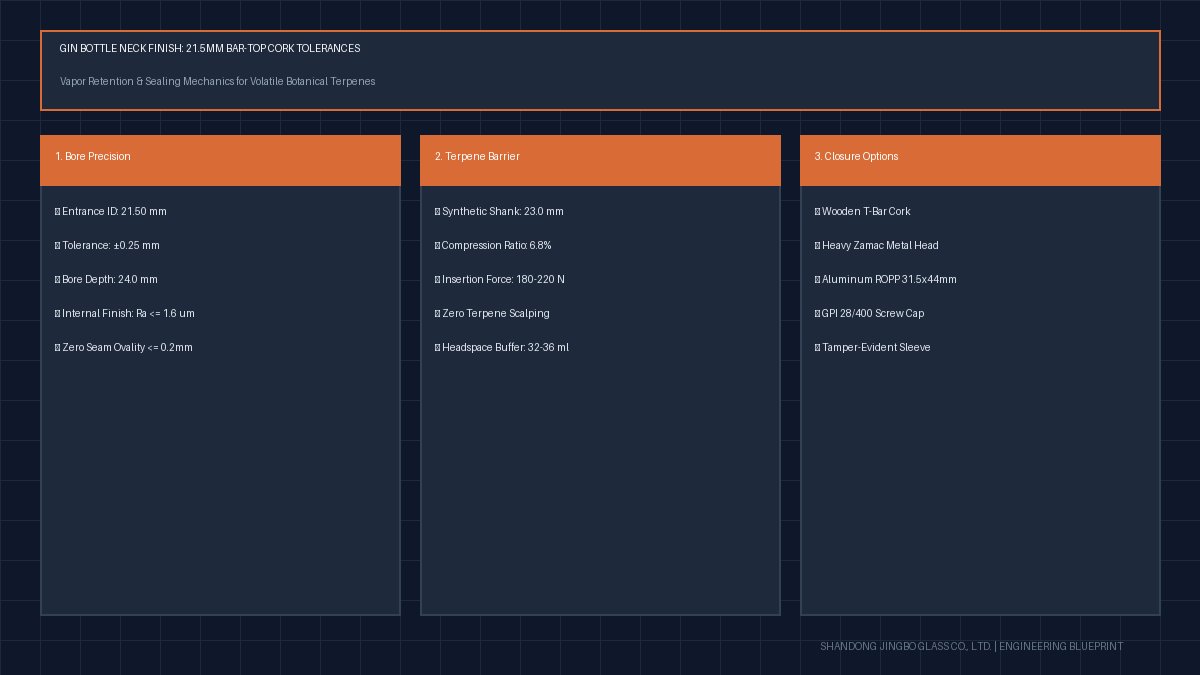
At Shandong Jingbo Glass, our CNC-cut neck ring tooling maintains an entrance internal diameter of 21.50 mm ± 0.25 mm down to a sealing depth of 24.0 mm. Paired with standard 23.0 mm synthetic bar-top corks, this creates an engineered compression ratio of 6.5% to 7.0%. This provides an airtight hermetic seal capable of holding vacuum down to -0.06 MPa while keeping capping insertion force within 180 to 220 N.
2. Internal Sealing Surface Roughness (Ra ≤ 1.6 μm)
Our automated forming machines employ mirror-polished stainless steel plungers that achieve an internal glass bore roughness of Ra ≤ 1.6 μm. This eliminates microscopic mold parting seam grooves that allow volatile alcohol vapors to seep past cork ribs.
Volatile Botanical Vapor Pressure Dynamics During Ocean Freight
Distilleries shipping bottled gin across maritime cargo lanes frequently experience cargo container internal temperature spikes reaching 50°C to 58°C. High-strength gin (43% to 47% ABV) generates significant thermal expansion and head vapor pressure.
ΔV = V_nominal × β_gin × ΔT
Where:
• V_nominal = 750 ml
• β_gin (Ethanol-Water 45% ABV Volumetric Expansion Coeff) ≈ 0.00088 / °C
• ΔT (Temperature rise from 16°C bottling to 56°C shipping) = 40°C
Thermal Liquid Expansion:
ΔV = 750 × 0.00088 × 40 = 26.4 ml
Because gin expands by over 26 ml under peak heat, bottles engineered with insufficient headspace risk hydraulic cork ejection. To prevent leaks, all Jingbo Glass 750ml gin containers are engineered with a brimful capacity of 784 ml to 788 ml, leaving a certified vapor expansion headspace buffer of 34 ml to 38 ml above the fill line.
Technical Specification Comparison: Gin Packaging Silhouettes
The table below compares engineering specifications across our three primary wholesale gin container silhouettes:
| Engineering Spec | Victorian Apothecary Round | Modern Fluted Decanter | Nordic Minimalist Square |
|---|---|---|---|
| Nominal Volume | 750 ml (25.36 fl oz) | 750 ml (25.36 fl oz) | 750 ml (25.36 fl oz) |
| Brimful Volume | 785 ml ± 5 ml | 788 ml ± 5 ml | 786 ml ± 6 ml |
| Finished Glass Weight | 800 g ± 20 g | 880 g ± 25 g | 920 g ± 30 g |
| Total Height | 235.0 mm ± 1.5 mm | 260.0 mm ± 1.5 mm | 245.0 mm ± 1.5 mm |
| Base Thickness | 18.0 mm | 20.0 mm | 22.0 mm |
| Neck Finish | 21.5mm Bar Top Cork | 21.5mm Bar Top Cork | 21.5mm Cork or GPI 28/400 |
| Neck Bore Tolerance | ±0.25 mm | ±0.25 mm | ±0.25 mm |
| Thermal Shock (ΔT) | ≥ 45°C | ≥ 42°C | ≥ 42°C |
| Pallet Quantity | 1,152 btls / pallet | 1,008 btls / pallet | 1,008 btls / pallet |
To cross-reference industry volume standards between standard 750ml fifths and 700ml European sizes, explore our complete liquor bottle sizes chart and dimension breakdown.
Seaworthy Master Cartons & Container Palletizing
Exporting heavy flint gin decanters worldwide requires comprehensive multi-layer shock mitigation:
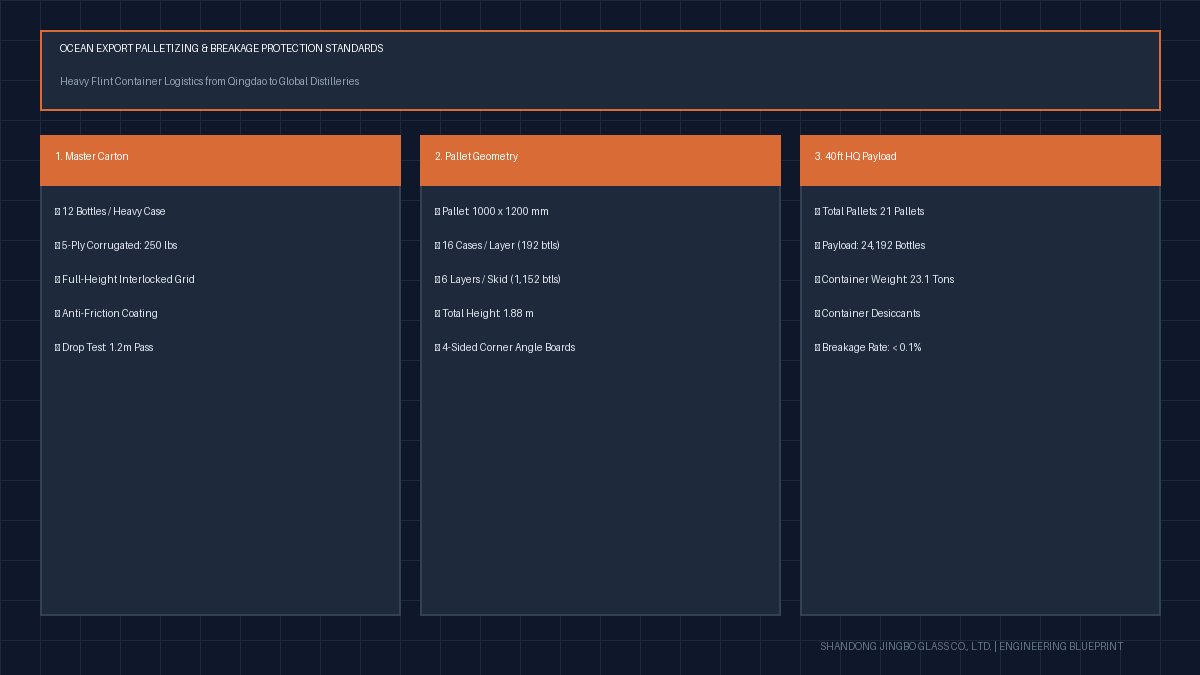
- 5-Ply Heavy Corrugated Master Cartons: 250 lbs burst-test export cartons with full-height corrugated cell partitions. Every bottle is cradled in its own cell, completely preventing glass-to-glass contact during rough ocean transit.
- Cold-End Anti-Abrasion Lubricant: As bottles exit the annealing lehr, an automated misting system applies an FDA-approved polyethylene emulsion coating (friction coefficient μ ≤ 0.18). This prevents scuff marks and line scratching on automated bottling carousels.
- ISPM-15 Heat-Treated Export Pallets: Stacked on 1000 × 1200 mm export skids with 4 mm heavy cardboard edge angle protectors, top protective lids, and machine stretch-wrapped with 7 layers of UV film. A 40ft High Cube container loads 21 pallets (24,192 units) with certified breakage below 0.1%.
Frequently Asked Questions: Gin Glass Bottle Wholesale
What is the minimum order quantity (MOQ) for wholesale gin glass bottles?
Can you supply matching wooden T-corks and tamper-evident shrink sleeves?
How do you ensure zero air bubble defects in heavy base gin bottles?
What is the typical lead time for custom gin bottle tooling?
Request Factory Direct Wholesale Pricing & Free Samples
Are you launching a new botanical gin brand or upgrading your current bottle packaging? Contact our glass engineering team with your drawings, target bottle photos, or CAD concepts for free technical reviews, mold pricing, and complimentary physical sample packs.
Contact Glass Engineering Team