

In craft spirits packaging, few profiles command the authoritative shelf presence of a heavy-base square bottle. From heritage Kentucky straight bourbons and small-batch ryes to modern botanical spirits, sourcing square glass liquor bottles wholesale represents a deliberate engineering choice. Yet, for distillery founders, packaging managers, and plant engineers, transitioning from standard cylindrical containers to square profiles introduces non-trivial thermodynamic, mechanical, and logistical realities that off-the-shelf catalogues rarely discuss.
When blowing glass at 1,180°C in an Individual Section (IS) machine, molten glass naturally seeks cylindrical symmetry under air pressure. Forcing molten gob material into a four-cornered blow mould demands precise cavity thermal profiling, micro-engineered corner radii, controlled parison wall distribution, and extended lehr annealing cycles. At Shandong Jingbo Glass Co., Ltd., where our tooling shop and forming lines have produced over 40 million spirits containers across 18 years, here is the complete engineering breakdown of sourcing, customising, and running square spirits bottles at commercial scale.
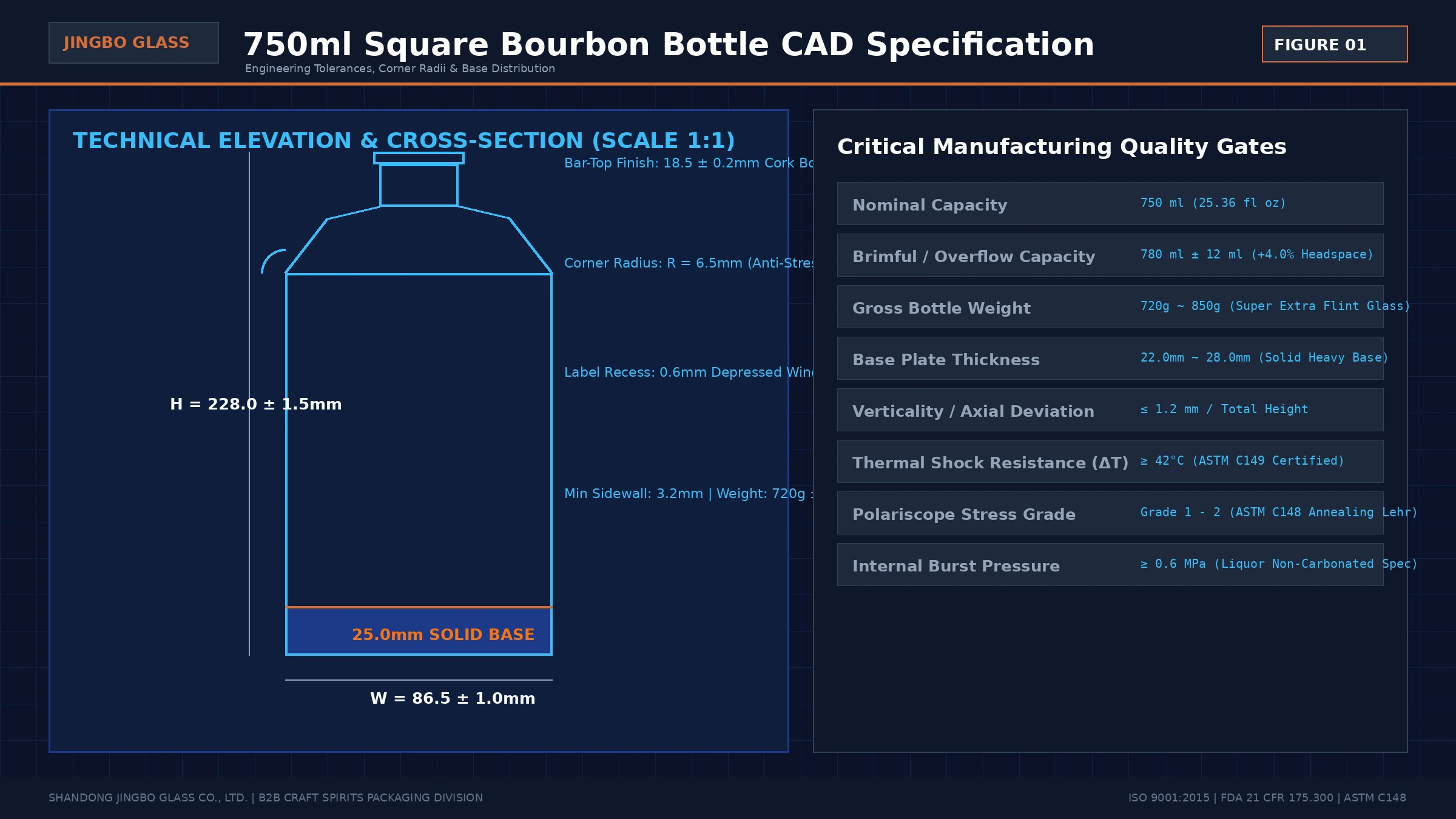
1. The Physics of Square Forming: Mitigating Corner Thinning and Hoop Stress
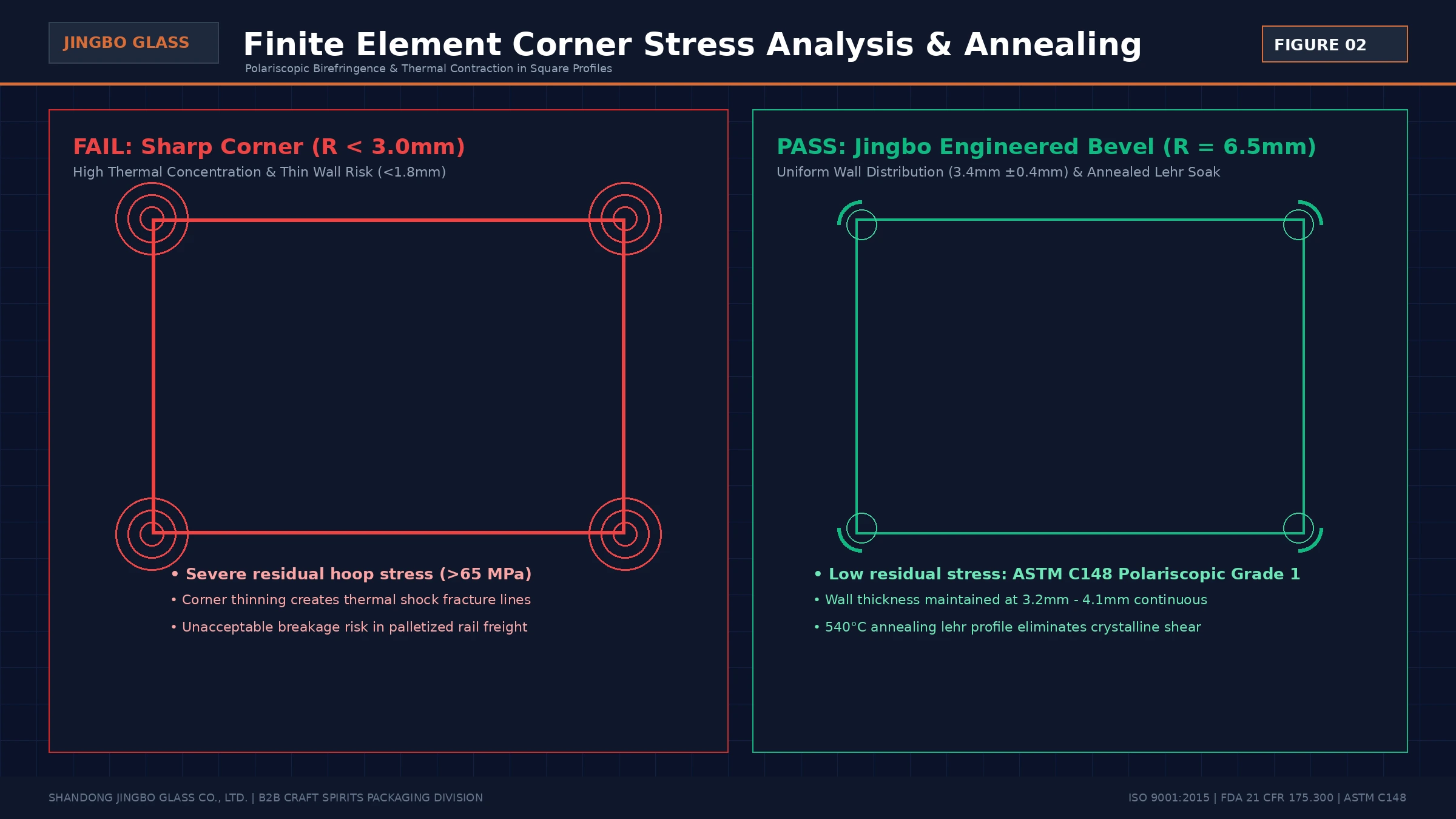
The primary engineering failure mode in sub-par square bottles is corner thinning. In conventional blow-and-blow forming, molten glass expands outward from the parison center. The distance to the flat sidewall is significantly shorter than the distance to the four 90-degree corners. If mould temperatures are uncalibrated, glass chills prematurely on the flats while dragging thin across the corners, leaving corner wall thickness under 1.8mm while sidewalls exceed 4.5mm.
To eliminate fragile corner pinch points, our CNC mould engineering enforces three strict geometric rules:
- Engineered Corner Radii (R ≥ 6.5mm): True 90-degree sharp corners create severe stress risers. By introducing an engineered transition bevel radius of R6.0mm to R7.5mm, molten glass flows smoothly without turbulent freezing, maintaining a uniform 3.2mm to 3.8mm minimum corner wall.
- Differential Blank Mould Pre-Cooling: Mould cavities utilize variable internal cooling channels (drilled cooling vents) that dissipate heat 15% faster along flat panels than in corners, equalizing glass viscosity during final blow forming.
- Brimful Headspace Expansion (+4.0% Ullage): Square bottles possess rigid flat walls with lower mechanical elasticity than cylinders. For a standard 750ml spirits bottle (25.36 fl oz), we engineer an overflow capacity of 780ml ±12ml. This 30ml thermal expansion buffer prevents bar-top cork extrusion during unconditioned intermodal container transit across extreme seasonal temperature swings (-15°C to +45°C).
2. Heavy Solid Bases: Annealing Lehr Dynamics & ASTM C148 Stress Relief
A signature characteristic of premium square bourbon and whiskey bottles is the solid heavy glass base (ranging from 18mm up to 32mm solid glass depth). Beyond visual prestige and optical magnification of the spirit’s amber hue, a heavy base lowers the bottle’s center of gravity, preventing line tip-overs on high-speed conveyors. However, a massive glass heel introduces acute thermal gradients during solidification.
If the 25mm thick base cools at a different rate than the 3.5mm sidewall, severe residual polariscopic strain forms along the heel radius. Under ASTM C148 polarized light examination, unsophisticated glass shows high birefringence coloration (Grade 4–5 strain), meaning slight shelf bumping or thermal rinse shock on the bottling line will shatter the container.
To deliver commercial durability, all Jingbo square bottles pass through a 48-meter automated continuous annealing lehr operating an extended 140-minute thermal curve. The containers soak at 540°C~560°C to completely relax crystalline shear stress before undergoing controlled gradient cooling at 1.8°C/min down to 120°C. Every production batch is certified to ASTM C148 Grade 1 to Grade 2 polariscopic standards and withstands a minimum thermal differential (ΔT) of 42°C in accordance with ASTM C149.
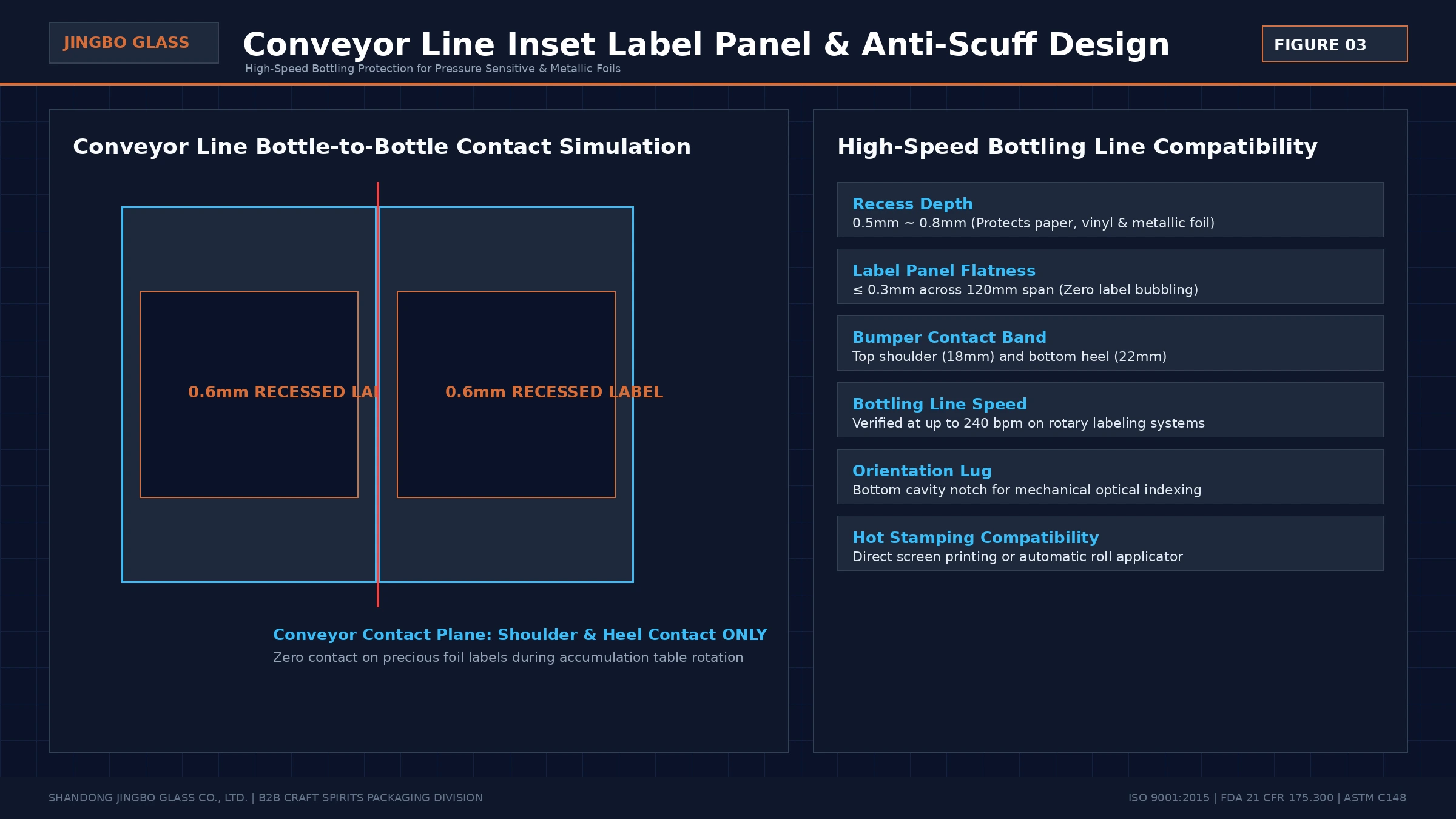
3. High-Speed Bottling Automation: Recessed Label Panels & Anti-Scuff Geometry
One of the most persistent complaints packaging managers face when switching to square containers is label scuffing and bottle twisting on automated bottling lines. On rotary unscramblers, rinsers, and accumulation tables, round bottles roll smoothly past one another. Square bottles, conversely, encounter flat-to-flat and corner-to-corner friction.
To eliminate label wrinkling, foil tearing, and conveyor line jamming, our production moulds incorporate high-efficiency packaging line provisions:
- 0.6mm Inset Label Recess (Debossed Label Window): The central body area where the pressure-sensitive front and back labels sit is recessed into the mould cavity by 0.5mm to 0.8mm. When bottles travel bumper-to-bumper along conveying guides, contact occurs exclusively on the raised shoulder and bottom heel bands, keeping delicate foil and textured paper labels 100% pristine.
- Conveyor Orientation Lugs: Square bottles require exact angular orientation prior to label application and multi-head capper insertion. A precision registration notch is integrated into the bottom base cavity, allowing optical sensors and mechanical guide stars to index the container in milliseconds at speeds up to 240 bpm.
- Contact Band Flatness (≤0.3mm across 120mm): Precision mould polishing guarantees absolute flat contact planes, preventing micro-wobble during optical inspection and automated carton packing.
4. Commercial Specifications Matrix for Square Spirits Bottles
Whether bottling standard 750ml batches for the US market, 700ml exports for the UK and European Union, or 375ml flask / half-bottle sizes, commercial compatibility requires exact dimensional adherence:
| Nominal Capacity | Gross Weight | Base Dimensions (L × W) | Total Height | Solid Base Thickness | Standard Neck Finish | Case Pack / Pallet Tier |
|---|---|---|---|---|---|---|
| 750 ml (Bourbon Standard) | 750g ~ 850g | 86.5 × 86.5 mm | 228.0 mm | 24.0 ~ 28.0 mm | 18.5mm Bar-Top / GPI 33-400 | 12/case • 132/tier |
| 700 ml (EU / UK Standard) | 700g ~ 780g | 84.0 × 84.0 mm | 222.0 mm | 22.0 ~ 25.0 mm | 18.5mm Bar-Top / GPI 31.5 | 12/case • 140/tier |
| 375 ml (Half Bottle / Flask) | 420g ~ 500g | 68.0 × 68.0 mm | 185.0 mm | 18.0 ~ 20.0 mm | 17.5mm Bar-Top / 28-350 ROPP | 24/case • 180/tier |
| 1000 ml (Bar / Duty Free) | 950g ~ 1100g | 94.0 × 94.0 mm | 255.0 mm | 25.0 ~ 30.0 mm | 18.5mm Bar-Top / GPI 33-400 | 6/case • 110/tier |
| 50 ml (Miniature Sampler) | 95g ~ 125g | 35.0 × 35.0 mm | 108.0 mm | 8.0 ~ 12.0 mm | 18mm ROPP / 18-400 Thread | 120/case • 450/tier |
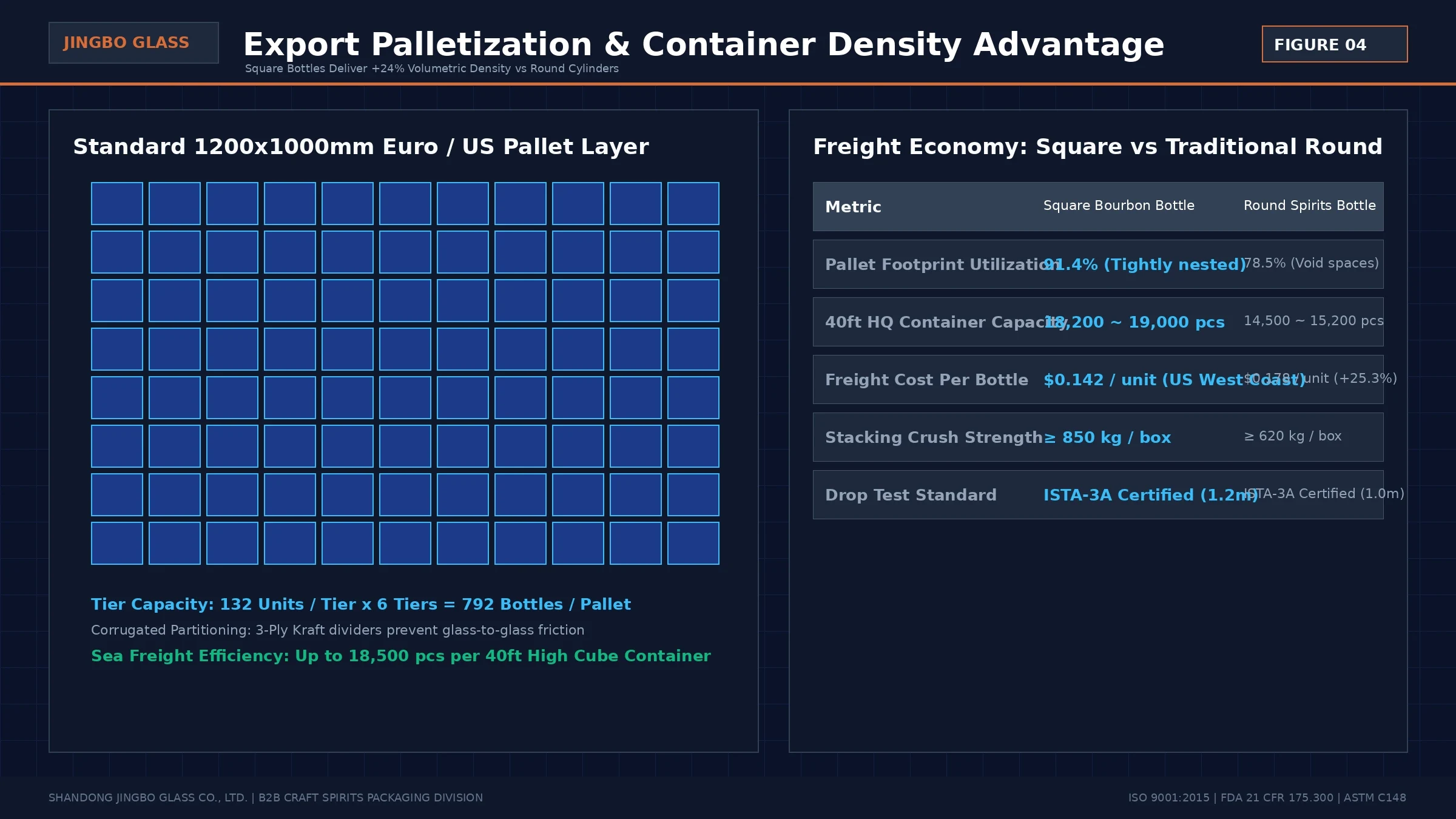
5. Export Logistics Advantage: +24% Volumetric Density Over Cylinders
While square bottles demand rigorous forming tolerances, they deliver an overwhelming financial advantage in international ocean logistics: volumetric packing density. Cylindrical bottles leave continuous empty interstitial voids when packed on pallets, resulting in only 76% to 79% pallet footprint utilization.
Square bottles, by contrast, pack in a true rectilinear grid, achieving 91.4% pallet utilization. For craft distilleries importing full container loads (FCL), the economics are compelling:
- Container Loading Capacity: A standard 40ft High Cube (HQ) container accommodates approximately 14,800 to 15,200 round 750ml bottles. Packed with our square 750ml bottles, container capacity increases to 18,200 to 19,000 units (+24.3% more bottles per ocean crossing).
- Ocean Freight Cost Per Bottle: With container freight rates averaging between $2,800 and $4,200 from Qingdao port to US West Coast hubs (Long Beach/Oakland), packing 3,400 additional bottles per container slashes inbound freight cost by $0.035 to $0.048 per unit.
- Crush-Resistant Pallet Integrity: Because flat sidewalls distribute vertical stacking compression evenly across cardboard tier dividers, pallet columns resist shifting and crushing. Stacking crush resistance exceeds 850 kg per pallet tier, verified under ISTA-3A transit testing.
Explore Complete Spirits Packaging & Technical Guides
Frequently Asked Questions: Square Liquor Bottle Manufacturing
Engineering Your Distillery’s Next Signature Square Profile
Whether you require fast-dispatch stock square bourbon containers from our 40,000 m² warehouse or need our CNC mould engineers to draft a bespoke heavy-base private bottle with custom embossing, Jingbo Glass delivers turnkey B2B manufacturing backed by ISO 9001 and FDA compliance.
Request Technical 2D/3D Drawings & Free Sample Kit