

When people compare tempered glass vs borosilicate glass, they are often trying to figure out which material performs better under heat, impact, or specific application conditions. The two are not the same type of glass. Borosilicate glass is defined by its chemical composition, while tempered glass is defined by the strengthening process it goes through. Understanding how tempered glass is made helps explain why they behave differently.
How Is Tempered Glass Made?
The most common method is thermal tempering.
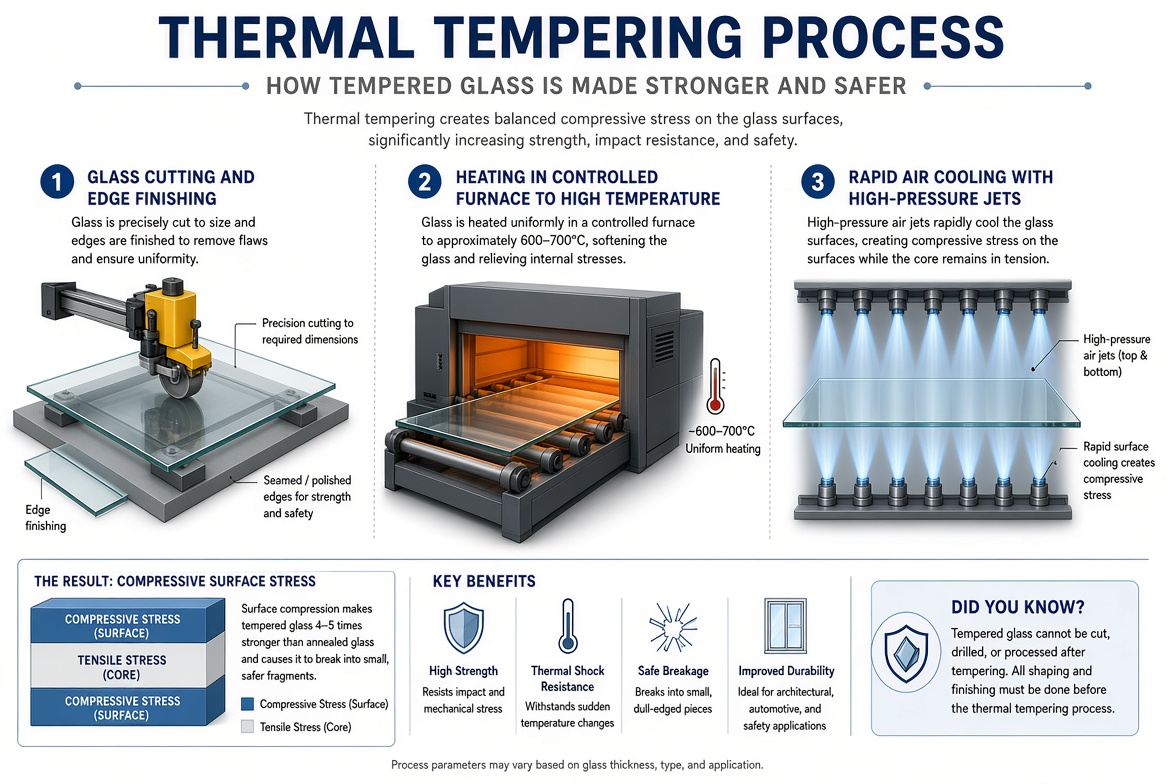
The glass is first cut to size. Edge finishing, drilling, and any other processing must be completed before tempering, because tempered glass is very difficult to cut or modify afterward.
The prepared glass is then heated in a controlled furnace to around 600–700°C. Once it reaches the right temperature, it is rapidly cooled with high-pressure air. The surface cools much faster than the inside, creating compressive stress on the surface and tensile stress in the core. This stress pattern makes the glass several times stronger than ordinary annealed glass and causes it to break into small, relatively harmless pieces instead of large sharp shards.
Final performance depends on the type and thickness of the original glass, how evenly it is heated, the cooling rate, and the quality control during production.
There is also a chemical strengthening method, mostly used for thinner glass. It works differently from thermal tempering. The right method depends on the product design and performance requirements.
Where Is Tempered Glass Commonly Used?
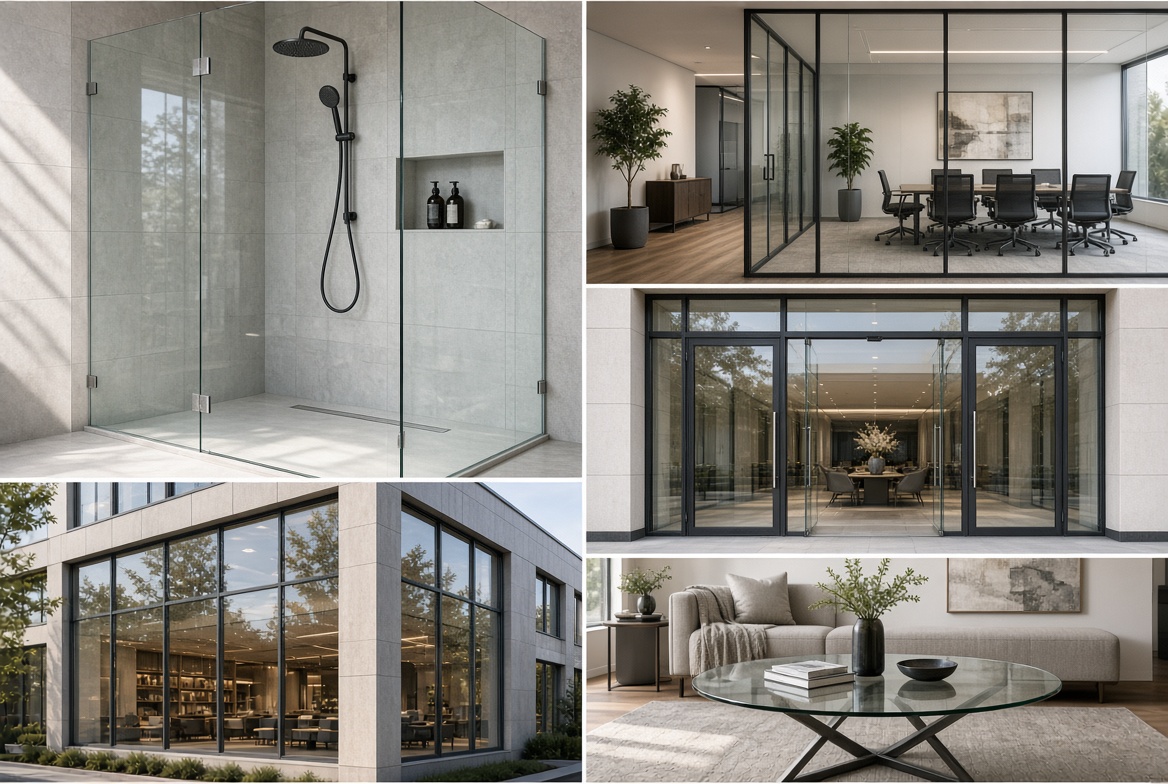
Because of its higher strength and safer breakage pattern, tempered glass is widely used in construction and industrial applications where impact resistance and safety matter. Common uses include:
- Glass doors and shower enclosures
- Building windows and partitions
- Furniture and tabletops
- Certain vehicle and equipment components
- Selected household and commercial glass products
Its main advantage is significantly higher mechanical strength compared with ordinary annealed glass of the same thickness. However, tempering alone does not automatically give the glass good resistance to sudden temperature changes. If a product needs to handle repeated heating and cooling, tempered glass may not be the best choice.
Tempered Glass vs Borosilicate Glass: What’s the Real Difference?
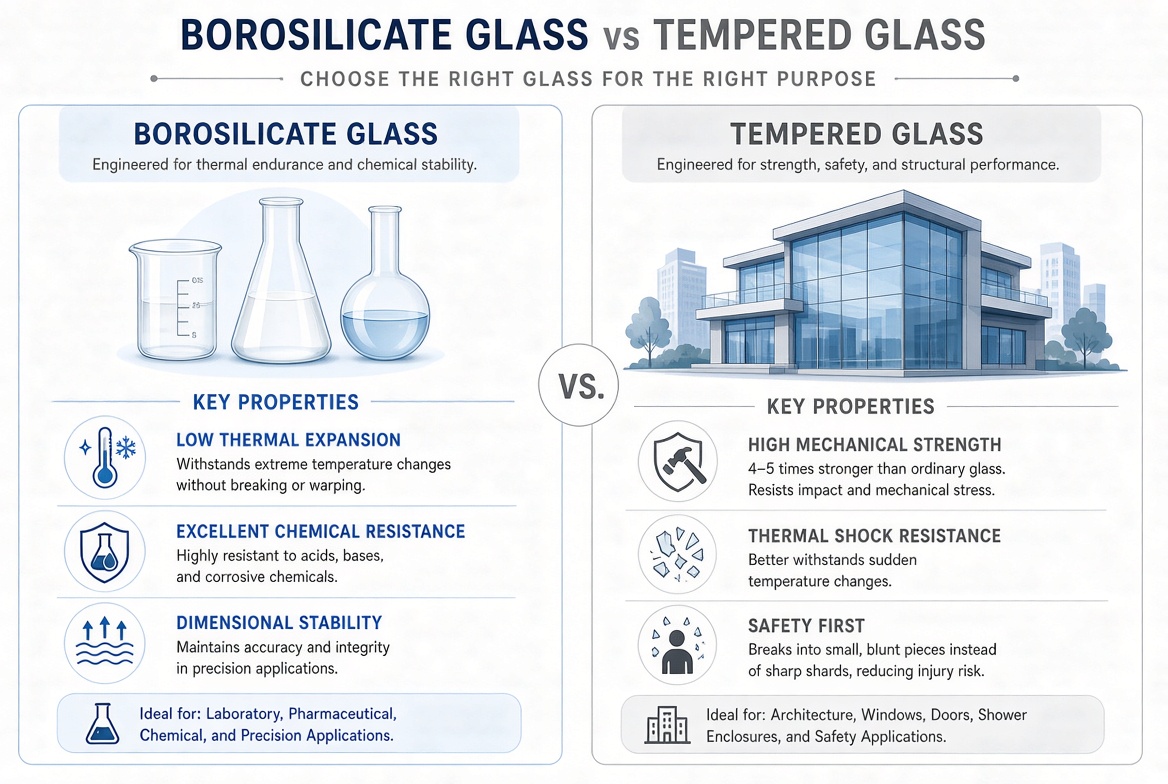
Although these two are often compared, they are not opposites. One refers to composition, the other to a processing method. The right choice still depends on the actual product and its requirements.
| Feature | Borosilicate Glass | Tempered Glass |
|---|---|---|
| Definition | Glass composition that contains boron oxide | Glass that has been strengthened through a tempering process |
| Main advantage | Low thermal expansion and good thermal-shock resistance | Higher mechanical strength |
| Chemical durability | Generally good (depends on the specific grade) | Depends on the base glass composition |
| Response to temperature changes | Usually suitable for rapid temperature changes | Depends on the base glass and design; tempering itself does not guarantee high thermal-shock resistance |
| Common applications | Laboratory glassware, some cookware, specialty containers | Architectural glass, doors, partitions, furniture |
| Cost | Influenced by grade, design, and manufacturing | Influenced by base material, size, and standards |
Which One Handles Heat Better?
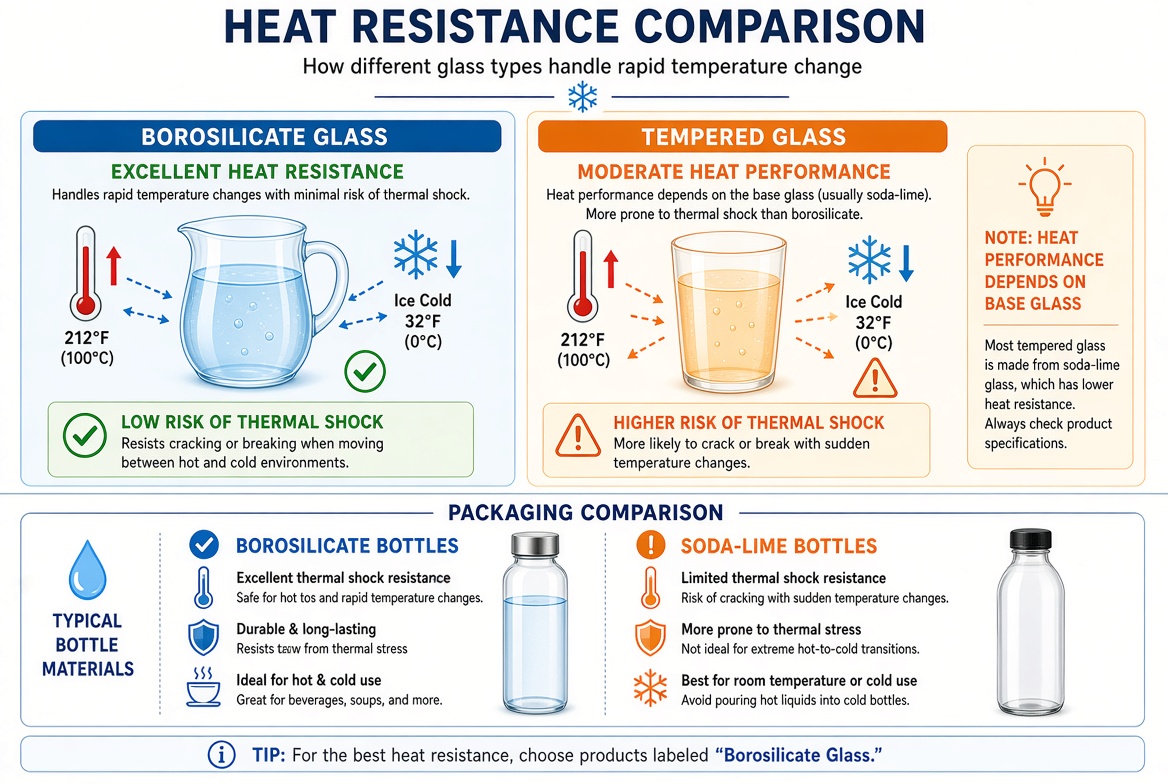
If the main requirement is resistance to rapid temperature changes, borosilicate glass is usually the better choice. Its low coefficient of thermal expansion gives it stronger thermal-shock resistance, which is why it is commonly used for laboratory glassware and many heat-resistant products.
Tempered glass becomes much stronger through processing, but its heat performance still largely depends on the original glass (most tempered glass is made from soda-lime glass). It should not be assumed that tempered glass automatically matches borosilicate glass in thermal-shock resistance.
Which One Is Better for Packaging?
For packaging, the decision should be based on filling temperature, storage conditions, and the specific performance needs of the product.
If the application requires strong resistance to thermal shock or higher chemical durability, borosilicate glass bottles are worth considering. For standard beverage or liquor bottles, traditional soda-lime glass is still the practical and cost-effective choice in most cases.
In the majority of packaging applications, tempered glass is not a direct substitute for other types of glass. Before choosing a material or process, it is important to clearly define the intended use and check the technical specifications provided by the supplier.
Frequently Asked Questions
Most tempered glass is produced by thermal tempering. The glass is heated to about 600–700°C and then rapidly cooled with air. This creates surface compressive stress that greatly increases its strength.
Not necessarily. Borosilicate glass generally offers better thermal-shock resistance because of its low thermal expansion. Tempered glass is stronger mechanically, but its heat performance still depends on the base glass.
In most cases, no. Tempered glass is rarely used for regular bottles. When packaging needs good thermal-shock resistance, borosilicate is usually the better option. Ordinary soda-lime glass remains the most common choice for beverage and liquor bottles.
It depends on the main requirement. Choose tempered glass when high mechanical strength and safer breakage are the priority. Choose borosilicate glass when resistance to sudden temperature changes or higher chemical durability is more important.