

The craft and independent distilling sector has entered a definitive phase of economic recalibration throughout 2025 and 2026. For distillery owners, operations directors, and procurement leaders, navigating today’s market requires managing a complex matrix of shifting capital expenditures, rising distillation equipment fabrication costs, volatile agricultural grain inputs, and tightening three-tier distribution access.
According to the latest Craft Spirits Data Project (CSDP) published jointly by the American Craft Spirits Association (ACSA) and Park Street, the number of active craft distillers in the United States contracted by 6.6% to 2,131 operations—marking the first time since tracking began that distillery closures outpaced new openings. As craft spirit sales volumes adjusted by roughly 8% to 11.7 million 9-liter cases, surviving and thriving requires a disciplined shift from unconstrained volume expansion to rigorous supply chain cost optimization.
Key Economic Takeaways for Distillery Executives:
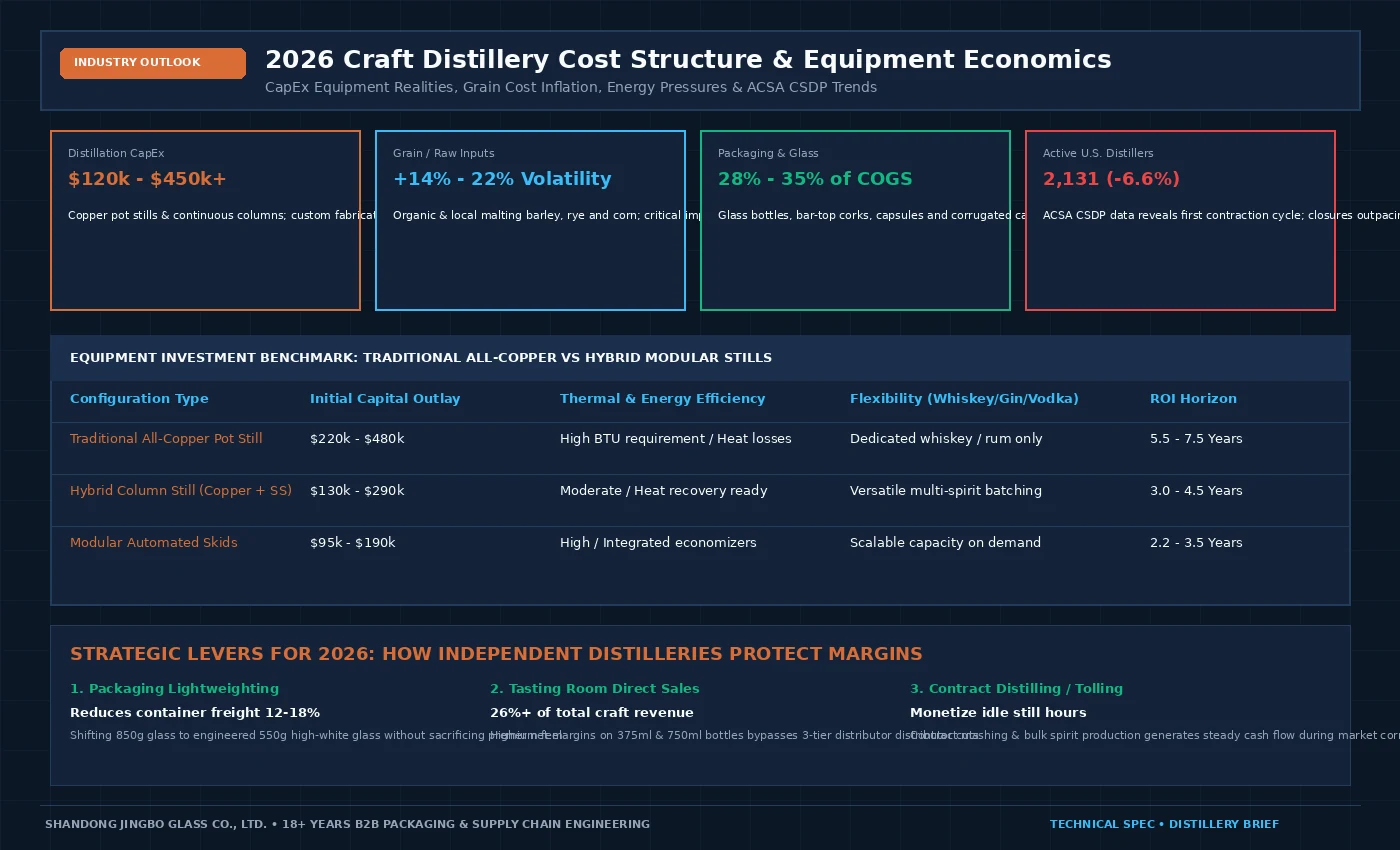
- Distillation CapEx Shifts: High industrial copper prices and metal fabrication overhead have pushed custom copper pot still investments to $150,000–$450,000+, driving adoption of modular hybrid column stills and heat-recovery economizers.
- Agricultural Inputs: Malting barley, rye, and non-GMO corn have seen regional price volatility between 14% and 22%, compelling distillers to maximize mashing extraction efficiency and monetize spent mash grains.
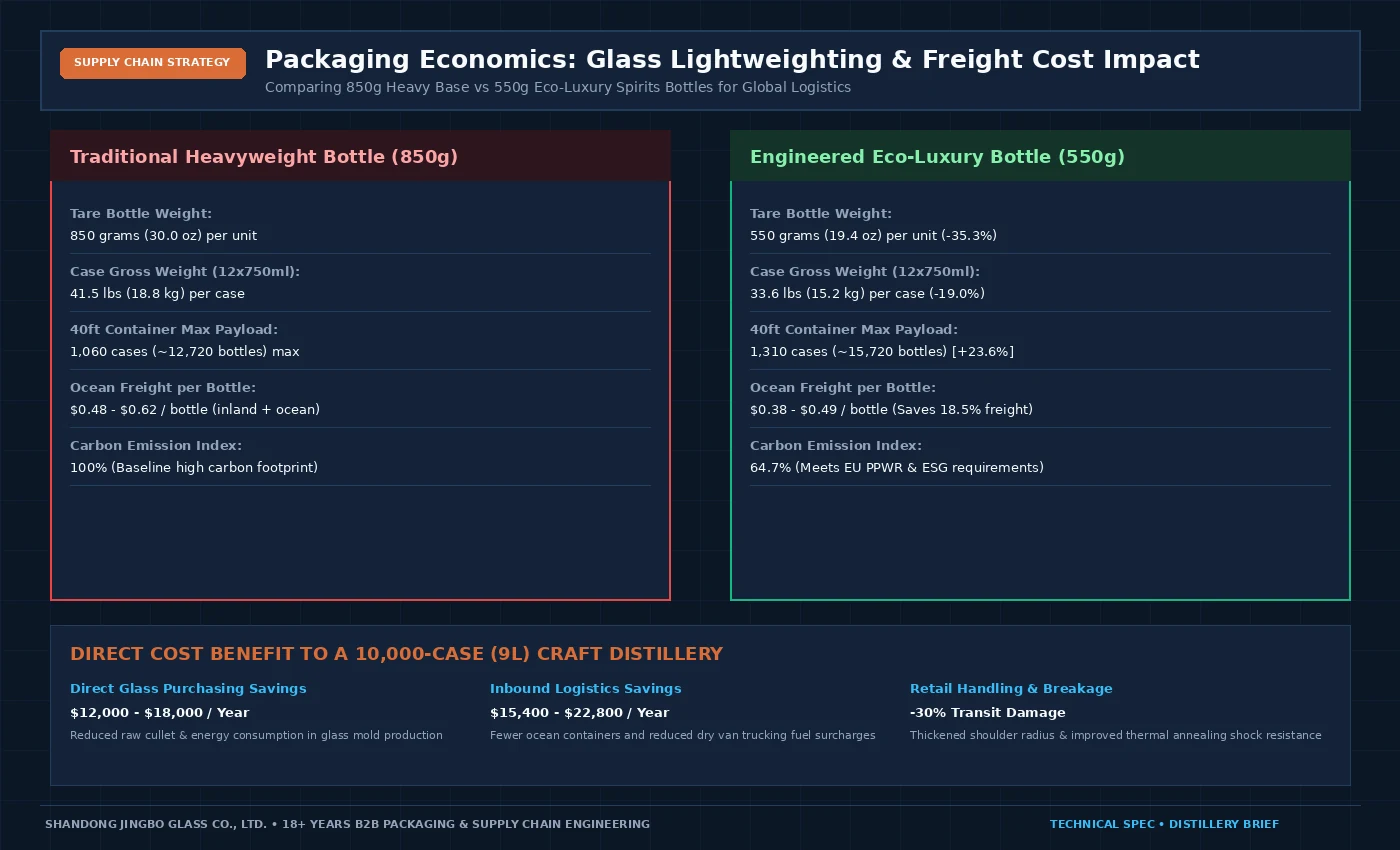
- Packaging COGS Relief: Packaging represents 28% to 35% of recurring Cost of Goods Sold (COGS). Shifting from ultra-heavy glass bottles (850g+) to precision-engineered eco-luxury containers (550g) delivers an immediate 12% to 18% savings in ocean and overland freight.
- Direct-to-Consumer (DTC) Momentum: Tasting room onsite retail and local bottle releases now represent over 26% of craft spirit revenues, insulating independent producers from distributor portfolio bottlenecks.
1. Distillation Equipment Economics: Copper Still Pressures & Modular Engineering
Copper remains the irreplaceable metallurgical gold standard in spirits distillation due to its high thermal conductivity and chemical ability to precipitate foul-smelling sulfur compounds during vapor-phase reflux. However, sustained volatility in global industrial copper markets and specialized coppersmith labor costs have substantially inflated lead times and equipment price tags.
Where prospective distillery founders previously committed entire capital rounds to monumental all-copper pot stills, operators in 2026 are increasingly deploying hybrid distillation systems. These setups pair a stainless steel boiler kettle and lower column with a high-efficiency copper helmet, copper packing sections, and modular multi-plate columns:
- Capital Preservation: Hybrid systems lower initial equipment acquisition costs by 35% to 45% compared to monolithic copper pot stills while delivering identical organoleptic spirit profiles.
- Process Versatility: Modular plate columns allow a single equipment footprint to produce full-flavored pot-distilled bourbon and rum on one day, and high-purity 96% ABV neutral spirits for gin or vodka the next.
- Thermal Efficiency: Modern skid-mounted stills feature closed-loop condenser cooling and condensate pre-heaters, reducing distillery boiler energy costs by up to 28%.
2. Agricultural Volatility: Grain Sourcing, Mash Efficiency, and Byproduct Management
Grain is the foundational raw cost center for whiskey, bourbon, and grain-to-glass vodka. Weather-driven harvest fluctuations and regional supply pinches have created noticeable spreads between commodity commercial grains and heritage, locally malted grains:
| Raw Grain / Input | 2025-2026 Cost Trend | Impact on Mash Cost | Distillery Counter-Strategy |
|---|---|---|---|
| Distiller’s Yellow Corn (#2) | Moderate Stability | Baseline (Standard) | Forward-contracting 6-12 months with regional agricultural elevators |
| Craft Malting Barley (2-Row) | +12% to +18% Volatility | High (+0.18/Proof Gallon) | Optimizing high-diastatic malts to reduce enzyme adjunct requirements |
| Rye (Cereal & Heritage) | +15% to +22% Volatility | Moderate to High | Adjusting beta-glucanase rest periods to prevent mashing stuck lauters |
| Blue Agave / Tequilana Weber | Post-Peak Correction | Downward per Kilo | Securing long-term NOM-certified bulk supply agreements in Jalisco |
To defend gross margins, craft distillers are refining enzymatic conversion protocols to push starch-to-alcohol yields past 5.5 to 5.8 proof gallons per bushel, while partnering with local cattle farms or municipal composting digesters to turn spent wet grains (stillage) into revenue-generating byproduct credits.
3. Packaging Economics: The Glass Lightweighting Revolution
While distillers have limited control over international grain markets or natural gas tariffs, packaging specification is a 100% controllable cost driver. For years, craft spirits equated premium quality with massive, heavy-bottom glass bottles weighing 850g to 1,000g each. In 2026, freight economics and environmental regulations (including EU Packaging and Packaging Waste Regulation – PPWR) have made ultra-heavy containers an unsustainable liability.
The Mathematical Impact of Bottle Lightweighting:
By transitioning from an 850g heavyweight bottle to an engineered 550g high-flint glass bottle, a distillery reduces tare case weight by 7.9 pounds per 12-pack. In a standard 40ft HQ ocean container, this enables shippers to pack up to 1,310 cases (15,720 bottles) without exceeding federal 44,000-lb gross payload regulations—a 23.6% increase in per-container bottle capacity and an average savings of $0.12 to $0.18 per bottle in freight overhead.
Modern glass mold engineering achieves this lightweighting without compromising the substantial tactile handfeel consumers expect. By optimizing shoulder curvature radius, distributing wall thickness evenly along the mold parison, and utilizing ultra-pure crystal flint glass, a 550g bottle matches the luxury shelf presence of older 850g models while achieving exceptional thermal-shock resistance.
4. Tasting Rooms and Strategic Cash-Flow Diversification
With multi-state wholesaler portfolios overcrowded and consolidation creating barriers for emerging brands, craft distillers are turning their attention inward toward direct-to-consumer (DTC) channels:
- Tasting Room Superior Margins: Retailing bottles directly across the bar yields full retail pricing ($38–$65 per bottle) without sacrificing 25-30% distributor cuts and 30-35% retail markups.
- Contract Distilling & Tolling: Distilleries with excess boiler and still capacity are generating steady monthly cash flow by offering contract mashing, stripping runs, and private-label barrel aging for non-distiller producers (NDPs).
- Agile Bottle Formats: Demand for 50ml sampler packs, 200ml pocket flasks, and 375ml tasting sets has grown exponentially, enabling consumers to explore high-end craft expressions at an accessible entry price point.
Strengthen Your Distillery Supply Chain with Jingbo Glass
Shandong Jingbo Glass Co., Ltd. partners with over 300 commercial and craft distilleries across North America, Europe, and the Asia-Pacific. We engineer high-strength lightweight 750ml bottles, custom private-mold spirits carafes, bar-top cork finishes, and export-grade partition cartons designed to reduce landed COGS.
Frequently Asked Questions (FAQ)
Why have distillation equipment costs increased so rapidly in recent years?
Rising industrial copper prices, increased stainless steel raw material costs, higher industrial energy tariffs for equipment fabricators, and a shortage of specialized artisan coppersmiths have collectively pushed fabrication expenses up by 25% to 40% across North America and Europe.
How can craft distillers counteract rising grain input expenses?
Distillers protect margins by forward-contracting grains directly with regional agricultural cooperatives, utilizing higher-diastatic malts to maximize enzyme starch conversion, optimizing milling grind size to prevent stuck sparges, and monetizing spent grain stillage as livestock feed.
Does lightweight glass compromise bottle durability or luxury perception?
No. Precision computer-aided mold design distributes glass thickness evenly across critical stress zones, eliminating fragile micro-thin walls while maintaining crystal-clear clarity. Modern 550g eco-luxury bottles preserve premium shelf presence while significantly reducing freight freight overhead and carbon taxes.