

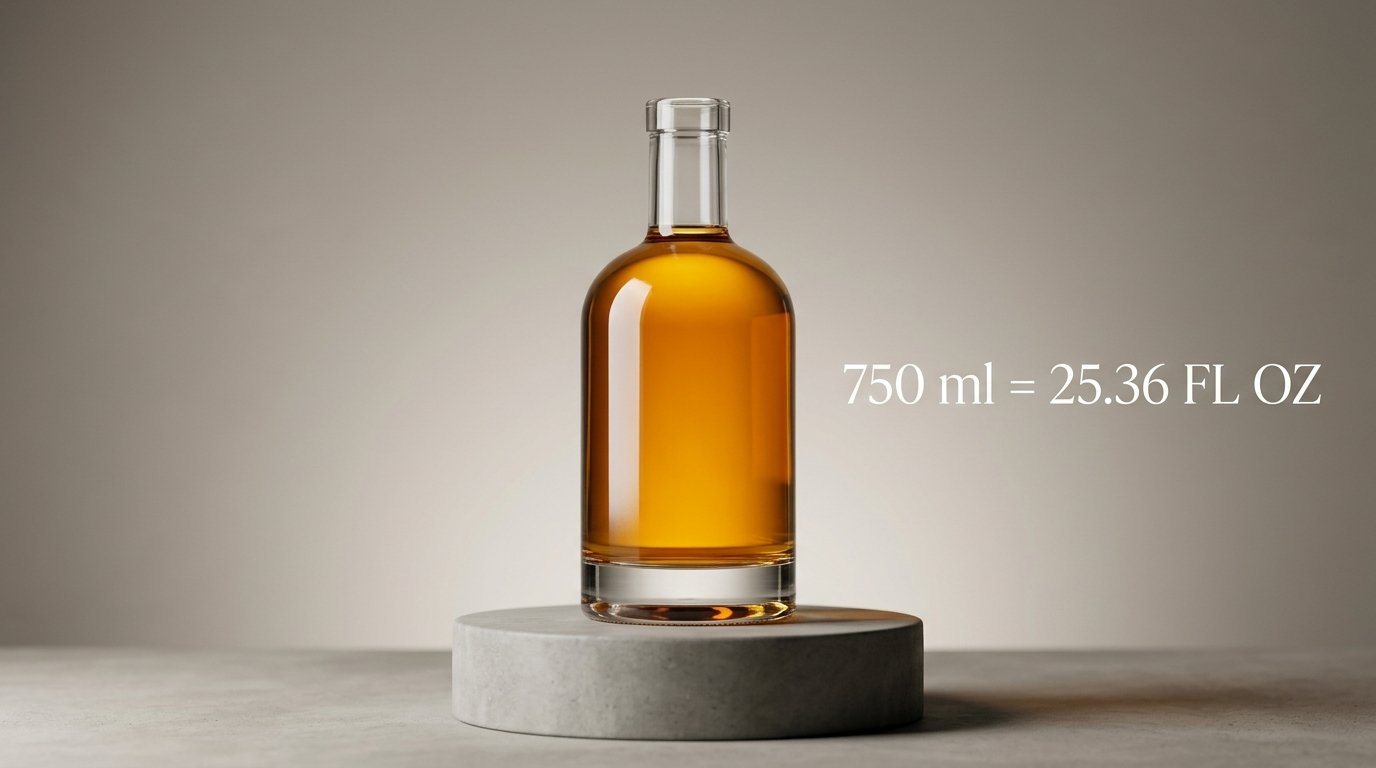
Here is the quick, no-nonsense answer you came for:
If you round it up like most commercial distilleries and beverage brands do, it’s 25.4 fl oz.
Now, if you only needed to win a trivia bet or calculate how many drinks you can pour at tonight’s party (it’s roughly 16 standard 1.5-ounce shots, assuming your bartender isn’t heavy-handed), you’re free to close this tab.
Still here? That probably means you’re designing a bottle, formulating a spirit, sourcing closures, or trying to figure out why your pre-cut packaging labels look off-center.
And if that’s the case, strap in. Because in the glass manufacturing world, confusing fluid ounces with bottle geometry is the fastest way to turn a $10,000 mold investment into a pile of expensive glass paperweights.
Let’s talk about what actually happens when you translate 750 ml into real-world packaging.
1. US Fluid Ounces vs. Imperial Ounces: The Transatlantic Headache
Before you finalize your label typography, make sure you know which “ounce” your legal department is talking about.
Physics doesn’t care about borders, but customs officers certainly do:
- 1 US Fluid Ounce = 29.5735 ml
- 1 UK / Imperial Fluid Ounce = 28.4131 ml
If you sell a 750 ml bottle in the United States, your label reads 25.4 fl oz. If that exact same 750 ml bottle crosses the Atlantic to the UK, it equals 26.39 Imperial fluid ounces.
And whatever you do, please don’t confuse fluid ounces (volume) with dry ounces (weight). A fluid ounce measures the space a liquid occupies; a dry ounce measures how heavy it is on a scale.
If someone in your procurement meeting says, “Just weigh 25 ounces of gin into the bottle,” politely hand them a coffee and remind them that alcohol has a specific gravity of around 0.94. You’ll either end up with underfilled bottles or an angry visit from the TTB (Alcohol and Tobacco Tax and Trade Bureau).
2. Why 750 ml? The Strange Story of “A Fifth”
Ever wondered why the entire global spirits industry settled on this oddly specific number? Why not a round 700 ml? Or an even 1,000 ml?
Blame 19th-century American drinking habits and metric European diplomacy.
Back in the late 1800s, commercial liquor in the US was legally sold by the US gallon (128 fl oz). But buying a full gallon was pricey, and quart bottles (32 oz) were often bootlegged or diluted. Retailers started selling what became colloquially known as “A Fifth”—literally one-fifth of a gallon, or 25.6 US fluid ounces.
When the US metricated distilled spirits packaging in 1979, the federal government had to pick a standard metric bottle that was close enough to “A Fifth” so distillers wouldn’t have to redesign all their wooden shipping crates and bar shelving.
750 ml (25.36 fl oz) was the closest international equivalent. The nickname stuck, the crates fit, and the 750 ml standard became gospel across North America.
(Fun fact: The European Union actually mandates 700 ml as the standard spirits bottle size under Directive 2007/45/EC. So if you’re exporting whiskey from Kentucky to London or Berlin, you have to run two completely separate glass molds. For complete volume calculations and regulatory specs, check out our guide on 700ml to oz conversion and spirits bottle engineering.)
3. The 2027 Spirits Bottle Conversion Cheat-Sheet
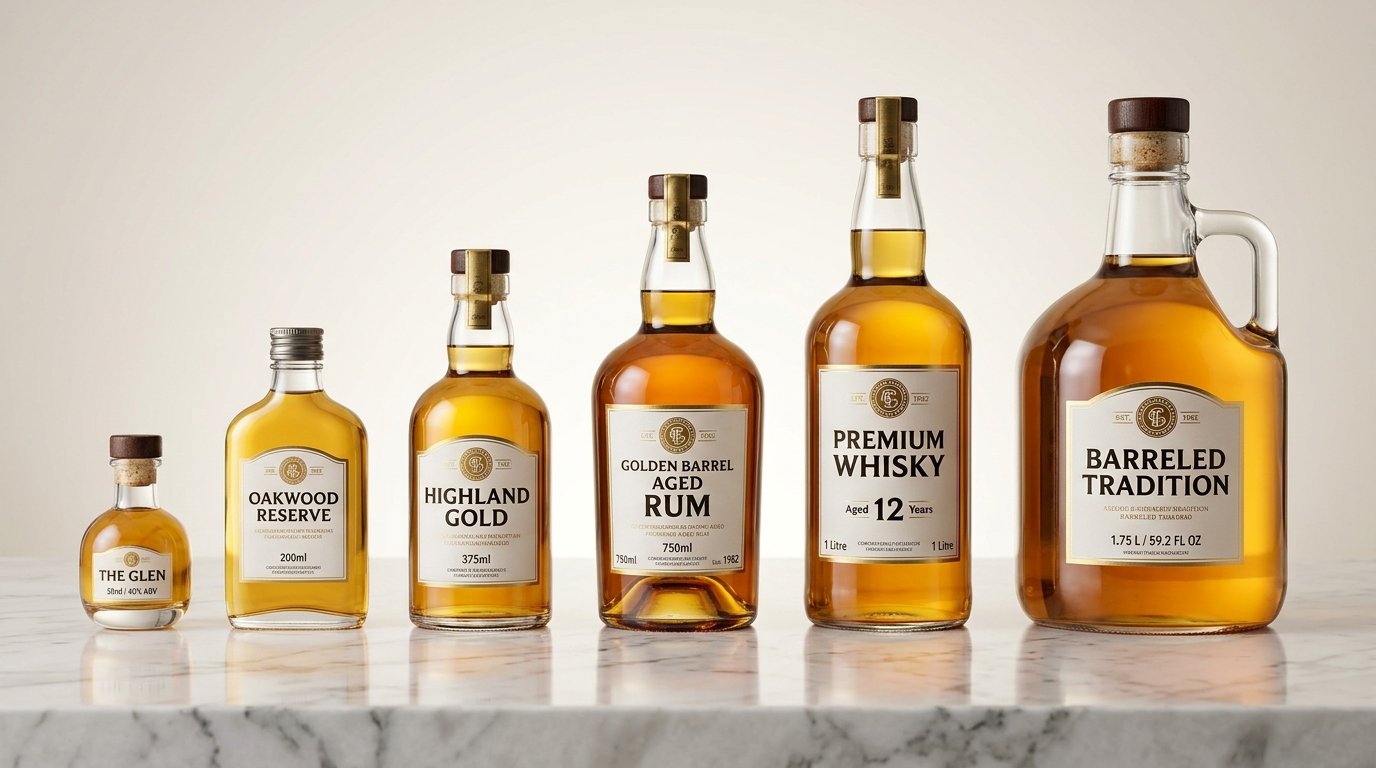
Whether you’re developing custom molds or buying stock pallets, here is how the most common metric bottle sizes translate into US fluid ounces and approximate pours:
| Bottle Size (Metric) | Industry Common Name | US Fluid Ounces (fl oz) | UK / Imperial Ounces | Standard 1.5 oz Pours |
|---|---|---|---|---|
| 50 ml | Miniature / “Nip” | 1.69 fl oz | 1.76 imp fl oz | ~1 shot |
| 100 ml | Travel / Sampler | 3.38 fl oz | 3.52 imp fl oz | ~2.2 shots |
| 200 ml | Flask / “Half-Pint” | 6.76 fl oz | 7.04 imp fl oz | ~4.5 shots |
| 375 ml | “Demi” / Half Bottle | 12.68 fl oz | 13.20 imp fl oz | ~8.4 shots |
| 700 ml | Standard EU Spirits Size | 23.67 fl oz | 24.64 imp fl oz | ~15.7 shots |
| 750 ml | Standard US Spirits / Wine | 25.36 fl oz (25.4) | 26.39 imp fl oz | ~16.9 shots |
| 1,000 ml (1L) | Liter / Duty-Free Standard | 33.81 fl oz | 35.20 imp fl oz | ~22.5 shots |
| 1,750 ml (1.75L) | “Handle” / Party Size | 59.17 fl oz | 61.59 imp fl oz | ~39.4 shots |
4. The Engineering Trap: Why a 750 ml Bottle Can’t Just Hold 750 ml
Here is where 90% of rookie brand owners get burned when commissioning custom glass molds.
If you design a glass bottle with an internal volume of exactly 750 ml (25.36 fl oz) right to the very lip of the rim, your product will fail before it ever leaves the warehouse.
In glass engineering, there is a massive distinction between two terms:
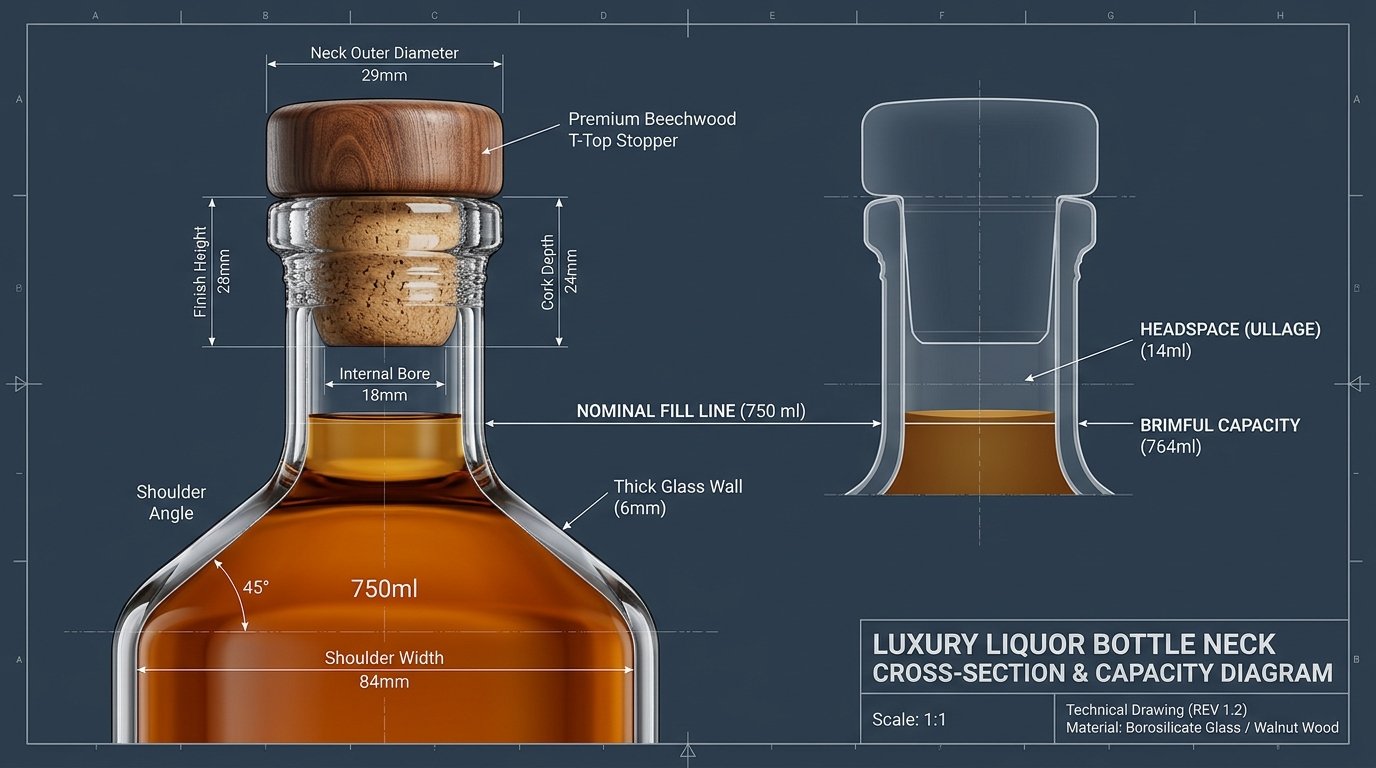
- Nominal Capacity (标称容量): The volume of product declared on your commercial label (750 ml / 25.4 fl oz).
- Brimful Capacity (满口容量): The total volume the bottle can hold when liquid is filled completely to the brim.
For a 750 ml bottle, the brimful capacity must always be 765 ml to 780 ml (around 25.9 to 26.3 fl oz).
Why that extra 15 to 30 ml cushion?
- Thermal Expansion: Liquids expand when temperatures rise. If your shipment sits in a shipping container baking under the Arizona sun or inside a tropical cargo hold at 45°C (113°F), the alcohol expands. Without that expansion gap, the liquid will hydrostatically blow your synthetic T-top cork clean out of the neck—or worse, crack the shoulder of the bottle.
- The Cork Insertion Displacement: When your bottling line plunges a dense synthetic cork or natural wood stopper into the neck, the cork displaces 3 to 7 ml of volume and compresses the trapped air inside the neck. Without sufficient ullage (headspace), that compressed air creates high internal pressure that causes slow weeping or seepage around the closure.
5. Summary: How to Spec Your Next 750 ml Bottle Run
Before you approve that final 3D CAD drawing or sign off on your pallet purchase order, keep this three-point checklist on your desk:
- Labeling: In the US, state 750 ml (25.4 fl oz). Don’t round to 25.3 or 25.36 on consumer labels—25.4 is the federal TTB convention.
- Mold Engineering: Ensure your mold drawings specify a brimful capacity of at least 770 ml ± 5 ml to give your filling line a clean, consistent fill line (usually 45–60 mm below the top lip).
- Closure Tolerance: Match your bottle’s internal bore diameter (typically 18.5 mm or 21.5 mm for spirits) with the correct cork shank density so liquid doesn’t seep when the bottle is laid flat during shipping.
Engineering Resource: Planning a custom bottle geometry from scratch? Read our technical breakdown on custom glass bottle design from concept to mass production or learn why high-flint soda-lime glass beats tempered glass in our tempered glass vs. borosilicate packaging guide.
Frequently Asked Questions
750 ml is equivalent to exactly 25.3605 US fluid ounces. On commercial spirits and wine packaging in the United States, this is legally and conventionally rounded to 25.4 fl oz.
A standard 750 ml liquor bottle contains approximately 16.9 standard 1.5-fluid-ounce shots. For bar inventory and party planning, it is commonly estimated at 16 to 17 servings.
Historically in the late 19th-century US, commercial liquor was sold as one-fifth of a US gallon (25.6 fl oz). When the US government transitioned distilled spirits packaging to metric sizing in 1979, 750 ml (25.36 fl oz) was selected as the closest international equivalent, and the historical nickname remained.
A 750 ml bottle requires a total brimful capacity of 765 to 780 ml to provide headspace (ullage). This extra volume absorbs liquid thermal expansion in warm cargo environments and accommodates cork stopper displacement without creating high hydrostatic pressure that leads to leaking.
Almost never. Thermal tempering requires uniform glass thickness and rapid air quenching. Irregular bottle geometries with heavy crystal bases create severe internal tension imbalances during cooling that cause spontaneous shattering. High-flint soda-lime glass with controlled annealing is the industry standard for spirits packaging.
Have Questions About Your Custom Bottle Dimensions?
We engineer custom high-flint glass bottles for craft distilleries and beauty brands worldwide. Send over your 2D drawings or sample concepts for a free technical feasibility review.
Connect With Our Engineering Team