

Distillery Sourcing Brief: Sourcing High-Spec Glass Rum Bottles
For craft and commercial rum distilleries, sourcing an export-grade glass rum bottle requires locking down three non-negotiable packaging parameters: Super Flint optical purity (Fe₂O₃ < 0.025%) to showcase amber barrel aging without greenish color distortion; an 18mm to 25mm heavy base punt to lower center of gravity and prevent bottle tipping on 120-BPM filling conveyors; and a 21.5mm ± 0.35mm calibrated bore finish paired with high-density synthetic T-top corks or 30x60mm ROPP caps to eliminate vapor leakage on 57%+ Navy Strength overproof spirits.
Walk into any premier spirits boutique or craft cocktail lounge in North America or Europe, and look at the centerpiece back bar. You will rarely find an award-winning rum presented in a generic, lightweight wine container. From Caribbean heritage distilleries in Barbados and Jamaica to emerging craft blending houses across Florida and California, master distillers and procurement directors recognize that selecting the right custom glass rum bottle is the ultimate anchor of retail shelf price.
A 12-year Solera dark rum packaged in an ordinary 450g flint container with thin 6mm glass bottoms struggles to justify a 5 retail price point. The exact same aged liquid transferred into an 820g super flint decanter with a 20mm crystal base commands 5 to 5 on retail shelves. Yet between industrial mold tooling and high-speed packaging lines, distillery operations frequently stumble over engineering oversights: conveyor line tipping, thermal shock fractures during winter rinses, and alcohol vapor seepage under hot export transit. Below is our complete engineering teardown of how commercial rum bottles are engineered, tested, and procured.
1. Super Flint vs. High Flint: Why Glass Purity Dictates Shelf Value
Rum spans the broadest color spectrum in commercial spirits—ranging from crystal-clear unaged white Agricole rums to golden cask finishes and dense, mahogany-tinted black rums. This spectrum exposes optical impurities in glass faster than nearly any other distilled liquor.
Standard glass bottles utilize raw batch formulations containing 0.08% to 0.12% ferric oxide (Fe₂O₃). Under natural daylight and LED shelf spots, this iron content imparts a visible greenish-blue undertone. When filled with an ultra-pure white rum, the liquid appears cloudy and discolored, triggering immediate consumer hesitation regarding chemical purity. Premium rum producers strictly mandate Super Flint glass (Extra Flint):
- Strict Iron Threshold (<0.025% Fe₂O₃): Our continuous electric-boosted furnace uses low-iron quartz sands and high-temperature bubbling clarification to achieve 91.5%+ light transmission, completely eliminating background tints.
- Optical Amplification for Solera Rums: Super flint glass features a higher refractive index, catching ambient back-bar lighting to illuminate the natural mahogany and reddish-amber hues derived from bourbon and sherry cask aging.
- Consistent Wall Thickness: Individual section gob feeders guarantee uniform sidewall thickness (minimum 3.2mm), preventing optical lensing distortion when the bottle is viewed from the side.
2. The 18mm–25mm Heavy Punt: Line Stability vs. Premium Hand-Feel
Distillery founders frequently request base thicknesses exceeding 25mm for pure physical presence. While heavy glass delivers a commanding tactile feel, packaging line managers know that improper weight distribution creates catastrophic conveyor jams. Achieving the perfect heavy base requires balancing three mechanical forces:
Low Center of Gravity (CG)
By engineering an 18mm–25mm solid glass bottom into a classic stubby cylindrical profile, over 45% of total bottle mass is anchored within the bottom 30mm. This low CG neutralizes centrifugal tipping forces as bottles enter starwheels on 120-BPM monoblock rinse-fill-cap systems.
Annealing Lehr Stress Relief
Bases exceeding 18mm cool far slower than thin sidewalls. In our computer-controlled annealing lehrs, cooling cycles are extended by 35% to eliminate differential thermal stress. All finished rum bottles are verified under cross-polarized light meters (polarimeters) to maintain ASTM stress grades below Level 2.
Thermal Shock Tolerance
Craft distilleries that hot-rinse bottles or bottle in unheated winter warehouses demand thermal shock resistance. Our heavy-base rum bottles withstand an instant temperature delta (ΔT) of ≥ 42°C without bottom fracture, compared to industry norms of just 35°C.
3. Neck Finishes & Leak Prevention for High-Proof Rums
Rum exports frequently encounter harsh tropical maritime climates. Overproof expressions (ranging from 50% Navy Strength to 75.5% ABV) build internal vapor pressure during ocean transit through equatorial waters, exposing faulty bore tolerances.
Distilleries must carefully select their neck finish based on ABV and distribution logistics:
| Closure Type | Target Rum Style | Bore Dimensional Spec | Engineering Advantage & Leak Defense |
|---|---|---|---|
| 21.5mm Bar-Top Cork | 40%–46% ABV Cask-Aged & Sipping Rums | 21.5mm ± 0.35mm internal bore; depth ≥ 22mm | Features an entry chamfer that guides 22.8mm agglomerated synthetic corks without shearing edges. Provides premium bartender pop without cork dust crumbling into liquid. See our bar-top cork fitment guide for full tolerance tables. |
| 30x60mm ROPP Aluminum | 50%–75.5% ABV Overproof & High-Volume Rums | Continuous thread OD 29.8mm ± 0.2mm | Saranex-lined aluminum screw caps hold up to 1.5 bar internal pressure, delivering a 100% leak-proof hermetic seal impervious to humidity shifts. |
| Transfer Ring Collar | High-Speed Automatic Bottling Lines | Ring outer diameter 34.0mm ± 0.5mm | Provides structural ledge for gripper arms and prevents heat-shrink capsules from sliding downward during warehouse storage. Read our guide on heavy base whiskey bottle engineering for starwheel fitment details. |
4. Standard 750ml Rum Bottle Engineering Benchmark Matrix
To assist packaging engineers and procurement teams in sourcing stock or custom moulds, below are standard manufacturing benchmarks for a commercial 750ml cylindrical heavy-base rum bottle:
| Engineering Parameter | Nominal Specification | Allowable Tolerance | Commercial & Operational Rationale |
|---|---|---|---|
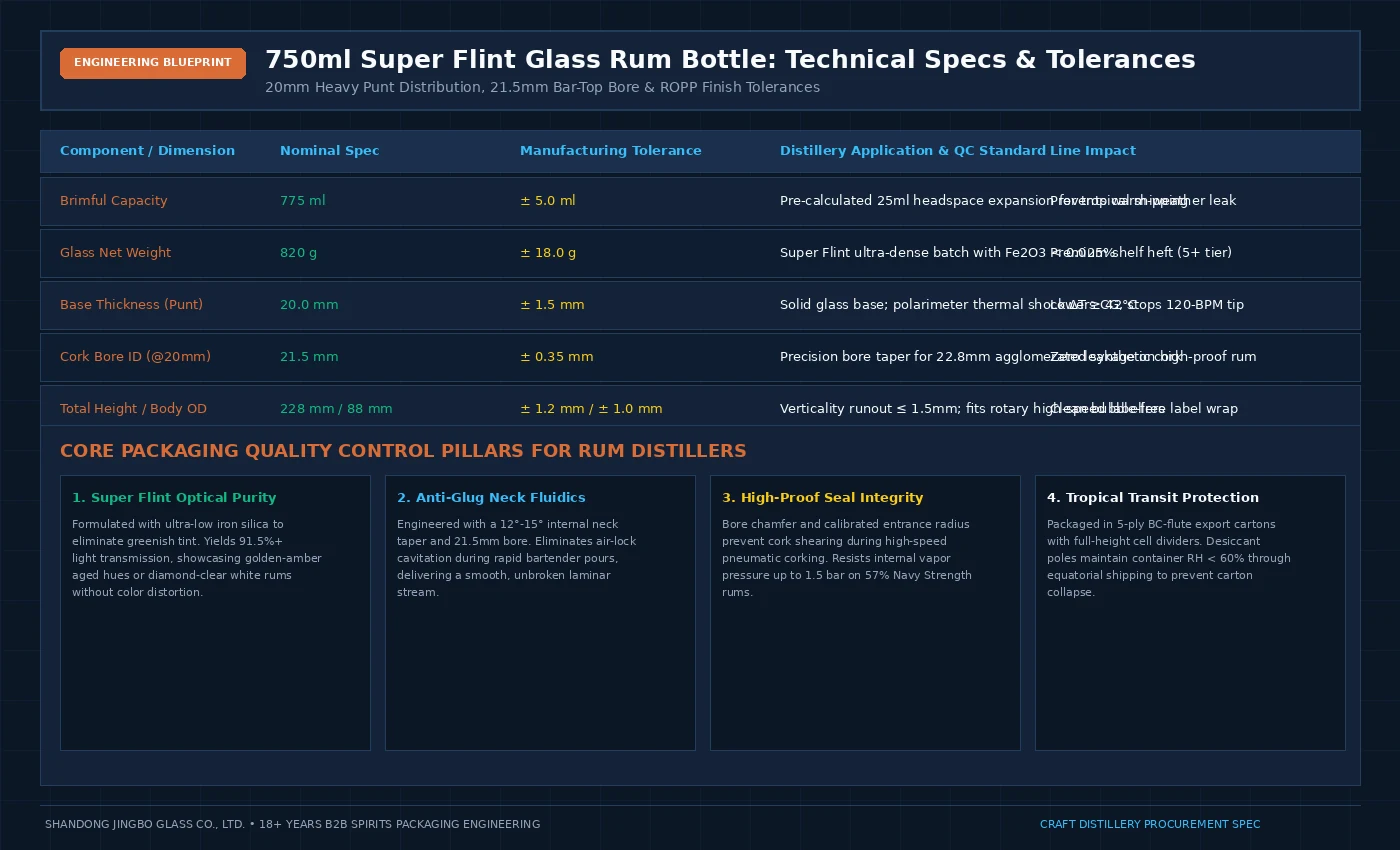
| Brimful Capacity | 775 ml | ± 5.0 ml | Ensures 25ml expansion headspace preventing cork push-out under summer warehousing |
| Net Glass Weight | 820 g | ± 18.0 g | Substantial luxury hand-feel aligning with top-shelf spirits retail categories |
| Total Height | 228 mm | ± 1.5 mm | Fits standard North American 12-pack master shippers and retail shelving tiers |
| Body Outer Diameter | 88 mm | ± 1.0 mm | Accommodates rotary pressure-sensitive labeling cylinders without seam wrinkling |
| Base Punt Thickness | 20.0 mm | ± 1.5 mm | Solid crystal base delivering visual depth and impact durability |
| Verticality Deviation | ≤ 1.5 mm | Max 2.0 mm | Guarantees straight bottle alignment under pneumatic labeling and filling nozzles |
5. Palletization, Ocean Freight, and Humidity Defense
Exporting glass containers across Pacific and Atlantic routes requires stringent packaging discipline. A standard 40-foot High Cube (40' HQ) container holds approximately 21,000 to 24,000 units of 750ml heavy-base rum bottles. Preventing micro-scratching (scuffing) and structural box collapse requires three physical layers:
- 5-Ply Corrugated Shippers (BC-Flute): Bottles are packed with full-height corrugated cell partitions. Direct glass-to-glass contact during 30 days of diesel engine vibration creates irreversible hairline scuffing; individual cell dividers eliminate friction damage.
- Standard Ti-Hi Configurations: Standard 1000mm × 1200mm fumigated export pallets are stacked 21 cartons per tier, 5 tiers high (Ti-Hi: 21 × 5 = 105 cartons per pallet). Pallets are bound with 23-micron stretch film and top honeycomb caps.
- Equatorial Desiccant Protection: Shipping containers transiting tropical waters generate internal container rain. We install calcium chloride desiccant poles to maintain interior relative humidity below 60%, safeguarding corrugated carton compression strength.
Frequently Asked Questions: Rum Bottle Sourcing & Custom Tooling