

If your distillery exports spirits to any EU member state — or plans to — the clock has already started. Regulation (EU) 2025/40, the EU’s new Packaging and Packaging Waste Regulation (PPWR), entered into force on February 11, 2025, with its core requirements taking general effect on August 12, 2026. For spirits brand owners and distillery procurement managers sourcing glass bottles from overseas manufacturers, this regulation fundamentally redefines who is legally responsible for packaging compliance — and the answer is you, the brand.
Unlike the old 1994 Packaging Directive (94/62/EC), which largely placed compliance responsibility on producers and importers of raw packaging materials, the PPWR’s brand-owner mandate means that the entity whose trademark appears on the bottle is the legal “packaging manufacturer” under EU law — even if the glass is sourced from a factory in China, the corks from Portugal, and the labels from a UK printer.
⚠ Already Effective: August 12, 2026
The PPWR’s core provisions — including chemical restrictions (PFAS limits, heavy metal caps), mandatory Technical Documentation, and the EU Declaration of Conformity — entered application on August 12, 2026. If your glass bottles contain components that exceed PFAS thresholds or use heavy-metal-based pigments without a registered derogation, you may already be out of compliance for EU market sales.
1. The Brand Owner Compliance Obligation — What It Means for Your Distillery
The PPWR eliminates the previous assumption that your packaging supplier handles compliance. Under Article 7 and related provisions, the brand owner (the entity whose trademark appears on the spirits label) must:
- Compile a Technical Documentation File that includes glass composition test reports, closure material specifications, label adhesive solubility data, foil/coating compatibility assessments, and recyclability grade calculations for the complete packaging unit.
- Sign and Hold an EU Declaration of Conformity (DoC) declaring the complete packaging system (glass + closure + label + foil + capsule) meets all applicable PPWR requirements.
- Conduct Bill-of-Materials Recyclability Assessment — evaluating whether individual label inks, label adhesives, neck foils, closure liners, and wax seals impair the glass container’s recyclability in EU sorting and processing facilities.
Practical implication: even if your Shandong or Shanxi glass manufacturer has already tested the base glass container and confirmed it meets ISO 7458 internal pressure and thermal shock standards, you as the brand owner must separately verify that every decorative element you’ve applied to that glass does not degrade the bottle’s recyclability grade from an EU-required A or B down to a non-compliant C, D, or E.
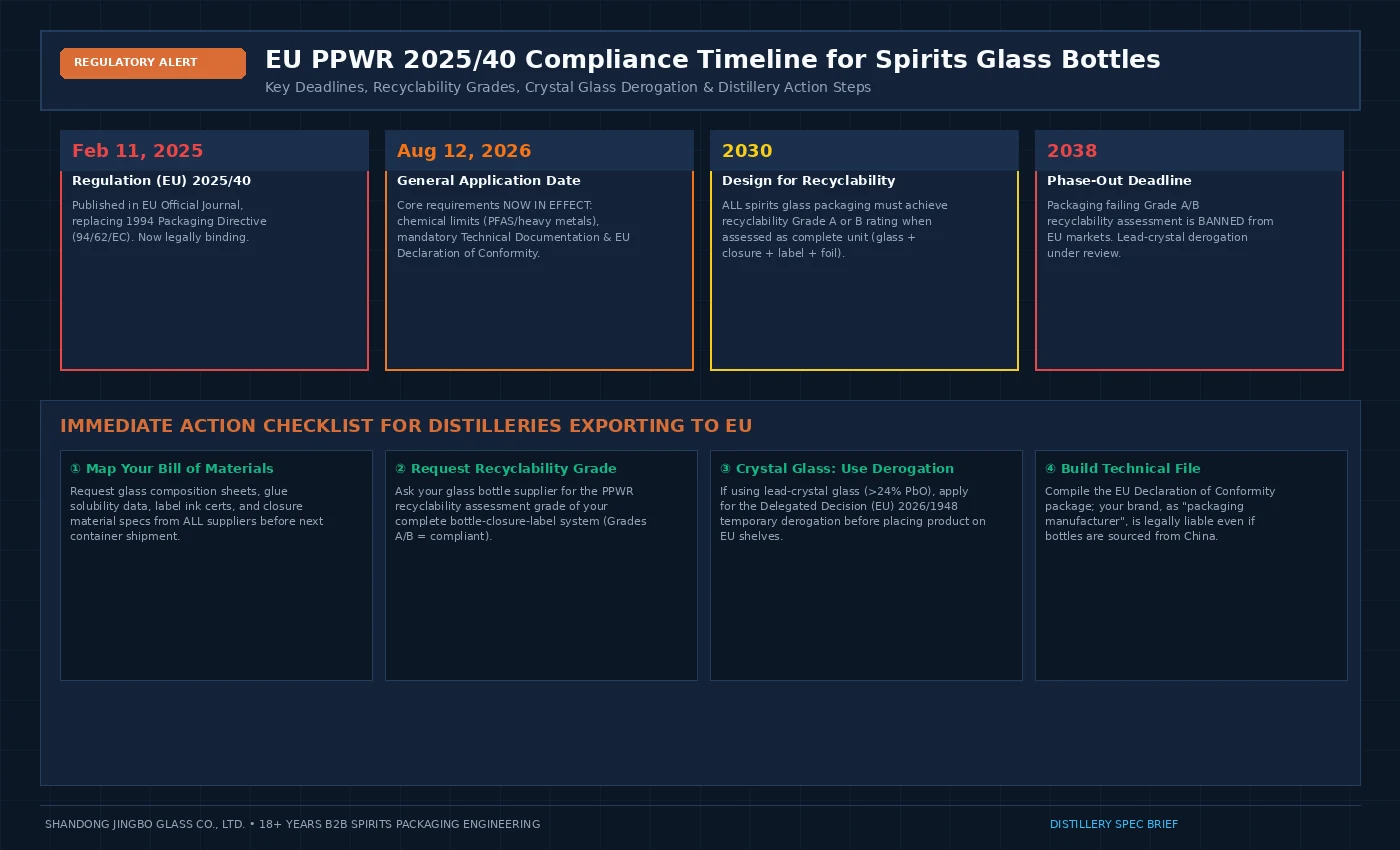
2. Key Compliance Deadlines Every Distillery Must Track
| Effective Date | Requirement | Impact on Spirits Glass |
|---|---|---|
| Feb 11, 2025 | Regulation (EU) 2025/40 in force | Replaces 1994 Directive; brand-owner mandate becomes law |
| Aug 12, 2026 ← NOW | General application of core requirements | PFAS/heavy metal limits active; Technical File & DoC mandatory; packaging minimization rules apply |
| 2030 | Design for Recyclability mandatory | All spirits bottles must achieve recyclability Grade A or B as a complete system (glass + all components) |
| 2038 | Non-compliant packaging phase-out | Bottles failing Grade A/B banned from EU market; lead-crystal derogation status under EU review |
3. The Crystal Glass Derogation: What Luxury Spirits Brands Must Know
Traditional lead-crystal glass — defined as glass containing at least 24% lead oxide (PbO) — is prized in the high-end spirits segment for its exceptional refractive index, weight, and acoustic ring. However, lead naturally exceeds the PPWR’s heavy metal (Pb + Cd + Hg + Cr⁶⁺) concentration limits.
Delegated Decision (EU) 2026/1948 — Crystal Glass Derogation:
The EU has published a targeted temporary derogation under Delegated Decision 2026/1948 permitting lead-crystal glass packaging to exceed the standard heavy-metal limits, subject to conditions. Distilleries using crystal decanters or high-end crystal spirits bottles must register for this derogation before placing product on EU shelves. The derogation is not permanent — it covers a defined review period while the EU evaluates alternative materials.
4. The Lightweight Bottle Opportunity: PPWR as a Cost-Reduction Lever
While many distilleries experience the PPWR primarily as a compliance burden, forward-thinking procurement teams are treating it as a catalyst to finally address the excess glass weight problem. The regulation’s packaging minimization principle states that packaging must be reduced to the minimum necessary for safety, hygiene, and product presentation — directly targeting oversized, ultra-heavy glass bottles used purely for marketing aesthetics.
- GI and Trademark Protections: Bottles whose shape or weight is protected by a Geographical Indication (GI) or registered IP (registered before February 2025) may qualify for minimization exemptions. Standard heavy bottles used purely for shelf differentiation do not qualify.
- Financial Case: A distillery transitioning from an 850g bottle to a precision-engineered 550g high-flint bottle saves approximately 18% in ocean freight costs, reduces glass purchasing cost per unit, and achieves better recyclability grades under the PPWR assessment framework.
- EU Recycled Content Targets: The PPWR also sets future mandatory recycled glass content requirements (percentage of post-consumer cullet) — selecting glass manufacturers who already maintain high cullet ratios positions your brand ahead of this additional obligation.
5. Immediate Action Checklist for Distilleries Exporting to EU
- Map your complete packaging bill of materials — request glass composition certs, label adhesive solubility data, closure liner material certs, and foil/capsule specs from every supplier.
- Request a recyclability grade assessment from your glass bottle manufacturer for the complete bottle-closure-label system.
- If using lead-crystal glass, apply for the Delegated Decision (EU) 2026/1948 derogation before shipping.
- Build your EU Declaration of Conformity technical file — this is a legal document your brand must hold and present to EU customs or regulators on demand.
- Evaluate lightweighting your standard range if bottles are not GI/IP protected — this reduces compliance risk AND freight costs simultaneously.
Need PPWR-Ready Glass Bottles for EU Export?
Shandong Jingbo Glass provides comprehensive technical documentation support for EU-market distillery customers — including glass composition test certificates, cullet ratio reports, and recyclability grade assessments compatible with PPWR compliance files.
Frequently Asked Questions
Does the EU PPWR apply to spirits bottles imported from outside the EU?
Yes. The PPWR applies to all packaging placed on the EU market regardless of where it was manufactured. A bourbon distillery in Kentucky importing bottles from China and selling the finished product in Germany is subject to PPWR requirements. The brand owner — not the glass manufacturer — holds the legal compliance obligation.
What is a recyclability grade under the EU PPWR?
The PPWR requires packaging to be assessed against harmonized recyclability criteria and assigned a grade from A (highly recyclable) to E (not recyclable). Grades A and B will be mandatory for all packaging placed on the EU market by 2030. Glass naturally achieves high recyclability grades, but the total system (including closure, label, adhesive, and decoration) must be assessed together — problematic decorative components can lower the overall grade.
Our whiskey uses a heavy wax seal — does this affect PPWR compliance?
Potentially yes. Wax seals that do not break away cleanly during glass recycling sorting can be flagged as a component that reduces the bottle system’s recyclability grade. Some wax formulations are more problematic than others. We recommend requesting a material compatibility assessment from your glass bottle manufacturer and referencing the specific wax chemistry against FEVE (European Container Glass Federation) recyclability guidelines.